

A copy trading stop loss is an equity-level instruction that automatically closes a copy when the monitored balance drops below a threshold you set, protecting the capital allocated to that trader. The practical move is to set a conservative equity-based stop, pair it with per-order stop losses where your platform allows one, and test the combination with a small allocation before committing real size. Platform documentation from providers like eToro and Bybit, along with hands-on trial data from platforms such as Snipethem, both point to the same conclusion: the number you set matters less than how the platform enforces it.
TL;DR:
- Setting a wide enough equity stop loss based on the trader’s historical drawdown prevents premature exits during normal market fluctuations.
- Combining a conservative equity stop with per-order stops helps protect against both overall capital erosion and single trade losses.
- Expected slippage and delays can cause execution of stop losses below the set threshold, especially in volatile or illiquid assets.
- Testing stop-loss settings with small allocations and recording actual execution helps avoid surprises during larger trades.
- Regulatory protections for copy trading stop-losses vary, so traders should review platform terms rather than assuming guaranteed execution or coverage.
Table of Contents
- How Does Copy Trading Stop Loss Work?
- Common Stop-Loss Types and Platform Settings
- How Do You Choose the Right Stop-Loss Level?
- What Execution Risks Can Undermine Your Stop Loss?
- What Do Real Copy Stop Loss Numbers Look Like?
- How Should You Test and Monitor Your Settings?
- Snipethem's Controls and How They Fit This Framework
- How Should Your Risk Tolerance Shape Your Stop Loss?
- Does Asset Volatility Change How Well Stop Loss Works?
- What Mistakes Do Traders Repeatedly Make With Copy Stop Loss?
- How Does Stop Loss Compare to Take Profit and Trailing Stops?
- Are Copy Trading Stop-Loss Mechanisms Regulated?
- A Conservative Default for Newcomers
- Try Snipethem's 24-Hour Access to Test These Settings Yourself
- Sources
How Does Copy Trading Stop Loss Work?
Two distinct mechanisms get lumped under the same name, and confusing them causes most of the bad outcomes traders report. An equity-based copy stop loss (CSL) watches the total value of everything allocated to one trader and closes the whole copy when that value falls below your threshold. A per-order stop loss, by contrast, protects a single position inside that copy and closes only that trade.
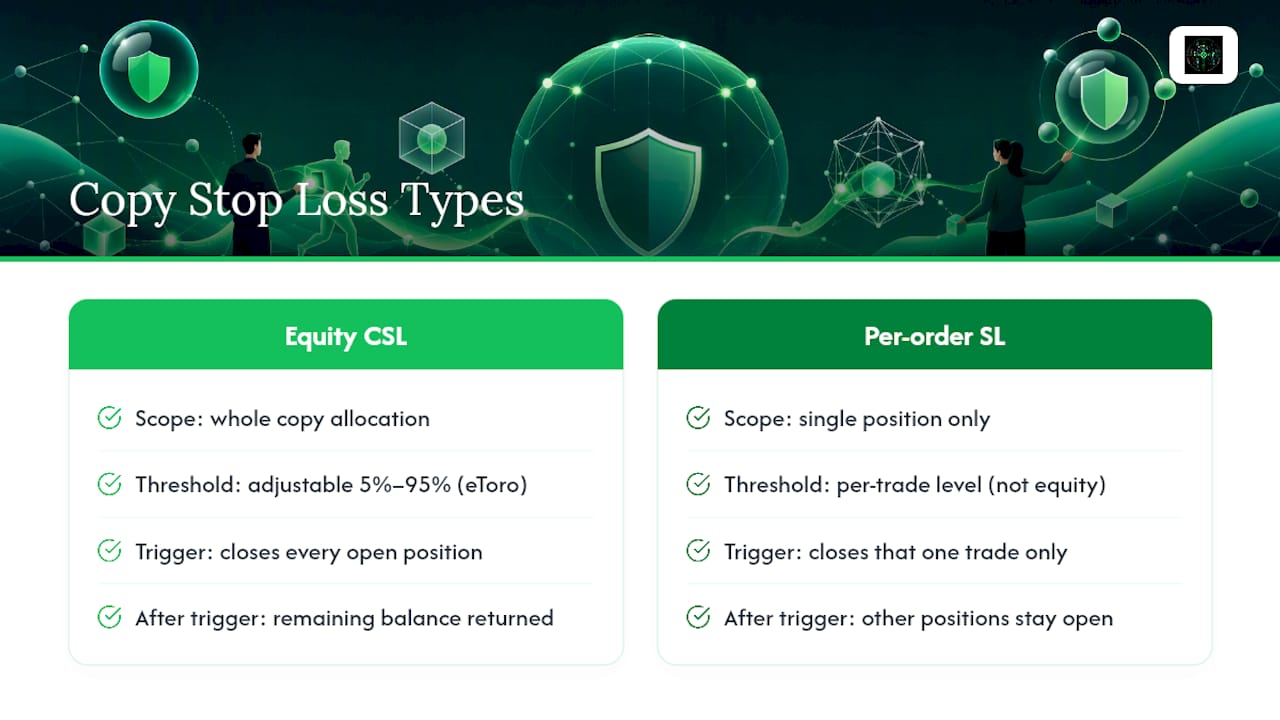
eToro's documentation describes CSL as mandatory on every copy, adjustable between 5% and 95% of the allocated amount. When it triggers, the platform closes every open position tied to that trader and returns the remaining balance to your available funds. You stop following that trader automatically. The math behind the trigger usually combines realized profit and loss with unrealized profit and loss, though Bybit's copy-trading rules note that accumulated-loss calculations may exclude pending profit-share adjustments, which can make your actual equity differ slightly from what the trigger measured.
Common Stop-Loss Types and Platform Settings
Copy trading interfaces label the same protective logic in different ways, and knowing the vocabulary saves you from misreading a slider. Expect to see some combination of these controls when you open a trader's copy settings:
- CSL percentage slider: sets the equity-level stop as a percentage of your allocated capital, typically adjustable from 5% to 95%.
- Per-order stop-loss ratio: caps the loss on any single trade inside the copy, independent of overall equity.
- Perpetual Copy Stop Loss (PCSL): an accumulated-loss trigger measured in dollar terms rather than percentage, common on derivatives-focused platforms.
- Max slippage and max delay: limit how far price can move or how long an order can wait before the platform skips it, a detail Duplikium's settings guide covers in depth.
- Min/max order size and wait-for-price-improvement: filter which trades get copied at all.
Some platforms make the equity CSL mandatory on every open copy. Others treat it as optional, which means a trader who skips it is running with no portfolio-level backstop at all.
How Do You Choose the Right Stop-Loss Level?
Picking a number without a framework is how traders end up either stopped out on ordinary volatility or holding a position that erodes 80% of an allocation before anything triggers. Work through the decision in order:
- Set your account-level risk budget first. Decide what percentage of your total trading capital you are willing to lose across all copies combined, not just one.
- Allocate capital per copy based on that budget. If you are following four traders, no single one should hold enough capital to breach your account-level budget on its own.
- Choose a drawdown threshold that matches the strategy's normal volatility, not your comfort level in isolation.
- Adjust for diversification. Running one copy at a wide CSL is riskier than running four smaller copies at the same percentage, because a single bad trader can't sink the whole account.
The classic 1% per-trade risk rule from discretionary trading translates reasonably well to per-order stops inside a copy. A low single-digit equity-level CSL can work for a steady, lower-volatility strategy, but it is far too tight for meme-coin sniping, where a trader's normal swing between entries and exits can exceed that range without any strategy failure at all. For high-volatility copy strategies, a wider band helps avoid getting stopped out by noise rather than by an actual losing trader.
Pro Tip: Before setting a CSL percentage, pull up the trader's historical maximum drawdown if the platform shows it. Set your threshold meaningfully wider than that number, or you'll get stopped out during a normal losing streak instead of an actual failure.
Reading more on copy trading risks before allocating capital helps you calibrate this threshold against your own risk tolerance rather than a generic rule.
What Execution Risks Can Undermine Your Stop Loss?
The number you set on a slider is a target, not a guarantee, and the gap between the two catches new copy traders off guard. cTrader's documentation warns explicitly that final equity can land lower than the set stop level because of volatility, price gaps, or thin liquidity at the moment of execution.
Several mechanics widen that gap further:
- Slippage and delay: even a one or two second lag between trigger and execution matters on a volatile asset, and Duplikium's advanced settings let you cap both explicitly.
- Profit-share withholding: some platforms hold back a trader's profit share until settlement after you stop copying, which can temporarily reduce the equity you see reflected, according to BingX's copy trading rules.
- Market gaps on illiquid tokens: a stop calculated against a stale price can execute well below the intended trigger once the order actually fills.
The practical fix is testing before you commit meaningful capital. Run a small allocation first, tighten your slippage and delay tolerances, and check the platform's execution log against what you expected the stop to do.
What Do Real Copy Stop Loss Numbers Look Like?
Numbers make the mechanics concrete. Take a $1,000 allocation to one trader with a CSL set at 60%, mirroring the exact structure eToro documents: the copy closes automatically once equity falls below $600, and the remaining balance returns to your available funds.
A dollar-denominated version works differently. Under Bybit's Perpetual Copy Stop Loss model, you can set a dollar-denominated accumulated-loss trigger on a copy. Once accumulated realized and unrealized losses hit that figure, the platform auto-unfollows the trader, regardless of your original allocation size.
Layer in slippage and the final number shifts again. Execution may occur below the intended stop level during fast moves, a gap worth planning for rather than discovering.
Before setting your own numbers, work out:
- Total capital allocated to the copy
- Maximum acceptable dollar loss (translate this into a percentage)
- The trader's historical drawdown, if available
- Your slippage and delay tolerance
How Should You Test and Monitor Your Settings?
Treat your first week on any trader as a controlled trial, not a live commitment. A short, disciplined process catches problems before they cost real money:
- Start small. Use a demo account if the platform offers one, or a very small live allocation, and take advantage of any 24-hour trial window, an approach covered in more detail here.
- Log actual execution against expectations. Record the slippage and delay you observe versus what you set, and compare your triggered stop price to the intended one.
- Set a review trigger. Change your CSL or per-order settings only after you see a consistent, meaningful gap between expected and observed execution, or after the trader's strategy itself shifts noticeably.
Scenario-testing tools, including Monte Carlo style simulators referenced by The Final Tape, can help stress-test a CSL choice against a range of volatility outcomes before you commit real capital.
Snipethem's Controls and How They Fit This Framework
Snipethem applies this same logic to Pump.fun trader replication, with a reported 0.3 second response time and a 94.2% success rate figure the platform cites for its copy execution. The 24-hour access model lets you test a trader's behavior and your own stop-loss assumptions on a short, defined window rather than committing indefinitely. Analytics inside the platform let you compare intended stop levels against actual execution, the same discipline described above with cTrader and Bybit's documentation.
How Should Your Risk Tolerance Shape Your Stop Loss?
The number on the slider is a math problem. Whether you actually let it do its job is a psychology problem, and it's usually the harder one.
This tends to happen for a predictable reason: a triggered stop feels like a loss you caused, even when it's the mechanism working exactly as designed. The fix isn't a better number. It's deciding your threshold before you're emotionally invested in the outcome, then treating any mid-drawdown urge to change it as a signal to step back rather than act.
Risk tolerance also isn't static across your portfolio. Match the threshold to what losing that specific allocation would actually mean for you, not to a single risk number applied uniformly everywhere. Traders who skip this step tend to discover their real risk tolerance only after a stop triggers on money they weren't prepared to lose, which is the expensive way to learn it.
Does Asset Volatility Change How Well Stop Loss Works?
A stop-loss percentage that works well on a large-cap asset can fail almost entirely on a thinly traded meme coin, and the difference comes down to how price actually moves between trigger and execution. Liquid, high-volume assets tend to have tighter bid-ask spreads and more continuous price action, so an equity stop closes reasonably close to where you set it.
Meme coins and other low-liquidity tokens behave differently. Price can gap several percentage points between trades when order books are thin, meaning your CSL might trigger against a stale reading and execute well past your intended threshold, exactly the scenario cTrader's documentation warns about.
Normal volatility versus a genuine losing streak also looks different by asset class. The practical adjustment is widening your CSL band in proportion to the asset's typical intraday swing, then relying on per-order stops and position sizing, rather than the equity stop, to catch a genuine trend reversal.
What Mistakes Do Traders Repeatedly Make With Copy Stop Loss?
The same handful of errors show up across nearly every copy trading platform, and most of them are avoidable with a five-minute check before you allocate capital.
Setting a CSL too tight for the trader's normal volatility is the most common one. Traders copy a pattern of drawdowns they never checked, then get stopped out during what turns out to be a routine dip for that particular strategy. Reading a trader's historical maximum drawdown before setting the threshold, not after, prevents this.
Ignoring the difference between equity-level and per-order stops causes a second class of mistakes. A trader assumes the CSL will catch a single catastrophic trade, when in reality a large loss on one position might not move total equity below the CSL threshold if other positions are profitable. Without a per-order stop layered underneath, a single bad trade can run far longer than expected.
Editing a CSL mid-copy without understanding the recalculation is a subtler trap. eToro's documentation notes that changing your CSL percentage applies the new figure against current equity, not your original allocation. A trader who lowers their CSL after a drawdown, thinking they're tightening protection, may actually be locking in a worse floor than intended.
Finally, over-allocating to a single trader defeats the purpose of the stop loss entirely. If one copy represents most of your capital, no CSL setting fully protects you from correlated risk if that trader's entire strategy stops working.
How Does Stop Loss Compare to Take Profit and Trailing Stops?
Stop loss, take profit, and trailing stops solve different problems, and treating them as interchangeable is a common source of frustration. A stop loss defines your maximum acceptable loss and does nothing else. It has no opinion about upside.
A take profit rule works the opposite direction, closing a position or copy once it reaches a target gain, locking in profit before a reversal erases it. Pairing a CSL with a take profit target gives you both a floor and a ceiling, which matters more in copy trading than in manual trading, because you aren't watching the trader's positions in real time.
A trailing stop behaves differently from both. Instead of a fixed threshold, it moves upward as equity or price improves, locking in gains progressively while still allowing room for further upside. On a copy that's performing well, a trailing stop can protect accumulated profit without forcing an early exit the way a fixed take profit would.
None of these three tools substitutes for the others. A fixed CSL protects against a genuine strategy failure. A take profit protects gains you've already earned from evaporating. A trailing stop tries to capture more upside while still holding a protective line. The traders with the fewest ugly surprises tend to run some combination of an equity CSL, a per-order stop loss underneath it, and either a take profit or trailing stop layered on top, rather than relying on any single control alone.
Are Copy Trading Stop-Loss Mechanisms Regulated?
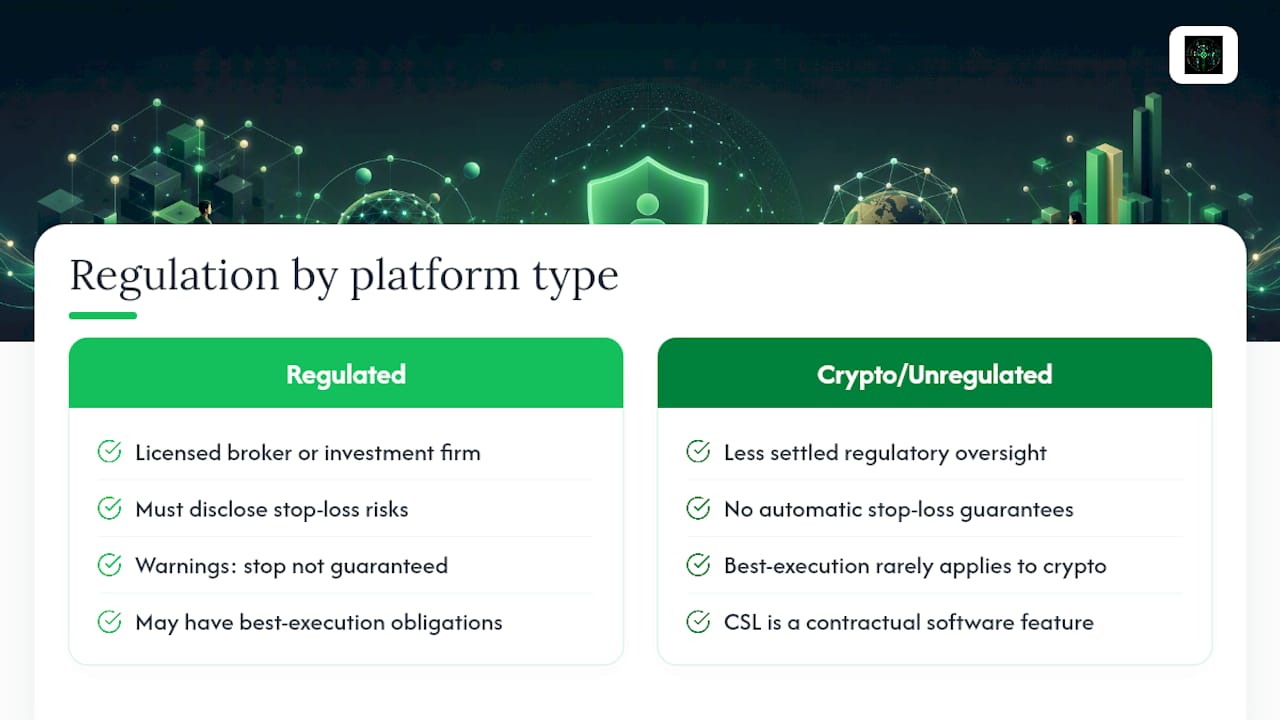
Regulatory oversight of copy trading stop-loss mechanisms varies significantly by jurisdiction and by whether the platform falls under securities, derivatives, or largely unregulated crypto-asset frameworks. In jurisdictions where copy trading platforms are licensed as investment firms or brokers, regulators may require clear risk disclosures around stop-loss execution, including warnings that a stop is not a guaranteed price, which is why platforms like cTrader and eToro build that exact language into their own documentation rather than leaving it implied.
Crypto-native copy trading, including meme-coin replication on decentralized or semi-decentralized infrastructure, generally sits in a less settled regulatory space. Protections that exist for traditional brokerage stop-loss orders, such as best-execution obligations in some regulated markets, don't automatically extend to crypto copy trading platforms unless the specific jurisdiction has extended that framework to digital assets. Traders should not assume a copy stop loss carries the same regulatory backing as a stop-loss order placed through a licensed securities broker.
The practical takeaway is to read the specific platform's terms rather than assume industry-standard consumer protections apply uniformly. Where a platform operates without a securities or derivatives license in your jurisdiction, the CSL is a contractual feature of that platform's software, not a regulated financial safeguard, and the responsibility for verifying execution against the promised threshold rests largely with the trader.
A Conservative Default for Newcomers
Test everything, journal your results, and never let one trader hold too much of your capital.
— dang
Try Snipethem's 24-Hour Access to Test These Settings Yourself
The platform gives you a direct way to put this framework into practice instead of just reading about it. Access is available through a one-time fee in SOL for 24-hour access to a specific top Pump.fun trader's history, letting you test stop-loss assumptions on a defined window before deciding whether to scale up.
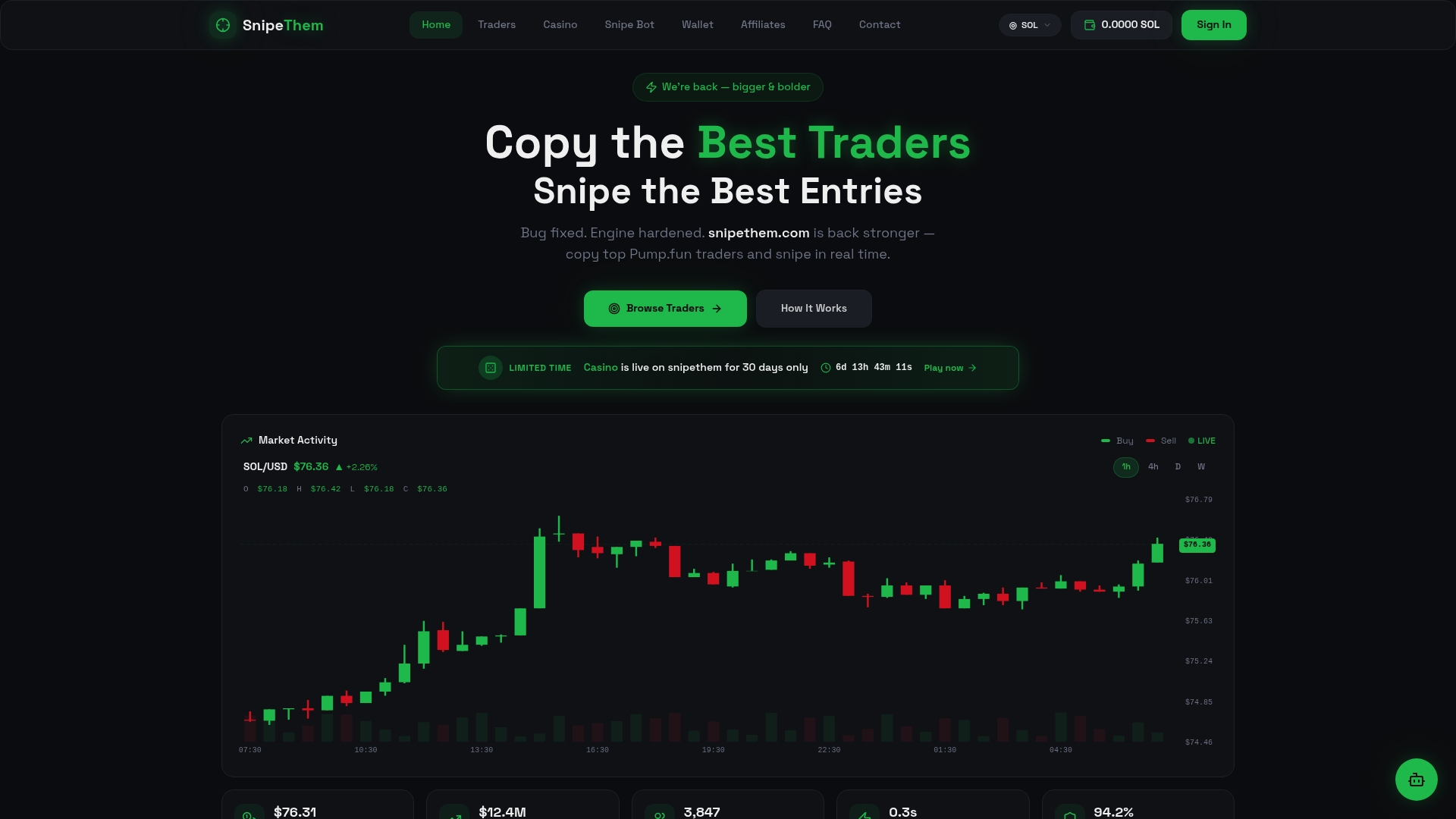
The platform's real-time replication and live analytics let you check actual execution against your intended CSL threshold, the same gap this article walked through with cTrader and Bybit's own documentation. That means you can measure slippage, delay, and trigger accuracy on a small, contained test rather than discovering the difference with a large allocation on the line. Browse the current lineup of top Pump.fun traders to find a strategy that matches your risk tolerance, set your stop-loss level using the framework above, and run your first 24-hour access window to see how the numbers hold up in practice.
This article is general information, not a substitute for advice from a qualified financial advisor. Consult a qualified financial professional about your own circumstances before acting on anything here.
Sources
- What is Copy Stop Loss? — eToro Help Center
- Copy Mode and Parameter Settings (Copy Trading Classic) - Bybit Help Center
- Invest in strategies - cTrader Copy
- Managing advanced copy settings - Duplikium