

A trailing stop is a dynamic exit order that follows price by a set percentage or point value, then fires a market order the moment price reverses by that amount. It locks in profit while a position keeps moving in your favor, which is the core appeal for crypto traders who don't want to babysit charts. The catch: trailing stop crypto orders perform best in clean, directional trends and can work against you in choppy markets or on leveraged perpetual futures, where liquidation math sometimes beats the stop to the punch.
Before setting one on any position, confirm:
- The trail is measured in percent, fixed dollars, or a volatility unit like ATR
- The exchange triggers off last price, mark price, or index price
- Whether the trail runs server-side or depends on your app staying connected
Key Takeaways
A trailing stop protects gains in trending crypto markets, but its trail type, price source, and activation timing all need to match the asset's volatility to work as intended.
| Point | Details |
|---|---|
| Trail type matters | Use fixed percent for large caps, ATR-based (1.5x to 3x) for volatile altcoins and meme coins. |
| Trigger differs from fill | A trailing stop guarantees a market order fires, not the exact trigger price, especially during gaps. |
| Check the price feed | Confirm whether your exchange uses last, mark, or index price before enabling the order. |
| Leverage changes the math | On perpetual futures, verify liquidation price sits beyond your trail before activating it. |
| Automation is an alternative | Snipethem lets traders copy top Pump.fun traders' live trades instead of managing trails manually. |
Table of Contents
- How Does a Trailing Stop Crypto Order Actually Work?
- What Types of Trailing Stops Work Best for Crypto?
- What Should You Check on Your Exchange Before Setting a Trail?
- When Do Trailing Stops Help, and When Do They Hurt?
- How Do You Set Up a Trailing Stop Crypto Trade Step by Step?
- What Mistakes Cost Traders the Most Money on Trailing Stops?
- A Trader's Take on Trailing Stops in Practice
- An Automated Alternative to Manual Trailing Stops
- Frequently Asked Questions
- Sources
How Does a Trailing Stop Crypto Order Actually Work?
A trailing stop doesn't sit at a fixed price. It anchors to the highest price reached since you placed it (on a long) and recalculates the stop level continuously as that peak rises. If price climbs to $120, the stop follows to $114. It never moves down.
The mechanism runs in three steps:
- You define an offset, either a percent or a fixed amount.
- The exchange tracks the peak-since-placement price and recalculates the trail level in real time.
- When price falls back through that level, the exchange fires a market order to close the position.
That last step matters more than most traders realize. A trailing stop guarantees a trigger, not a fill at that exact price. In a fast-moving crypto market, the market order can execute several ticks or even a few percent below the trigger level, especially during a flash wick. Investor confirms this mechanic across markets: the order type adjusts with favorable moves and converts to a market order on reversal, with no price guarantee on the fill itself.
Spot and perpetual futures behave differently here. On spot, a triggered trailing stop simply sells your holdings. On leveraged perps, the exchange's liquidation engine runs independently and can close your position before your trailing stop ever triggers, particularly if your trail sits close to your liquidation price. Zippfeed's trailing stop loss crypto guide notes that exchanges differ in whether they calculate triggers off last, mark, or index price, which changes how much buffer you actually have.
What Types of Trailing Stops Work Best for Crypto?
Not every trail type suits every asset. A fixed 3% trail that works fine on Bitcoin can shake you out of a healthy Solana meme coin swing within minutes. Matching the trail type to the asset's actual volatility is the single biggest lever you control.
- Fixed percent trails work well on large, relatively stable caps (BTC, ETH) where 2% to 5% trails capture normal trend pullbacks without excessive noise.
- Fixed-dollar trails suit traders running consistent position sizes who want a predictable dollar risk per trade.
- ATR-based trails adapt to changing volatility automatically, which makes them the preferred choice for altcoins and meme coins.
- Chart-structure trails (trailing below swing lows or a moving average like the 20-EMA) suit experienced traders who read price action rather than a fixed formula.
RoadTo1M's crypto trailing stop guide points to 1.5x to 2x ATR as the common practitioner range, with wider multipliers reserved for thinly traded tokens prone to sharp wicks.
| Trail Type | Typical Setting | Best Fit |
|---|---|---|
| Fixed percent | 2% to 5% | BTC, ETH, large caps |
| ATR-based | 1.5x to 3x ATR(14) | Altcoins, meme coins |
| Chart structure | Below swing low or 20-EMA | Discretionary trend traders |
Worked example one: you buy ETH at $3,000 with a 4% trail. The price rises to $3,300, so your trail sits at $3,168.
Worked example two: a meme coin trades with a 14-period ATR of $0.02 on a $0.50 token.
What Should You Check on Your Exchange Before Setting a Trail?
Two accounts running the "same" trailing stop settings can produce very different outcomes if their exchanges handle price triggers differently. Crypto exchanges commonly trigger off one of three price feeds:
- Last price: the most recent executed trade, which can spike on thin order books
- Mark price: a smoothed price often based on an index and funding rate, used mainly on perpetual futures to resist manipulation
- Index price: an aggregate of prices across multiple venues, generally the most stable reference
Trailing stops also differ in where the logic runs. A server-side trail lives on the exchange's matching engine and keeps working even if you close your laptop. A client-side trail depends on your browser tab, app, or trading bot staying connected. Client-side trails simply stop tracking price if that connection drops, leaving your position fully exposed.
Pro Tip: Before enabling any trailing stop, check your exchange's documentation for three things: which price feed triggers the order, whether the trail runs server-side, and whether the order type is exposed through the API if you're running automated strategies. Investor.gov notes availability and standards for this order type differ across trading venues, so never assume your last platform's behavior carries over.
When Do Trailing Stops Help, and When Do They Hurt?
Trailing stops earn their keep in trending markets with moderate, consistent volatility, especially on multi-day swing positions where you're not glued to a screen. They struggle in range-bound markets, around major news catalysts, and in thin, illiquid order books where price can wick through your trail and back within seconds.
- Good conditions: clear directional trend, moderate and steady volatility, multi-day holding periods
- Poor conditions: sideways chop, scheduled news events, low-liquidity tokens with wide spreads
- High-risk setup: leveraged perpetual positions where the trail sits close to the liquidation price
Slippage compounds the problem on gap moves. A token that closes at $1.00 and reopens at $0.85 after a liquidity crunch will fill your trailing stop far below the trigger level, not at it.
On leveraged perpetuals, the exchange's liquidation engine can close a position before a trailing stop order ever fires, particularly when mark price diverges sharply from last price during volatile swings.
Before enabling a trail on any leveraged position, calculate your liquidation price first. If the trail sits closer to entry than liquidation does, you're fine. If liquidation sits above your trail on a long, the exchange will close you out first regardless of what your trailing stop says.
How Do You Set Up a Trailing Stop Crypto Trade Step by Step?
A trailing stop crypto strategy earns its value only when the setup is deliberate, not an afterthought bolted on after you're already in profit.
- Enter the position and set an initial hard stop based on your risk tolerance, not the trail itself.
- Decide your activation trigger, commonly after the position clears your initial profit target.
- Choose your trail type and distance (percent or ATR) based on the asset's volatility.
- Confirm the price source (last, mark, or index) and whether the order runs server-side before submitting.
For example, you might buy a token and activate a trail immediately. If the price rises, your trail will follow at a set distance, allowing you to capture gains while giving enough room to avoid premature stop outs. Using an ATR multiplier often tolerates normal swing ranges better than a flat percentage trail.
| Checklist Item | What to Confirm |
|---|---|
| Price source | Last, mark, or index price for triggers |
| Order location | Server-side vs. client-side execution |
| Position size | Matches account risk, not just conviction |
| Liquidation buffer | Trail sits well above liquidation on leverage |
What Mistakes Cost Traders the Most Money on Trailing Stops?
The most common error is enabling a trailing stop the instant you enter a leveraged trade, before the position has any cushion, which invites a normal wick to stop you out at a loss. A close second: ignoring which price feed your exchange uses to trigger orders, then wondering why a stop fired on a last-price spike that mark price never confirmed.
Pro Tip: Enable your trailing stop only after the trade clears TP1, and widen the trail on thin order books rather than tightening it, since low liquidity produces sharper wicks, not smoother ones.
Other frequent mistakes: using a flat percent trail on high-volatility meme coins instead of an ATR-based one, and assuming a trigger equals a fill, which leaves traders unprepared for slippage on fast reversals. A re-entry plan matters just as much as the exit. A trail that stops you out of a strong trend without a rule for getting back in just converts one good trade into a missed one.
A Trader's Take on Trailing Stops in Practice
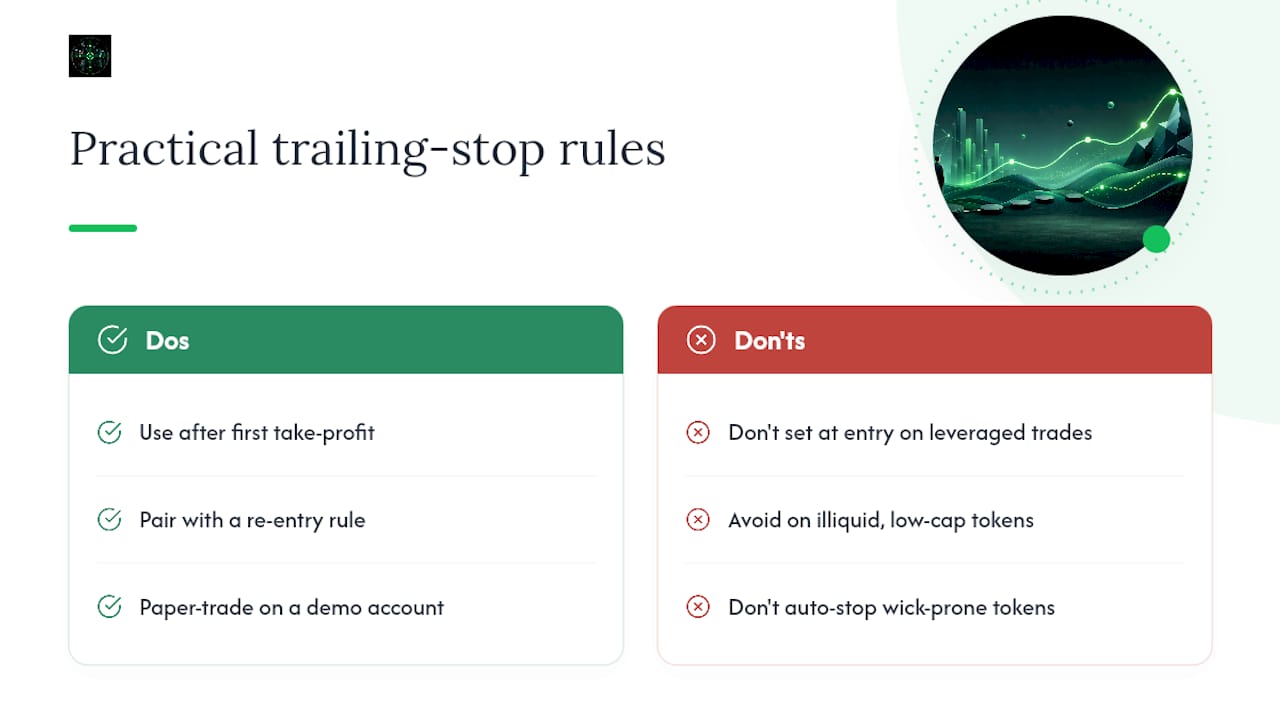
I lean on trailing stops after a position has already banked a first take-profit, never at entry on anything leveraged. Manual exits still win on illiquid, low-cap tokens where a wick can trigger a stop that price recovers from within minutes. Pair the trail with a re-entry rule, and paper trade the setting on a demo account before risking real capital on it.
An Automated Alternative to Manual Trailing Stops
Manually tracking ATR multipliers, price feeds, and activation timing works, but it demands constant attention that not every trader has. Snipethem takes a different route: instead of managing your own trail, you copy the live trades of top Pump.fun traders with a track record already established.
Snipethem gives traders who prefer automation over manual order management:
- 24-hour access to a specific trader's real-time trade history and execution
- A reported 0.3-second response time on trade replication
- Live market analytics and trending token data to spot opportunity without scanning charts manually
Traders who want to size their own trailing stops with more precision can also run trade data through analytics tools like TP Scanner before deciding on a distance. But if manual stop management isn't where you want to spend your time, browse the current top traders on Snipethem and see which strategies match the risk profile you're already comfortable with.
Frequently Asked Questions
Is there a standard percent for a crypto trailing stop? There's no universal number.
Is a trailing stop better than a fixed stop loss? A fixed stop protects a set risk level and never moves; a trailing stop moves with price to lock in gains as a trade runs. Trending markets favor trailing stops, while choppy or event-driven markets often favor a fixed stop or a mental stop the trader executes by hand.
Does a trailing stop guarantee my exit price? No. It guarantees a market order fires once the trigger is hit, but the fill price can differ, sometimes significantly during a gap or thin liquidity.
Should I use a trailing stop on a leveraged crypto position? Only after checking your liquidation price. If liquidation sits closer than your trail, the exchange's liquidation engine can close the position before your trailing stop ever triggers.
This article is general information, not a substitute for advice from a qualified financial advisor. Consult a qualified financial professional about your own circumstances before acting on anything here.
Sources
For platform-specific trigger behavior, always check your exchange's own support documentation before enabling a trail, since standards vary by venue. Investor.gov's bulletin on trailing stop orders and the Investopedia trailing stop definition cover the order type's mechanics and trade-offs in plain terms. For sizing trails against real volatility, the Statista cryptocurrency volatility chart shows how much realized volatility differs across tokens and time periods.