
Copy trading does not eliminate risk; it transfers execution to someone else while leaving you fully responsible for the financial outcome. That single fact should shape every decision you make before linking your account to a trader. Set two controls before copying anyone: a per-trader allocation cap and an account-level equity stop.
Start with these numbers:
- Allocation cap: limit any single trader to a conservative portion of your total copy-trading capital, even if their track record looks exceptional.
- Equity stop: set an account-level stop at a moderate percentage of total equity so a bad week cannot become a ruined year.
Pro Tip: Before you commit real capital, find out exactly how much leverage the trader you're copying already uses. A trader running 10x leverage on their own account can turn a routine 5% market move into a liquidation event on yours, and a platform outage during that move can prevent you from closing the position at all.
Key Takeaways
Copy trading works only when a fixed allocation cap, an account-level equity stop, and active monitoring replace blind trust in someone else's track record.
| Point | Details |
|---|---|
| Cap single-provider exposure | Limit any one trader to 10% of capital, extending to 20% only for verified, long-tracked performers. |
| Set an equity stop | Halt all copying at 15% to 20% account-level loss regardless of provider-level settings. |
| Vet before you copy | Check maximum drawdown, track record length, and trade frequency, not headline win rate. |
| Watch leverage and margin | Keep copied leverage below the leader's own multiplier and margin utilization under 30%. |
| Use Snipethem's trader data | Snipethem's trader rankings surface drawdown and frequency metrics before you commit access fees. |
Table of Contents
- What Are the Real Copy Trading Risks in Practice?
- What Are the Biggest Risks of Copy Trading?
- How Do You Vet a Trader Before Copying Them?
- What Controls Actually Limit Copy Trading Losses?
- How Much Do Allocation Limits Actually Reduce Losses?
- Who Publishes This Guidance and Why It Matters
- Copy Trading Risks: What Actually Deserves Your Attention
- Copy Smarter With Snipethem's Trader Data and Tools
- Sources
What Are the Real Copy Trading Risks in Practice?
Copy trading works through a chain: the leader executes a trade, that action broadcasts as a signal, and your account receives instructions to replicate it. Latency and slippage live in the gap between the leader's fill price and yours, and during volatile markets that gap widens fast.
You control some parameters and inherit others whether you like it or not:
- You typically control: position size, whether to copy a specific trader at all, and an overall stop-loss on the copy relationship.
- You often cannot override: certain trailing stop-loss logic embedded in the leader's strategy, specific broadcast fields like exact entry timing, and sometimes the leverage multiplier itself.
This distinction matters because your profit and loss is never identical to the leader's. A leader with a strong percentage return can still produce a worse outcome for you once slippage, fees, and execution lag stack up. Execution mismatches and symbol mapping errors are common enough that testing any new provider with a small position first is standard practice among experienced copiers, not an optional precaution.
What Are the Biggest Risks of Copy Trading?
Copy trading risk breaks down into distinct categories, and treating them as one generic "market risk" bucket is how new copiers get blindsided.
Market and volatility risk sits at the foundation. If the trader you copy loses money, you lose money, in roughly the same proportion as your allocation to them. Illiquid assets amplify this because you may not be able to exit at the price you expect.
Leverage and margin risk is often the fastest path to a blown account. If a leader trades with high leverage and your platform mirrors that multiplier, a modest adverse move can trigger liquidation before you have time to react.
Execution risk shows up as slippage, partial fills, and occasional symbol mapping errors between the leader's broker and yours. In fast markets, the price you get can differ meaningfully from the price the leader received.
Platform and operational risk covers outages, automation failures, and cyber incidents. A copy relationship depends entirely on the platform staying online and processing signals correctly during exactly the moments that matter most.
Trader-specific risk is the hardest to spot from the outside. Some traders use martingale sizing (doubling down after losses), hide their true position sizing, or drift from the strategy that built their track record. Others have undisclosed incentives to trade more frequently than is good for their followers. The IOSCO Final Report on imitative trading flags frequent trading and misleading performance presentation as recurring investor-harm patterns across copy, mirror, and social trading platforms.
Cost drag erodes returns quietly. High-turnover strategies rack up fees and spread costs that eat into performance, and a headline return without drawdown context can be dangerously misleading.
Suitability and regulatory risk rounds out the list. Regulators expect copy trading services to disclose costs and risks clearly and to run suitability checks, per ESMA's MiFID II guidance. Not every platform meets that bar consistently.
How Do You Vet a Trader Before Copying Them?
A trader's headline win rate tells you almost nothing on its own. Check these metrics instead, in this order:
- Maximum drawdown — the largest peak-to-trough loss in their history. This matters more than average returns because it tells you what you'd have to survive emotionally and financially.
- Track record length — favor traders with performance history spanning multiple market conditions, not just a hot streak during one favorable trend.
- Risk-adjusted metrics — Sharpe or Sortino ratios, where available, show whether returns came from skill or from taking outsized risk.
- Trade frequency and average duration — a sudden jump in either can signal strategy drift or a shift toward riskier, shorter-term bets.
Watch for these red flags: a track record that starts suspiciously clean with no visible losing streaks, performance history under a few months, sudden increases in leverage or position size, and vague or absent explanation of how the trader gets compensated.
Pro Tip: Ask directly for raw trade logs rather than relying on summary statistics. A trader confident in their process will share this without hesitation; one relying on a curated highlight reel usually won't. Trader statistics on Snipethem are built to make several of these checks, like trade frequency and historical win rate, visible before you commit capital.

What Controls Actually Limit Copy Trading Losses?
Layered, numeric controls consistently outperform vague intentions to "watch things closely." Practitioner risk-management analyses point to a specific combination that reduces the chance of account blow-ups.
- Cap any single provider at a conservative portion of total capital by default; extend to a higher portion only for a provider with a verified low drawdown and a long track record, in line with guidance following Which?'s copy trading research.
- Set an account-level equity stop at 15% to 20% that halts all copying regardless of what any individual provider-level stop does.
- Use a copy stop-loss, per-trade size caps, and leverage overrides so no single copied trade can exceed your own risk tolerance.
- Apply symbol filters to exclude assets you don't want mirrored, such as illiquid tokens or instruments outside your risk appetite.
- Check margin utilization daily; practitioner guidance treats margin utilization beyond a moderate threshold across copied positions as an elevated-risk signal worth acting on immediately.
| Control | Recommended Setting |
|---|---|
| Per-provider allocation cap | Conservative portion of total capital by default; higher allowance for verified low-drawdown, long-history providers |
| Account-level equity stop | Moderate percentage of total capital |
| Margin utilization threshold | Keep below a moderate threshold across all copied positions |
| Diversification target | Several genuinely uncorrelated strategies |
Pro Tip: Diversification only works if the strategies are actually different. Copying five traders who all trade the same handful of trending meme coins is concentration risk wearing a diversification costume.
How Much Do Allocation Limits Actually Reduce Losses?
The math behind these controls is straightforward once you run it.
- Allocation size: on a $10,000 account, a 10% allocation to a trader who suffers a 50% drawdown costs you $500. The same drawdown at a 40% allocation costs $2,000, four times the damage for the same trader failure.
- Leverage exposure: a leader running 10x leverage can face liquidation on a roughly 10% adverse move. Capping your own copied leverage at 3x means the market would need to move about three times further against you before liquidation becomes a threat.
- Slippage during fast markets: a copy stop-loss set in advance closes your position at a predetermined threshold, capping damage even when execution lags the leader's fill by several seconds.
Who Publishes This Guidance and Why It Matters
Snipethem operates a copy-trading marketplace for Pump.fun traders on Solana, which means this guide comes from inside the category it describes, not from a neutral outside observer.
- The platform reports a 0.3-second response time and a 94.2% success rate across its sniping and copy execution.
- Author credentials or trading experience:.
- Snipethem competes in the copy-trading space it's writing about, and readers should weigh that context alongside the regulatory sources cited throughout.
Copy Trading Risks: What Actually Deserves Your Attention
The conventional advice on copy trading treats win rate as the headline metric, and that's backward. Maximum drawdown tells you what you'd need to survive; win rate tells you almost nothing about whether you could stomach the losing streak that got that trader to their current balance. If the article's research supports one conclusion above all others, it's this: the numeric controls (allocation caps, equity stops, margin thresholds) matter more than trader selection itself, because even a skilled trader has a bad month, and your controls determine whether that month is survivable or account-ending.

Most guides also underweight platform and operational risk. A cyber incident or an outage during a fast market doesn't care how good the trader's strategy is. Prioritize the boring stuff first: set your caps, confirm your stop actually triggers, then evaluate traders. Skipping that order is how experienced traders, not just novices, end up with losses they didn't see coming.
Copy Smarter With Snipethem's Trader Data and Tools
Snipethem gives you the metrics this guide recommends checking, drawdown history, trade frequency, and win rate, directly on each trader's profile, so vetting takes minutes instead of guesswork.
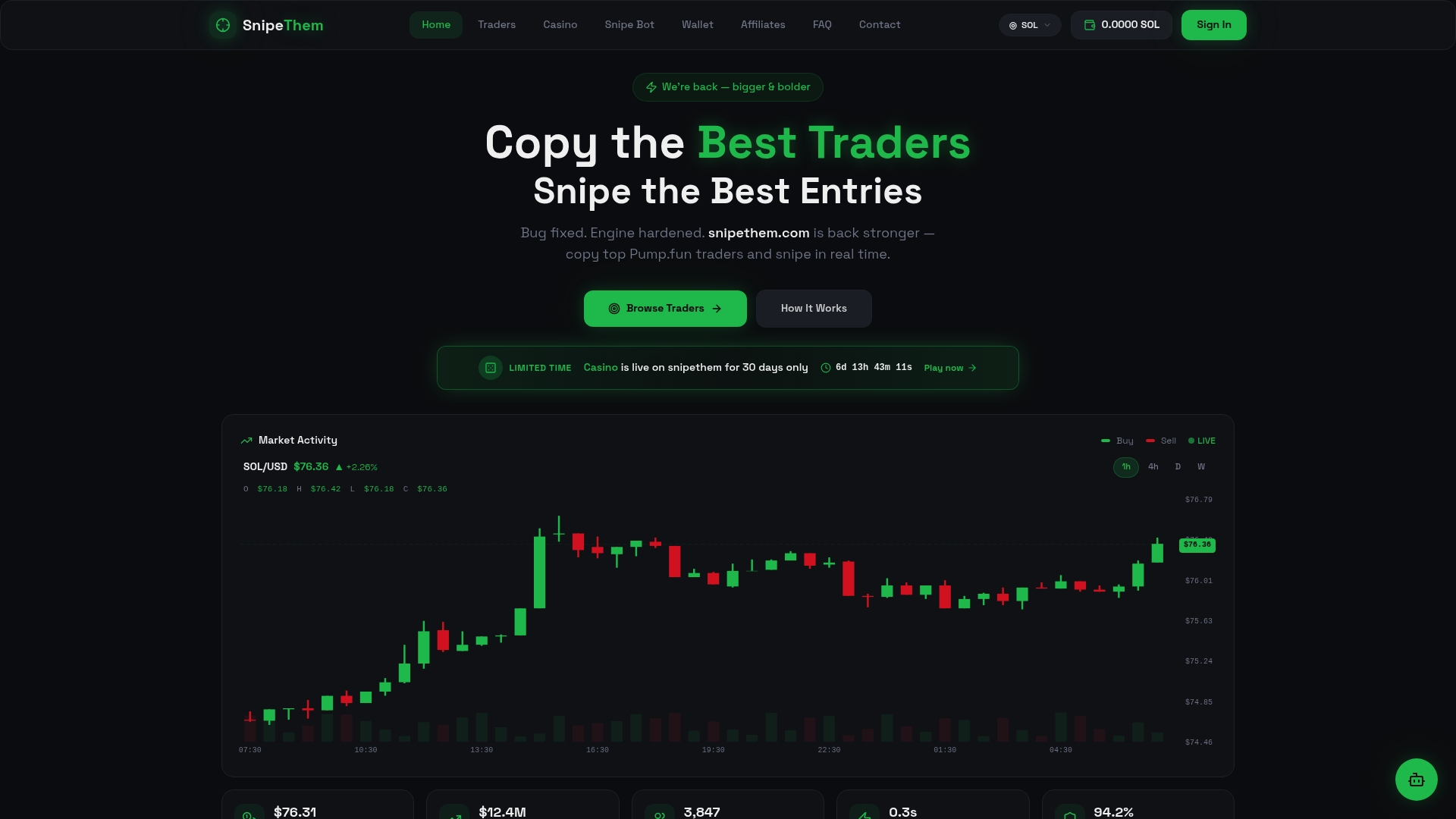
Rather than blindly following a signal with no visibility into the leader's actual sizing or leverage, you get 24-hour access to a trader's real trade history on Solana meme coins before deciding how much capital to allocate. The platform's sniper bot executes at a reported 0.3-second response time, which reduces some of the execution lag that turns a leader's good trade into a follower's mediocre one. Combine that speed with the allocation caps and equity stops covered above, and you're applying real risk management rather than hoping a fast platform alone solves the problem.
Browse the current trader rankings and check drawdown and frequency data before you commit your first allocation.
This article is general information, not a substitute for advice from a qualified financial advisor. Consult a qualified financial professional about your own circumstances before acting on anything here.
Sources
- Supervisory briefing on copy trading — ESMA
- Online imitative trading practices - Copy Trading, Mirror Trading, Social Trading — IOSCO
- Will copying someone else’s investments make you better off? — Which?
- Copy Trading Risk Management — Xoomar analysis