

Most traders should start with a low-friction, all-in-one social copier that carries visible regulation and lets you test with a small allocation before scaling up. Reserve a multi-broker copier for cases requiring granular risk controls or portability across accounts. Before funding anything, confirm the provider's regulatory status, run a demo or minimum-stake trial, shortlist two or three traders with verifiable track records, and set a stop-copy threshold. Snipethem's 0.3-second execution response and transparent trader rankings meet the same standard for meme-coin copy trading on Solana.
TL;DR:
- Use a regulated, low-fee social copier with visible trader rankings and a trial window of about 24 hours to test execution speed and accuracy.
- Prioritize multi-broker setups if you need control over risk parameters or plan to switch brokers, otherwise all-in-one platforms suit risk-averse traders.
- Verify trader track records by examining sample size, historical consistency, and independent verification rather than just recent high returns.
- Regularly monitor your copy trades, limit exposure to any single trader, and review performance weekly to avoid chasing short-term gains.
- Test new traders with small allocations during short-term access windows to avoid long-term capital lock-ins and verify that execution speed and slippage meet expectations.
Table of Contents
- How to Choose a Copy Trading Platform That Matches Your Goals
- What Should Be on Your Copy Trading Platform Checklist?
- Which Platform Features Actually Move the Needle?
- What Are the Real Risks of Copy Trading?
- How Does Snipethem Match the Copy Trading Checklist?
- What Do Experienced Copy Traders Actually Do Differently?
- How Can You Try Snipethem Safely?
- Where Can You Verify These Copy Trading Standards?
- Sources
How to Choose a Copy Trading Platform That Matches Your Goals
The first decision isn't which brand to trust. It's which structural model fits how you actually want to trade. Copy trading platforms fall into three broad categories, and each one trades away a different thing to give you something else in return.
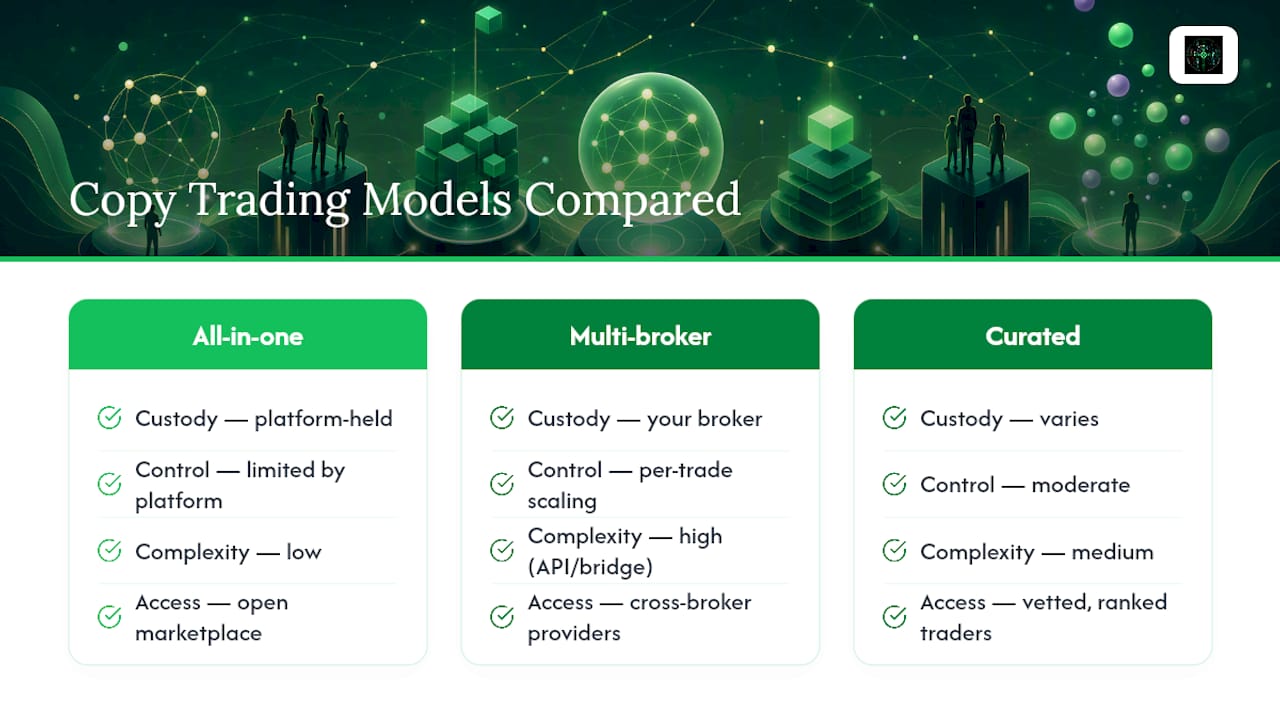
All-in-one social platforms bundle discovery, execution, and account custody into a single environment. You browse trader profiles, pick one, and the platform copies trades directly inside your existing brokerage account. The appeal is obvious: no third-party software, no manual configuration, and usually a lower technical bar to entry. The trade-off is control. You're working inside whatever risk parameters the platform builder decided to expose, and you generally can't take your copied relationship elsewhere if you switch brokers. According to comparative research from Forexbrokers, these networks trade simplicity for portability, while multi-broker copiers trade that same simplicity for control.
Multi-broker copiers work differently. Instead of living inside one platform's walled garden, they connect to your brokerage account via API or bridge software, letting you copy signals from providers who may not even use the same broker you do. This unlocks finer control, things like per-trade lot scaling, custom risk multipliers, and the ability to disconnect a signal source without abandoning your broker relationship. The cost is complexity. You're now managing two relationships instead of one, and troubleshooting a bad trade sometimes means figuring out which system is actually at fault: the signal provider, the bridge software, or your broker's execution.
Curated mirror services sit in between. A team or algorithm pre-selects the traders available for copying, often with some form of vetting layer, and you pick from a shorter, filtered list rather than an open marketplace. This is where a platform like Snipethem operates for meme-coin trading on Solana: instead of sifting through thousands of anonymous Pump.fun wallets, you get ranked traders with visible statistics and pay for time-boxed access to replicate their live trade history through an automated snipe bot.
The practical consequences of each choice
Who holds your funds matters more than most beginners realize. In an all-in-one social model, your capital typically stays inside your brokerage account, and the platform only has permission to execute trades, not withdraw funds. Multi-broker setups usually work the same way, though the added software layer means you're trusting two parties instead of one. Curated mirror services vary; some, like Snipethem, sell time-limited access to a trader's strategy rather than pooling your capital at all, which limits custody risk considerably.
Portability is the second factor. If you build a strong relationship with a signal provider on an all-in-one platform and later want to switch brokers, you often lose that copying arrangement entirely. Multi-broker systems are built for exactly this kind of continuity. Curated services sidestep the question altogether: you're buying access to a strategy for a defined window, not building a long-term custodial relationship.
Ask yourself three questions before shortlisting any provider:
- Do I want the platform to manage execution entirely, or do I want to configure position sizing myself?
- Am I trading assets with fixed market hours (stocks, forex) or 24/7 markets (crypto), and does my chosen model actually support that rhythm?
- Would I rather commit to a long-term signal relationship or test a trader's strategy for a short, defined window before deciding?
If your honest answers point toward "I want this simple and I'm risk-averse," an all-in-one social copier with strong regulatory disclosure is your starting point. If you answered "I want control and I'm willing to manage complexity," a multi-broker setup earns a closer look. If your focus is fast-moving, short-window assets like meme coins, a curated mirror model built for that specific market, with time-boxed access and verifiable trader statistics, tends to fit better than either of the other two.
What Should Be on Your Copy Trading Platform Checklist?
Once you know which model fits, the real work starts: separating platforms that look credible from ones that actually are. Comparative research from Investing points to four factors that matter most: regulation, fees, trader transparency, and asset coverage. Here's how to actually check each one, in the order that protects your capital fastest.
- Verify regulation and custody before anything else. Look up the platform's license number on the relevant regulator's public register, not just the badge displayed on their homepage. Regulators including ESMA have issued supervisory guidance noting that copy trading can be treated as a form of portfolio management in some jurisdictions, which carries added investor protection obligations for the provider. Ask whether client funds sit in segregated accounts, separate from the platform's own operating capital. If a provider can't answer that clearly, treat it as a red flag rather than an oversight.
- Total up the real cost, not just the advertised one. Spreads, per-trade commissions, profit-share arrangements, subscription fees, and currency conversion charges all eat into returns differently. A platform advertising "free copying" may recoup that cost through wider spreads or a cut of your profits. Run the math on a hypothetical $1,000 allocation across a full month of typical trading activity before comparing providers side by side.
- Interrogate the track record, not the highlight reel. A trader showing a 40% monthly return on a two-week-old account tells you almost nothing. Look for sample size (how many trades, over how long), whether the statistics are independently verified or self-reported, and whether drawdown periods are disclosed alongside the wins. Verification models differ significantly across platforms, and on-chain verification, common on crypto-native platforms, tends to offer stronger auditability than a screenshot-based dashboard because the trade history is publicly checkable rather than platform-reported.
- Demand real copier controls before you commit capital. At minimum, you should be able to set a per-copy stop-loss, a maximum-loss guard that halts copying automatically once a threshold is breached, a one-click stop-copy button, and an allocation cap per trader. Platforms that only let you turn copying on or off, with no granular controls in between, are asking you to accept far more risk than necessary.
- Match asset coverage to your leaders' actual trading hours. A trader who profits from overnight crypto volatility is useless to copy if your platform only executes during stock market hours. Confirm the platform supports the specific markets your shortlisted traders operate in, not just the asset class broadly.
- Run a real trial before scaling up. Open a demo account or fund a minimal live account, then track signal latency (the gap between the leader's trade and your copy executing), monitor slippage on entries and exits, and hold that observation period for at least 30 days before increasing your allocation.
Pro Tip: Keep a simple spreadsheet logging every copied trade's intended entry price versus your actual fill price for the first two weeks. If the gap consistently exceeds what the platform advertises, that's a more reliable red flag than any marketing claim.
Practitioner guidance from PuPrime frames copy trading as an active management role rather than a set-and-forget product, and that framing should shape how you read this checklist. None of these six steps are one-time tasks. Regulation status can change, fee structures get revised, and a trader's track record only stays meaningful if you keep checking it.
Which Platform Features Actually Move the Needle?
Feature lists are where marketing gets loudest and least useful. Strip away the buzzwords and only a handful of technical characteristics actually change your realized outcomes, and comparative analysis from SignalBots backs up prioritizing copier controls and transparent track records over brand recognition alone.

Execution speed and slippage matter more for fast-moving assets than almost anything else on this list. Snipethem's execution response of 0.3 seconds exists specifically to address this gap for Pump.fun-style trading, where price action often outpaces slower copy infrastructure entirely.
Reporting depth separates platforms built for transparency from ones built for marketing. Look for:
- Maximum drawdown disclosed alongside headline returns, not buried in a separate tab.
- Sample size large enough to mean something: dozens of trades minimum, ideally over multiple months.
- Consistency metrics rather than single best-week screenshots.
- Time-in-market data showing whether a trader has survived more than one market condition.
Allocation behavior varies more than most beginners expect. Fixed-proportion copying mirrors a leader's position size relative to their account, ratio scaling lets you size up or down relative to your own capital, and override settings let you cap any single position regardless of what the leader risks. Platforms that only offer one of these three options are giving you less control than a comparable one offering all three.
Minimums and friction deserve a direct comparison too. Some providers require a $500 minimum before copying unlocks; others, including time-boxed access models, let you test a strategy for a small one-time fee before committing serious capital. Deposit and withdrawal friction (how many business days, how many verification steps) matters most in an emergency, when you need to pull capital fast.
Mobile command-and-control shouldn't be an afterthought. If you can't hit a stop-copy button from your phone at 2 a.m. when a leader starts making erratic trades, you don't have real control over your own risk.
Running your own execution test is straightforward. Fund a minimal account, copy one trader for five to ten trades, and log the timestamp gap between the leader's entry and your fill, plus the price difference between intended and actual entry. A gap under one second with slippage under 0.5% on liquid assets is generally acceptable. Anything consistently worse than that, especially on fast-moving tokens, signals infrastructure that can't keep pace with the strategy you're trying to copy.
What Are the Real Risks of Copy Trading?
Copy trading gets marketed as passive income with none of the learning curve. That framing sets up most beginners for disappointment. Industry observation compiled by BrokerChampion notes that most retail copiers lose money over six-to-twelve-month windows, which makes capital preservation, not headline returns, the metric that should guide your allocation decisions.
Consistency tends to beat flash. A trader posting one 200% month followed by three flat months is statistically riskier than one posting steady 8% months with a shallow, well-documented drawdown curve. When you're comparing leaders, plot their equity curve if the platform provides one. A jagged line with deep valleys tells you more about future risk than any win-rate percentage.
Leader selection has its own failure traps worth knowing by name:
- Sample-size traps: a trader with 12 winning trades over two weeks hasn't demonstrated a repeatable edge, just a short favorable run.
- Cherry-picking: some platforms let traders hide or delete losing positions from public view, inflating apparent performance.
- Survivorship bias: the traders you see ranked today are the ones who survived; the marketplace rarely shows you the ones who blew up and quietly disappeared.
- Capacity constraints: a strategy that works with $5,000 might fail entirely once too many copiers pile into the same trade, moving the price against everyone simultaneously.
One check worth running that most beginners skip: does the leader have real skin in the game? A trader risking their own substantial capital is generally more aligned with your interests than one running a small demo-style account with nothing meaningful at stake.
Pro Tip: Split your copy-trading capital across three to five leaders rather than one, cap any single trader at 20 to 25% of that allocation, and set a calendar reminder to review performance monthly rather than reacting to daily swings.
Build a governance rhythm from day one: diversify across a small handful of leaders, prune underperformers on a monthly schedule rather than an emotional one, and set your stop-copy threshold before you fund the account, not after a loss makes the decision for you.
How Does Snipethem Match the Copy Trading Checklist?
Every criterion from the checklist above maps directly onto how Snipethem is built for Solana meme-coin trading. Execution speed, the single biggest lever for fast-moving tokens, sits at 0.3 seconds, addressing the exact latency gap that causes slippage on volatile Pump.fun trades. Trader transparency comes through visible rankings and statistics rather than self-reported screenshots, giving you the sample-size and consistency data the checklist calls for. And because access is sold in 24-hour windows rather than requiring a long-term custodial commitment, you can test a trader's strategy without the portability trade-offs that come with all-in-one social platforms.
The platform tracks strong success rates on copied strategies; treat any performance figure, on any platform, as a snapshot rather than a guarantee, and verify it against your own trial period before scaling allocation.
Here's how the checklist criteria line up against what the platform offers:
| Checklist Criterion | How Snipethem Addresses It |
|---|---|
| Execution speed | 0.3-second response time on copied trades |
| Trader transparency | Public rankings and statistics for top Pump.fun traders |
| Trialability | 24-hour paid access windows instead of long-term lock-in |
| Custody risk | No pooled fund custody; access-based model |
| Asset coverage | Purpose-built for Solana meme-coin markets |
A sensible trial sequence looks like this:
- Create an account and review the current top Pump.fun traders available to copy.
- Purchase 24-hour access to one trader whose statistics and drawdown history meet your own risk threshold.
- Start with a small allocation, not your full intended position size.
- Monitor execution and slippage against the leader's actual trade prices throughout the window.
- Decide whether to renew access, switch traders, or scale allocation based on that real trial data, not on hope.
This mirrors the same due-diligence workflow you'd apply to any multi-broker or all-in-one platform. The difference is that the trial commitment is measured in a day, not a month of minimum deposits and lock-in periods.
What Do Experienced Copy Traders Actually Do Differently?
The gap between beginners who lose money copy trading and the ones who don't usually comes down to oversight habits, not smarter trader selection. Anyone can find a trader with a good three-month run. Fewer people actually check on that trader every week afterward.
Active oversight is the single habit that separates sustainable copying from gambling by proxy. A leader who was profitable in a trending market can fall apart entirely once conditions shift, and if you're not checking in regularly, you'll find out only after the drawdown has already happened. Set a recurring review, weekly at minimum for anything as volatile as meme coins, and actually read the recent trade history rather than just glancing at the summary return.
Three rules are worth following whenever you're deciding to add or remove a leader from your rotation. First, never add a trader based on a single standout week; wait for at least a few weeks of visible, varied market conditions. Second, remove a trader the moment their drawdown exceeds your predetermined threshold, not after you've talked yourself into "just one more trade" to recover. Third, never let any single leader represent more than a quarter of your total copied allocation, regardless of how confident you feel about them.
The biggest mistake beginners make is anchoring on headline returns from the last 30 days. A number like "+180% this month" says almost nothing about whether that trader will still be profitable next month, and it says nothing at all about how much risk they took to get there. Depth of track record, consistency across different market conditions, and visible drawdown discipline tell you far more than any single high-water mark. Treat a flashy short-term number as a reason to investigate further, never as a reason to allocate immediately.
— dang
How Can You Try Snipethem Safely?
Snipethem gives you a way to test a Pump.fun trader's strategy without committing to a long-term subscription or handing over custody of your funds. You pay a one-time fee in SOL for 24-hour access to a specific trader's history, then configure the automatic snipe bot to replicate their trades in real time.
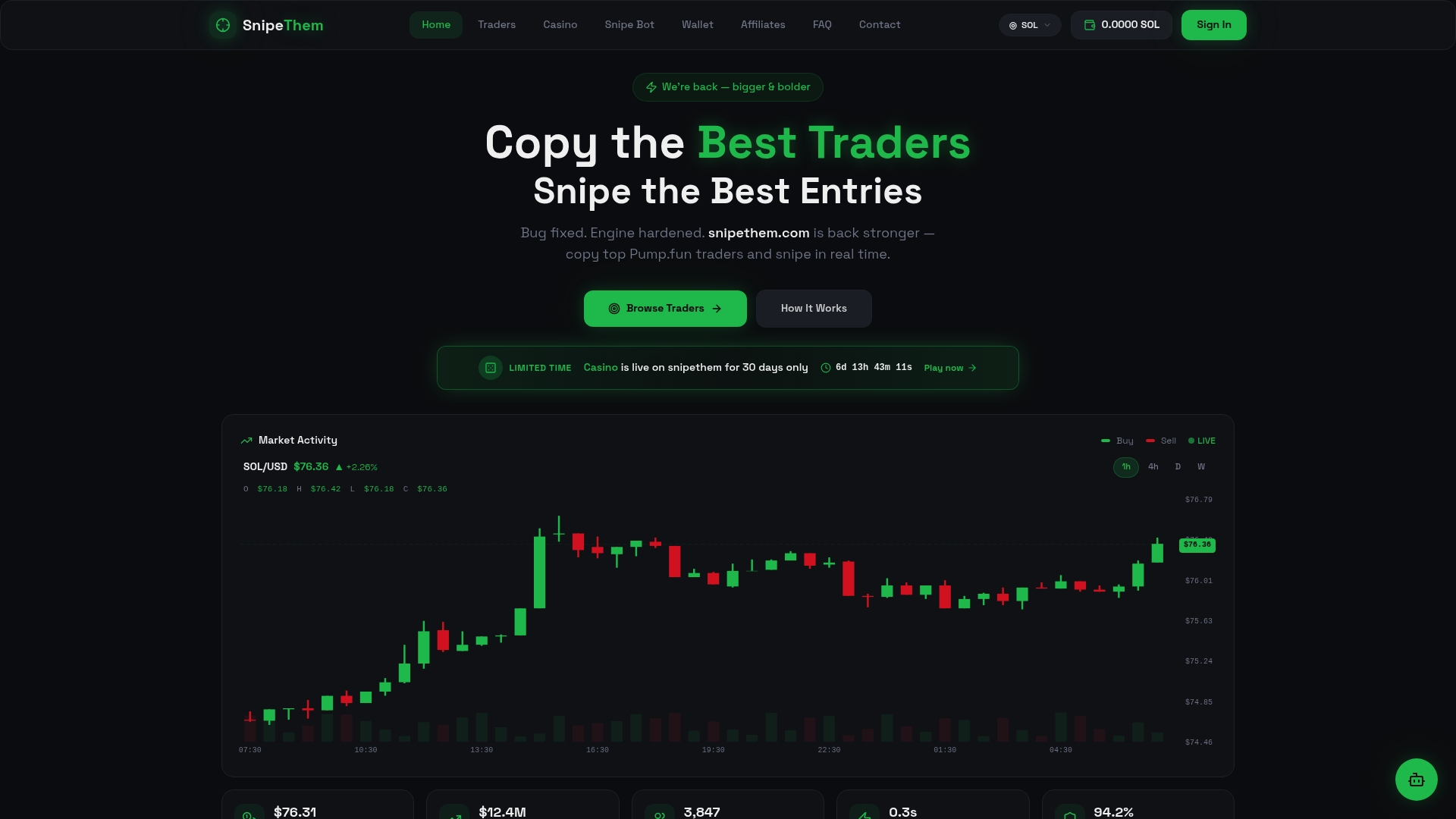
The trial path follows the same due-diligence sequence covered throughout this guide. Start by reviewing the ranked traders available for copying, and shortlist one or two whose track record and drawdown pattern match your own risk tolerance. Purchase 24-hour access to your top choice and begin with a small allocation rather than your full intended position. During that window, monitor execution timing against the leader's actual trade prices, check slippage on entries and exits, and note whether the 0.3-second response time holds up under real market conditions. If the results match what you saw in the trader's published statistics, you can renew access or explore additional bot configuration options for future windows. If they don't, you've lost a day, not a month of locked-in capital.
That short feedback loop is the practical advantage here: you get real trial data on a real trader in 24 hours, not 24 weeks. Visit Snipethem to review current trader rankings and start your first access window.
Where Can You Verify These Copy Trading Standards?
The regulatory and comparative guidance behind this checklist comes from a mix of official supervisory sources and independent industry comparisons, and it's worth checking the primary documents yourself rather than taking any single guide's word for it.
- The ESMA supervisory briefing on copy trading lays out how European regulators approach copy trading as a form of portfolio management, useful reading before assuming any platform's regulatory claims at face value.
- ForexBrokers.com's 2026 guide breaks down the model taxonomy referenced earlier in this article, all-in-one social versus multi-broker copiers, in more technical depth.
- Investing.com's copy trading broker comparison covers the regulation, fee, and transparency checklist points applied throughout this guide.
- PuPrime's platform selection guide supports the active-management framing used in the risks and governance sections.
- For readers outside the trading space specifically, general guidance on regulatory frameworks and investor responsibilities offers a useful parallel on why verifying local rules before committing capital applies well beyond copy trading alone.
Sources
- Forexbrokers
- Investing
- ESMA supervisory briefing on copy trading
- How to choose the best copy trading platform | PuPrime