

The single best-practice take-profit setup for Pump.fun copy-trades on Snipethem is tiered partial exits combined with a trailing stop on the remaining position. This structure locks in gains at two defined levels while keeping exposure open for larger runs, which is precisely what Pump.fun's volatile momentum cycles demand. To apply it immediately, navigate to a trader's profile on Snipethem, select "Buy Access," and open the override settings panel before confirming your 24-hour purchase.
A quick-start configuration to paste and adjust:
- TP1: Exit 50% of the position at +30% gain
- TP2: Exit 25% at +60% gain
- Trailing stop on remainder: Activate at +60%, trail distance 5–8%
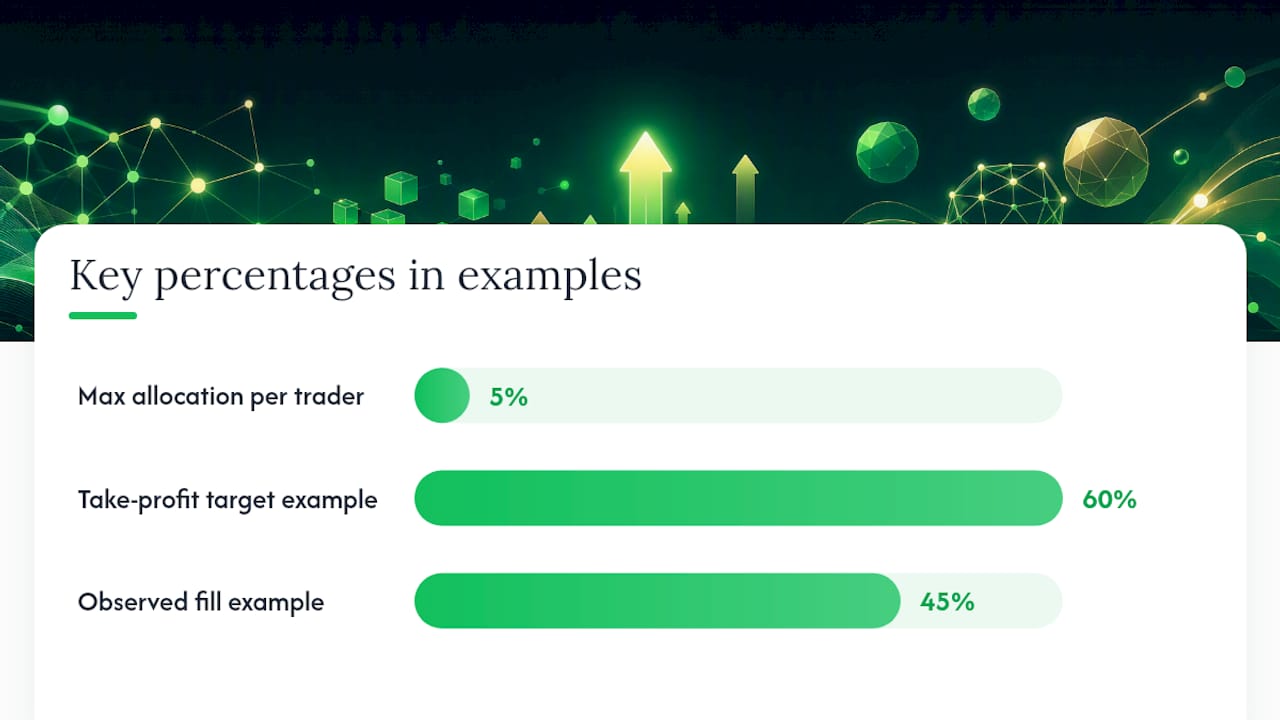
- Max allocation per copy-trade: 2–5% of total account balance
This setup follows the scale-out framework that experienced traders default to – lock partial gains early, then let the rest run with a trailing guard.
Key Takeaways
Tiered partial exits combined with a trailing stop on the remainder represent the most structured approach to automated profit-taking for Pump.fun copy-trades on Snipethem, with micro-allocation testing as the essential first step before scaling.
| Point | Details |
|---|---|
| Use tiered exits as default | Exit 50% at TP1 (+30%) and 25% at TP2 (+60%), then trail the remainder at 5–8%. |
| Maintain a 1:2 risk/reward minimum | Set stop-loss so the distance to TP1 is at least double the distance to the stop. |
| Cap allocation per copy-trade | Limit each trader copy to 2–5% of total account balance to control concentration risk. |
| Micro-test every new configuration | Run at 1–2% of normal allocation for the first 24 hours and log fill rate and slippage. |
| Snipethem for auditable copy-trading | Use Snipethem's override panel and preview tool to configure and verify rules before scaling. |
Table of Contents
- What do take-profit rules mean for Pump.fun copy-trading?
- Which types of take-profit rules fit Pump.fun meme-coin trades?
- How to choose take-profit rules for the trader you copy
- Step-by-step: configure take-profit rules inside Snipethem
- Three ready-to-use take-profit rule templates
- Risk controls and monitoring after enabling automated rules
- How to test a take-profit setup safely before scaling
- Common mistakes that break copy-trading take-profit plans
- Why tiered exits with trailing stops suit Pump.fun copy-trading
- Snipethem gives you a faster path to tested take-profit configurations
- Sources
What do take-profit rules mean for Pump.fun copy-trading?
In the context of Snipethem, take-profit rules are configurable automated exit settings that determine when and how a replicated position closes. They are not the evaluation or consistency rules used by prop-trading firms. The term here refers strictly to percentage targets, tranche exits, trailing stops, and time-based closes that the Snipethem bot executes on your behalf when copying a Pump.fun trader's activity.
Pump.fun meme coins move fast. Snipethem's automated replication tools execute overrides with a reported 0.3-second response time and a cited 94.2% success rate, giving configured rules a realistic chance of filling near target. These are brand-reported performance signals, not guarantees of execution in every market condition.
This guide covers configuration and testing only. It is not financial advice. Meme-coin trading carries substantial risk of loss.
Which types of take-profit rules fit Pump.fun meme-coin trades?
Professional traders scale out in tranches rather than exiting at a single level, because no single exit strategy fits every token or market phase. The five primary rule types and their best-fit scenarios for Pump.fun copy-trades:
- Fixed % target: Exit 100% at one predetermined gain level. Best for scalpers copying traders with tight, consistent run magnitudes and high trade frequency.
- Tiered/partial exits (TP1 + TP2): Exit in two or more tranches at ascending targets. The default choice for most Pump.fun copy-trades because it balances certainty with upside capture.
- Trailing take-profit: A stop that moves up with price and locks in gains if price reverses by a set distance. Most effective as the final exit on a remaining tranche during strong trending moves; suggested trail distances run 3–5% for short timeframes and 5–8% for longer holds.
- Time-based close: Automatically closes the position after a set duration regardless of price. Useful when copying traders whose tokens frequently lose momentum after 30–60 minutes.
- Conditional/volume exit: Closes when on-chain volume drops below a threshold or when smart-wallet activity signals distribution. More advanced; requires monitoring rather than a simple percentage input.
The tradeoff across all types is consistent: tighter rules protect capital but cap upside; wider rules capture larger runs but risk giving profits back on a reversal.
How to choose take-profit rules for the trader you copy
Before configuring any override, answer three questions about the trader's history on Snipethem's auditable trade logs:
- What is the typical run magnitude? A trader averaging +40% peaks needs different tiers than one averaging +150%.
- What is the historical fill rate and average slippage? Thin-liquidity tokens fill poorly at wide targets.
- What is the average trade duration? Trades closing in under 10 minutes favor fixed targets or tight tiers; longer holds suit trailing stops.
Mapping trader style to rule archetypes keeps configuration grounded in evidence rather than preference. A balanced trader copying mid-frequency swings fits the tiered + trailing hybrid described in the opening. A conservative holder replicating longer-duration positions can use a wider trailing stop with minimal partial exits and a time-based timeout as a backstop.
Step-by-step: configure take-profit rules inside Snipethem
- Select a trader from the Snipethem marketplace and review their trade history and statistics before purchasing access.
- Click "Buy Access" on the trader's profile page to open the 24-hour access purchase flow.
- Open the override settings panel within the purchase flow. This is where you set your own take-profit and stop-loss rules rather than mirroring the trader's exact exits.
- Enable tiered take-profits. Input TP1 percentage and the portion of the position to close at that level, then repeat for TP2.
- Add a trailing stop on the remainder. Set the activation threshold (typically at or above TP2) and the trail distance in percentage points.
- Set max allocation. Use the allocation field to cap the SOL amount committed per replicated trade.
- Preview the replicated order using Snipethem's preview tool before confirming. Verify that open orders appear correctly under the "Open Orders" panel.
- Enable micro-allocation mode for the first run by setting allocation to 1–2% of your normal amount.
Pro Tip: Run every new configuration at micro-allocation for the first 24 hours. The preview tool shows the intended order structure, but actual fills depend on on-chain liquidity at the moment of execution. Micro-allocation limits downside while you verify real fill quality.
Platform performance note: Snipethem reports a 0.3-second response time and a 94.2% success rate across replicated trades. These figures reflect platform-level execution speed and order success under normal conditions. They do not guarantee fills at exact target prices during low-liquidity or high-volatility events, which are common on Pump.fun tokens.
Three ready-to-use take-profit rule templates
The table below presents three starting configurations. Adjust percentages based on the specific trader's historical run magnitude and the token's order-book depth.
Editing these templates is straightforward. For tokens with shallow order books, tighten TP1 by 5–10 percentage points and reduce exit size at TP2 to limit slippage exposure. Automated trailing take-profit can improve ROI and reduce drawdown compared with manual exits, but only when the bot maintains stable API connectivity and local hard-stop fallbacks are in place.
Risk controls and monitoring after enabling automated rules
Configuring rules is the first step; monitoring their real-world behavior is where most copy-traders underinvest time.
Core risk controls to set before going live:
- Max allocation cap: Never exceed 5% of total account balance on a single trader copy.
- Per-trade dollar risk: Calculate the maximum loss if the stop-loss triggers and confirm it is acceptable before enabling replication.
- Automatic stop-loss: Always pair every take-profit configuration with a stop-loss. Skipping this step is one of the most common errors in automated copy-trading.
- Timeout close: Set a time-based exit as a backstop for any position that has not hit TP1 within the expected window.
Monitoring checklist for the first 24 hours:
- Compare average executed fill price against the configured target level.
- Track order-book depth at target levels before and during active trades.
- Note any repeated partial fills, which signal insufficient liquidity at the target price.
- Watch for a surge in trader cancellations or sudden volume drops at target levels.
- Check for API or connectivity errors in the bot log.
Pro Tip: *Log every replicated trade's fill price, slippage, and time-to-fill in a simple spreadsheet during the first 24 hours.
Solana transaction fees are typically a fraction of a cent per transaction, but they accumulate across high-frequency copy-trades. Snipethem charges a 24-hour access fee in SOL per trader, so factor both costs into the net P&L calculation when evaluating whether a configuration is performing as expected.
How to test a take-profit setup safely before scaling
- Review the trader's last 20 trades in Snipethem's auditable history. Note average run magnitude, trade duration, and any patterns of early reversal.
- Configure your override settings using the appropriate template from the section above.
- Run a micro-allocation test at 1–2% of your intended normal allocation for the first 24-hour access period.
- Record fill data: fill rate, average slippage per tier, time-to-fill at TP1 and TP2, and realized P&L versus the expected target.
- Compare trader behavior variance: check whether the trader's live trades during your access window match the historical pattern you reviewed.
- Evaluate after 24–72 hours. If fill quality is acceptable and realized P&L aligns with expectations, increase allocation incrementally, not all at once.
The 24-hour access model means each test cycle costs one access fee in SOL plus transaction costs. Budget for two to three test cycles before committing full allocation to a new trader configuration.
Common mistakes that break copy-trading take-profit plans
The most damaging errors are behavioral, not technical. Moving take-profit targets upward after a position opens, selling everything at a single level, and ignoring stop-losses are the three patterns that most reliably turn a profitable setup into a losing one.
Additional mistakes to avoid:
- Over-allocating to a single trader: Concentrating more than 5% of account balance in one copy-trade amplifies the impact of any single bad fill or unexpected reversal.
- Ignoring slippage and liquidity: A target set at +60% on a token with a thin order book may fill at +45% or not at all.
- Disabling the stop-loss to "give the trade more room": This removes the primary capital protection mechanism and is almost never justified on Pump.fun tokens.
Red flags that warrant immediate action:
- Repeated partial fills at TP1 across multiple trades (reduce allocation, tighten target).
- A sudden increase in trader cancellations or manual overrides (pause replication, review trader history).
- Volume collapse at the target level before fill (widen trail distance or lower TP1).
- API or connectivity errors appearing in the bot log (reduce allocation until connectivity is confirmed stable; robust API connectivity and local hard-stop fallbacks are non-optional for automated trailing strategies).
Why tiered exits with trailing stops suit Pump.fun copy-trading
The tiered plus trailing structure is not arbitrary. Pump.fun tokens exhibit sharp initial pumps followed by unpredictable momentum decay, which means a single fixed target either exits too early on a large run or holds too long on a reversal. Tiered exits address both failure modes: TP1 captures the high-probability initial move, TP2 captures the secondary push, and the trailing stop on the remainder adapts to whatever the token does next without requiring a manual decision.

Those figures are platform-level signals, not per-trade guarantees. Liquidity, network congestion, and token-specific order-book depth all affect actual fill quality. The practical implication is straightforward: always micro-test first, review real fills, and treat platform statistics as a baseline indicator rather than a certainty.
Snipethem gives you a faster path to tested take-profit configurations
Copy-trading Pump.fun tokens with pre-set, auditable rules is meaningfully different from discretionary trading. Snipethem's top trader marketplace lets you browse auditable trade histories, preview exact replicated orders before committing capital, and configure tiered take-profits and trailing stops directly in the override panel, all within a single 24-hour access purchase.
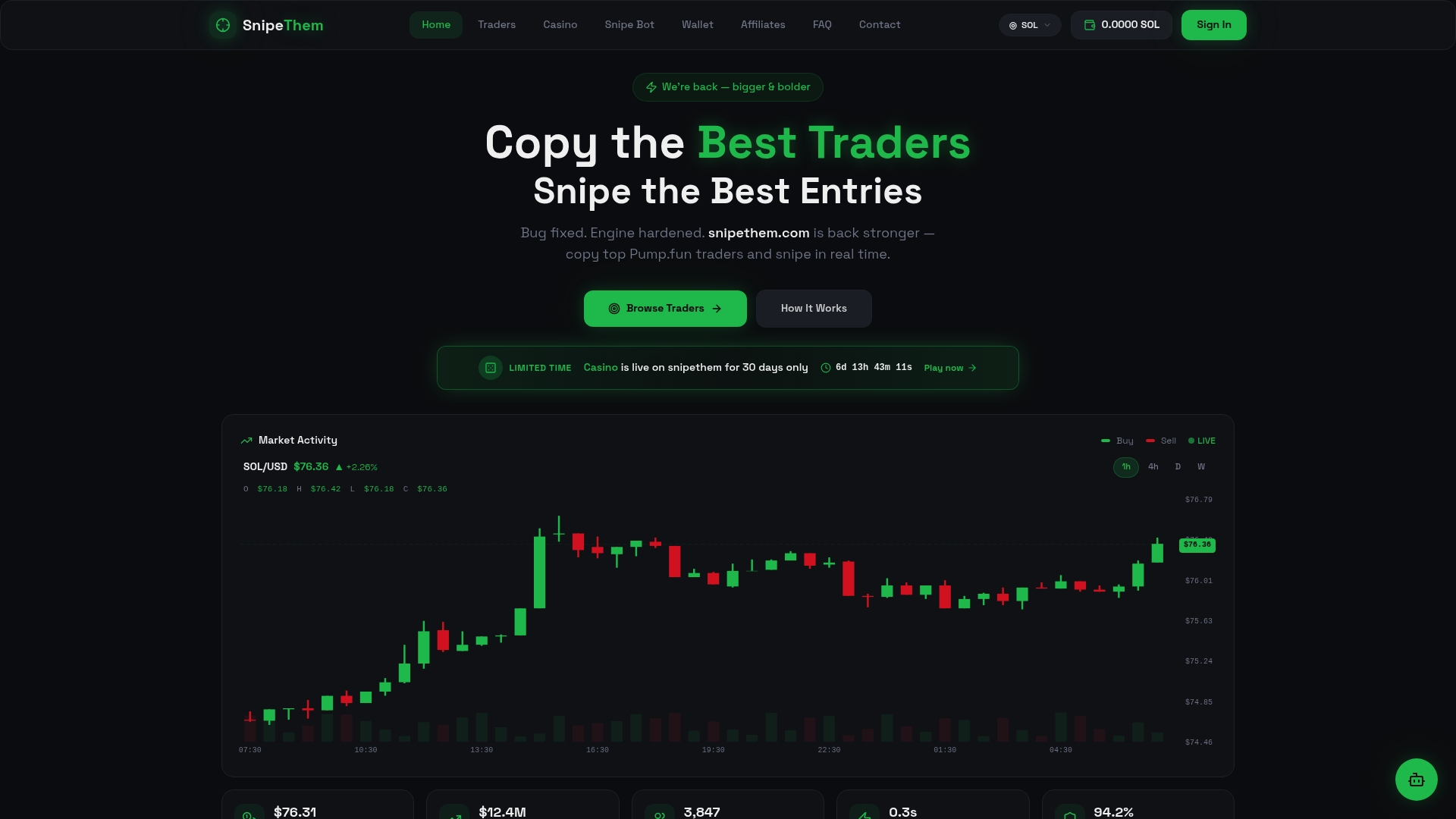
Snipethem's bot configuration tools include the preview and replicate functionality that makes this test-first approach fast to execute. Browse available traders, apply an override template from this guide, and run your first micro-allocation test today.
Sources
This article is general information, not a substitute for advice from a qualified financial advisor. Consult a qualified financial professional about your own circumstances before acting on anything here.