

The safest beginner approach to copy trading is a diversified portfolio of several verified traders, sized at a moderate percentage of your copy capital per trader, with mechanical unfollow rules applied without exception. This structure limits single-name concentration risk while giving you enough exposure to benefit from a range of market conditions. Realistic net returns from disciplined copying depend heavily on the traders you select and the fees your platform charges — a 10% profit-share applied to periodic gains can create a meaningful long-term gap between gross and net outcomes.
Three immediate steps you can take in the next hour:
- Open a demo account on a platform that shows per-trade histories, max drawdown, and Sharpe ratio for each trader.
- Filter the trader leaderboard to show only those with 12 or more months of continuous history and a max drawdown below 25%.
- Set a written rule now: if any copied trader draws down 15% from your entry peak, you unfollow immediately, no exceptions.
Pro Tip: Write your unfollow rules on paper before you fund a live account. Committing to mechanical triggers in advance removes the emotional hesitation that causes most beginners to hold losing positions too long.
Key Takeaways
Disciplined copy trading requires a diversified portfolio, mechanical stop rules, and ongoing monitoring — not passive set-and-forget execution.
| Point | Details |
|---|---|
| Diversify across 4–8 traders | Allocate 8–15% per trader to limit single-name concentration risk. |
| Apply the six-metric filter | Require 12+ months track record, max drawdown below 25%, and Sharpe above 0.7 before copying anyone. |
| Use mechanical unfollow triggers | Unfollow any trader who draws down 15% from your entry peak, no exceptions. |
| Run a demo before going live | A 2–4 week demo copy reveals slippage patterns and execution quality at no cost. |
| Snipethem for meme-coin copying | Snipethem's 24-hour access model and sniper bot let you test Pump.fun traders with a defined, limited commitment before scaling. |
Table of Contents
- What are copy trading strategies and how do they actually work?
- What copy trading helps you do — and what it does not solve
- What types of copy trading strategies fit different risk profiles?
- How do you pick the right trader to copy?
- Risk and money-management rules every copier should follow
- Which platform features should you prioritize for copy trading?
- How to set up a copy trading portfolio and what to do in the first 30 days
- Three strategy templates beginners can use right away
- How to validate a trader's track record before committing capital
- How Snipethem maps to the copy trading checklist
- A quick checklist to get started safely
- What beginners consistently get wrong — and how to avoid it
- Snipethem gives you a ready-made starting point for meme-coin copy trading
- Sources
What are copy trading strategies and how do they actually work?
Copy trading is a method where a follower's account automatically replicates the trades of a selected trader, proportionally to the capital allocated. When the lead trader opens a position, the platform calculates the equivalent size for the follower's account and executes it in near real-time. When the lead trader closes, the follower's position closes too.
The mechanics of a single copied trade follow a consistent sequence:
- Allocation: The follower designates a fixed amount of capital to copy a specific trader.
- Proportional sizing: The platform calculates the follower's position size as a fraction of the lead trader's position, matching the ratio of allocated capital to the trader's total managed capital.
- Execution: The follower's order is routed to the market independently, not bundled with the lead trader's order.
- Closing: When the lead trader exits, the platform sends a corresponding close order to the follower's account.
Two technical architectures underpin most platforms. The more common is mirror/proportional copying, where the follower's account retains full custody of funds and the platform mirrors signals. This preserves account-level controls and is the standard for retail copy trading. The less common master-slave architecture requires the follower to grant execution permissions to the lead trader's system, which raises custody concerns and is rarely used in regulated retail environments. Mirror/proportional copying preserves account-level controls; master-slave systems are structurally riskier because they require sharing execution access.
Copiers rarely receive fills identical to the lead trader's. Order routing, latency between signal and execution, and available liquidity at the moment of the follower's order all introduce slippage. This gap is small on liquid assets with longer holding periods but compounds quickly for high-frequency strategies. Scalpers who hold positions for under 30 minutes face a structural disadvantage for copiers precisely because of this latency effect.
What copy trading helps you do — and what it does not solve
Copy trading offers genuine advantages for beginners, but it also carries limits that are frequently understated on platform marketing pages.
Clear advantages:
- Access to experience: Beginners can participate in markets guided by traders with verified multi-year track records, without needing to develop their own analytical framework first.
- Diversification: Copying 4–8 traders across different asset classes or timeframes distributes risk in a way that a single beginner strategy rarely achieves.
- Time savings: Automated execution removes the need to monitor charts continuously; the platform handles order placement and closing.
- Learning by observation: Watching a verified trader's position history over weeks builds pattern recognition that textbooks rarely replicate.
Key limits and failure modes:
- Recency bias: Leaderboards surface recent high-performers, and new copiers flood in just as those returns revert. Platform guides consistently warn against selecting traders on trailing 30-day gains and recommend 6–12 month minimum track records with consistent metrics across quarters.
- Overreliance: Copy trading does not eliminate the need for monitoring. A trader who performed well for 18 months can change strategy, increase leverage, or simply hit a losing streak. Passive copiers who never review their portfolio absorb those losses silently.
- Fee and compounding drag: Performance fees reduce net compounding. A 10% profit-share sounds modest in any single period, but applied repeatedly across a multi-year horizon, the cumulative gap between gross and net returns becomes material.
- Platform risk: If the platform experiences technical failures, liquidity issues, or regulatory action, open copied positions may not close as expected.
A practical note on fees: always calculate your expected net return after profit-share and any spread markup before committing capital. The gross return a trader shows on a leaderboard is almost never what you receive.
What types of copy trading strategies fit different risk profiles?
Copy trading approaches generally fall into three risk archetypes, each with distinct metric ranges and timeframe preferences.
Conservative profile
A conservative approach prioritizes capital preservation. Holding periods tend to be measured in days to weeks rather than hours.
Balanced profile
Trade frequency is moderate, holding periods range from hours to days, and asset concentration is limited to two or three sectors.
Aggressive profile
Trade frequency is high, holding periods are short, and asset concentration is often narrow. This profile is not recommended for beginners with limited capital buffers.
On timeframe variants: Scalping strategies (holding periods under 30 minutes) are generally a poor fit for copiers. Execution latency and slippage compound quickly for high-frequency strategies, meaning the copier's fills diverge materially from the lead trader's. Day trading strategies (holding periods of hours) carry moderate slippage risk. Swing trading strategies (holding periods of days to weeks) are the most copier-friendly because latency has minimal impact on a trade held for 48–72 hours.
Pro Tip: If you are starting with less than $1,000, stick to swing traders only. Slippage on a scalper's strategy can consume a disproportionate share of a small account's gains before you even notice.
How do you pick the right trader to copy?
Selecting traders is the single most consequential decision in any copy trading approach. The metrics below form a repeatable, evidence-based filter that professional marketplaces use to identify high-probability traders.
Core metrics to evaluate
| Metric | Conservative threshold | Moderate threshold | Aggressive threshold |
|---|---|---|---|
| Track record length | 18+ months | 12+ months | 6+ months |
| Max drawdown | Below 15% | Below 25% | Below 25% |
| Sharpe ratio | Above 1.5 | Above 0.7 | Above 0.7 |
| % profitable months | Above 70% | Above 60% | Above 50% |
| Avg holding period | 24+ hours | 4+ hours | 1+ hour |
| Copier base | 50–150 | 50–150 | Any |
A six-metric filter combining Sharpe ratio, max drawdown, tenure, monthly consistency, holding period, and copier base is cited as a practical standard in professional marketplace analysis. Applying all six simultaneously eliminates most leaderboard noise.
Red flags to watch for
- Sudden strategy drift: a trader who was a swing trader for 12 months and suddenly starts scalping has changed their approach, and your copy settings may no longer match.
- Very high recent returns without a long track record: a 200% gain over 60 days with no prior history is a statistical outlier, not a repeatable edge.
- Rapid copier base growth: when a trader's follower count jumps from 200 to 2,000 in a month, their position sizing may be constrained by liquidity, and their historical returns may not scale.
- Inconsistent position sizing: large variance in trade size relative to account equity suggests emotional or discretionary sizing rather than a systematic approach.
- Hidden or unclear fees: profit-share structures buried in platform terms can significantly reduce your net return.
Verification checklist
- Export or screenshot the trader's full trade log, not just the summary statistics.
- Confirm the track record is continuous, with no unexplained gaps longer than two weeks.
- Check performance across at least two distinct market conditions (a trending period and a range-bound or declining period).
- Run a two-week demo copy before committing live capital, and compare your actual fills to the trader's reported fills to measure slippage.
- Verify the trader's copier base has been stable or growing gradually, not spiking recently.
Risk and money-management rules every copier should follow
Sound money management is what separates copiers who survive drawdowns from those who abandon their portfolio at the worst possible moment. The rules below are mechanical by design: they remove discretion from high-stress decisions.
Position-sizing framework
- Set a hard cap of 25% on any single trader. No matter how strong the track record, no single trader should control more than a quarter of your copy capital. This cap limits the damage from a single strategy failure.
- Target 8–15% per trader across 6–8 traders. This range, recommended in professional marketplace guidance, balances diversification against over-dilution. Below 8%, the position is too small to contribute meaningfully; above 15%, concentration risk rises.
- Apply a half-Kelly or quarter-Kelly fraction when sizing. Full Kelly maximizes long-run growth but produces drawdowns most retail copiers cannot tolerate emotionally. Half-Kelly cuts expected drawdown substantially while preserving most of the growth benefit.
- Rebalance quarterly. Drift from target allocations accumulates as traders perform differently. A quarterly rebalance keeps concentration in check without over-trading.
- Account for profit-share in your return expectations. A 10% profit-share on a trader generating 30% gross annual returns reduces your net to approximately 27% before other fees, and the compounding gap widens over time.
Mechanical unfollow triggers
Apply these three triggers without negotiation.
- 15% drawdown from your entry peak on any single trader. If a trader you are copying draws down 15% from the equity high at the time you started copying, unfollow immediately. This is not a prediction of further losses; it is a rule that limits maximum exposure to any single losing streak.
- Strategy drift. If a trader's average holding period, trade frequency, or asset class changes materially from what it was when you selected them, unfollow. You selected them for a specific approach; a different approach requires a new evaluation.
- Copier base exceeds 5,000. Very large follower counts can create liquidity constraints that distort the trader's fills relative to yours, particularly on less liquid instruments.
Worked example: $5,000 copy portfolio with 6 traders
That is a manageable loss that does not force a portfolio-wide decision. Rebalance the freed capital equally across the remaining five traders after a 30-day cooling-off period, during which you evaluate replacement candidates using the six-metric filter.
Pro Tip: *Keep a simple spreadsheet tracking each trader's equity high since you started copying. Update it weekly.
Which platform features should you prioritize for copy trading?
Platform selection shapes every other decision in a copy trading approach. The features below are not optional enhancements; they are the baseline for operating safely.
Essential features checklist:
- Visible per-trade histories: The platform must show individual trade entries, exits, sizes, and timestamps for each trader, not just summary statistics. Summary stats can be cherry-picked; trade logs cannot.
- Max drawdown and Sharpe ratio displayed per trader: These two metrics, visible at the selection stage, are the fastest filters for eliminating unsuitable traders.
- Latency and execution metrics: Some platforms publish average execution delay or slippage data. Prefer platforms that are transparent about this, particularly if you plan to copy traders with shorter holding periods.
- Demo or paper trading mode: Platform guides consistently identify demo accounts as a critical safety feature for beginners. Running a demo copy for two to four weeks before going live reveals slippage patterns and execution quality at no cost.
- Per-trader risk overrides: The ability to set a stop-loss at the trader level (not just account level) lets you apply the 15% unfollow trigger automatically rather than manually.
- Clear fee and profit-share disclosure: Every fee, including spread markup, profit-share percentage, and withdrawal fees, should be visible before you commit capital.
- Regulatory transparency: For U.S.-based users, platforms offering derivatives-based copy trading should be registered with the relevant regulatory body. The NFA BasicNet database provides registration and profile data for participants in U.S. futures markets and is a practical first check when evaluating a provider that handles futures or managed advisory activities.
A mandatory per-trader stop-loss is meaningfully safer than an optional one. Platforms that make stop-loss controls optional introduce a behavioral gap: most beginners will not set them consistently, and the one time they forget is often the one time it matters most.
How to set up a copy trading portfolio and what to do in the first 30 days
A structured onboarding process reduces the likelihood of costly early mistakes. The steps below follow a logical sequence from account selection to live monitoring.
- Select a platform that meets the essential features checklist above. Confirm demo account availability, visible trade histories, and clear fee disclosure before registering.
- Register and complete identity verification. Most regulated platforms require KYC documentation. Complete this before funding so there is no delay when you are ready to trade.
- Fund a demo account with an amount that mirrors your intended live allocation. If you plan to copy trade with $5,000, set the demo to $5,000. This makes the position sizes and drawdown figures directly comparable.
- Apply the six-metric filter to the trader leaderboard. Shortlist 8–12 candidates who meet your chosen profile (conservative, balanced, or aggressive). Do not skip this step in favor of copying the top-ranked trader by recent return.
- Select 4–6 traders for the demo portfolio and apply your allocation caps. Set per-trader stop-loss controls immediately. Do not wait until after you observe performance.
- Run the demo copy for 2–4 weeks. During this period, record each trader's actual fills versus their reported fills. Note any slippage patterns, especially for traders with shorter holding periods.
- Migrate to live with conservative sizes. Start at 50% of your intended allocation per trader. This gives you room to add capital as you gain confidence in execution quality.
- Apply all safety settings immediately on the live account. Per-trader allocation caps, equity stops, and the decision to disable copying of open positions until you are comfortable with the platform's execution are all settings to configure before the first live trade.
30-day monitoring checklist
- Week 1: Confirm all trades are executing and closing as expected. Check actual fills against reported fills for each trader.
- Week 2: Review each trader's drawdown from your entry peak. Confirm no trader has triggered the 15% unfollow rule.
- Week 3: Check trade frequency for each trader. A sudden increase or decrease in activity may signal strategy drift.
- Week 4: Review the full 30-day performance of each trader net of fees. Compare against the track record metrics you used to select them. Decide whether to increase allocation to full target size or maintain the conservative 50% level.
Three strategy templates beginners can use right away
These templates translate the abstract principles above into concrete, copy-pasteable starting points. Adjust allocations to your capital and risk tolerance.
Template 1: Conservative 80/20 barbell
Rebalance reserve capital quarterly.
Market scenario guidance:
- Bull market: Swing traders with trend-following approaches perform well; the 20% reserve can be deployed to a fifth trader if a strong candidate appears.
- Bear market: Swing traders with short-selling capability or hedged approaches hold up better; review each trader's historical bear-market drawdown before selecting.
- Sideways market: Range-bound swing traders tend to outperform trend-followers; check each trader's performance during flat periods in their track record.
Account size guidance: This template works at $1,000 ($200 per trader) but is most effective at $5,000 or above, where per-trader allocations are large enough to generate meaningful absolute returns after fees.
Template 2: Balanced multi-trader portfolio
Replace unfollowed traders within 30 days using the six-metric filter.
Market scenario guidance:
- Bull market: Trend-followers drive returns; range-traders underperform but provide stability.
- Bear market: Range-traders and hedged approaches buffer losses; trend-followers with short capability may generate positive returns.
- Sideways market: Range-traders outperform; rebalance toward them if the sideways condition persists for more than 60 days.
Account size guidance: Optimal at $5,000–$50,000.
Template 3: Aggressive single-trader with partial hedge
Do not replace primary trader without a full re-evaluation using the six-metric filter.
Market scenario guidance:
- Bull market: Primary trader drives strong returns; hedge trader may underperform but limits tail risk.
- Bear market: Primary trader may draw down significantly; the hedge position and reserve buffer the portfolio.
- Sideways market: Returns are likely modest; this template is designed for trending conditions and may underperform in flat markets.
Account size guidance: Not recommended below $5,000.
How to validate a trader's track record before committing capital
Track record validation is where most beginners skip steps, and where the most costly mistakes originate. Published leaderboard statistics are not always what they appear.

Survivorship and backfill bias are documented risks in performance databases. Academic research on performance persistence and selection biases confirms that incomplete histories or the removal of losing traders from leaderboards can make the available universe look significantly better than the true population. A platform that only shows currently active traders with positive track records has already filtered out the losers.
Validation checklist:
- Request or export the full trade log. Summary statistics (total return, win rate) can be calculated over any window; a trade-by-trade log cannot be easily manipulated. Look for exportable CSV or audited histories.
- Confirm a continuous time series. Gaps longer than two weeks in an otherwise active trader's history suggest account resets, strategy changes, or selective reporting. A clean track record has no unexplained gaps.
- Verify performance across market cycles. A trader with 18 months of history that spans only a bull market has not been tested. Look for at least one period of market stress or reversal in the track record.
- Compute rolling metrics, not just total figures. Rolling 3-month Sharpe ratio and rolling max drawdown reveal whether performance is consistent or driven by one exceptional period. A trader with a strong 18-month Sharpe but a single quarter that accounts for 80% of total gains is a different risk profile than the headline number suggests.
- Check monthly percent profitable. A trader with 70% profitable months over 12 months is more consistent than one with 90% profitable months over 4 months. Consistency across a longer window is a stronger predictor of forward performance.
- Compare average holding time to your platform's execution latency. If the trader's average hold is 45 minutes and your platform's execution delay is 5–10 seconds, slippage will be a persistent drag on your returns relative to the trader's reported figures.
Practical tests on demo environments reveal slippage patterns faster than theoretical analysis. Always run a short paper demo to observe real fills before committing live capital.
How Snipethem maps to the copy trading checklist
Snipethem operates as a marketplace for meme-coin copy trading on the Solana blockchain, with a specific focus on top traders from Pump.fun. The platform's structure maps directly to several of the checklist items covered in this guide.
Feature mapping:
- Trader statistics and transparency: Snipethem displays trader rankings and performance statistics, giving users data points to apply selection filters before purchasing access. The trader rankings page shows live market analytics and trending tokens alongside trader performance data.
- 24-hour access model: Rather than a long-term subscription, Snipethem sells 24-hour copy-trading access to individual traders' histories in SOL. This structure allows users to test a specific trader's approach with a defined, limited commitment before deciding to renew.
- Automated execution via sniper bot: Snipethem's sniper bot replicates real-time trading strategies automatically, with a reported response time of 0.3 seconds. This addresses the execution latency concern that affects copiers on slower platforms, particularly relevant for meme-coin markets where price moves quickly.
- Live market analytics: The platform provides live analytics and trending token data, supporting the monitoring function that the 30-day checklist requires.
How to start on Snipethem using the guide's framework:
- Review the trader rankings on the Snipethem marketplace and apply the available statistics to your selection criteria before purchasing access.
- Purchase 24-hour access to one or two traders initially, keeping allocation small relative to your total copy capital.
- Configure the sniper bot with per-trader allocation caps aligned to the 8–15% guideline before activating live copying.
- Monitor fills during the first 24-hour window and compare execution quality to the trader's reported performance.
Risk disclaimer: Meme-coin trading on Solana carries substantially higher volatility and liquidity risk than trading in established asset classes. The mechanical stop rules and allocation caps described in this guide are especially important in this context. Past performance of any trader on the platform does not guarantee future results, and the 24-hour access model means track records should be evaluated carefully before each renewal decision.
A quick checklist to get started safely
Use this list for your first session and first month. Each item is a single, concrete action.
First session:
- Open a demo account on a platform with visible per-trade histories and per-trader stop controls.
- Set demo capital to match your intended live allocation.
- Apply the six-metric filter to the leaderboard and shortlist 8–12 candidates.
- Select 4–6 traders and set per-trader allocation caps before copying begins.
- Configure per-trader stop-loss controls immediately.
- Disable copying of open positions until you have observed at least one full trade cycle.
First month:
- Review actual fills versus reported fills at the end of week one.
- Check each trader's drawdown from your entry peak at the end of week two.
- Monitor trade frequency for signs of strategy drift at the end of week three.
- Conduct a full 30-day performance review at the end of week four, net of all fees.
- Apply the mechanical unfollow trigger to any trader who has breached the 15% drawdown rule, without exception.
- Decide whether to migrate from demo to live, or extend the demo period, based on observed execution quality.
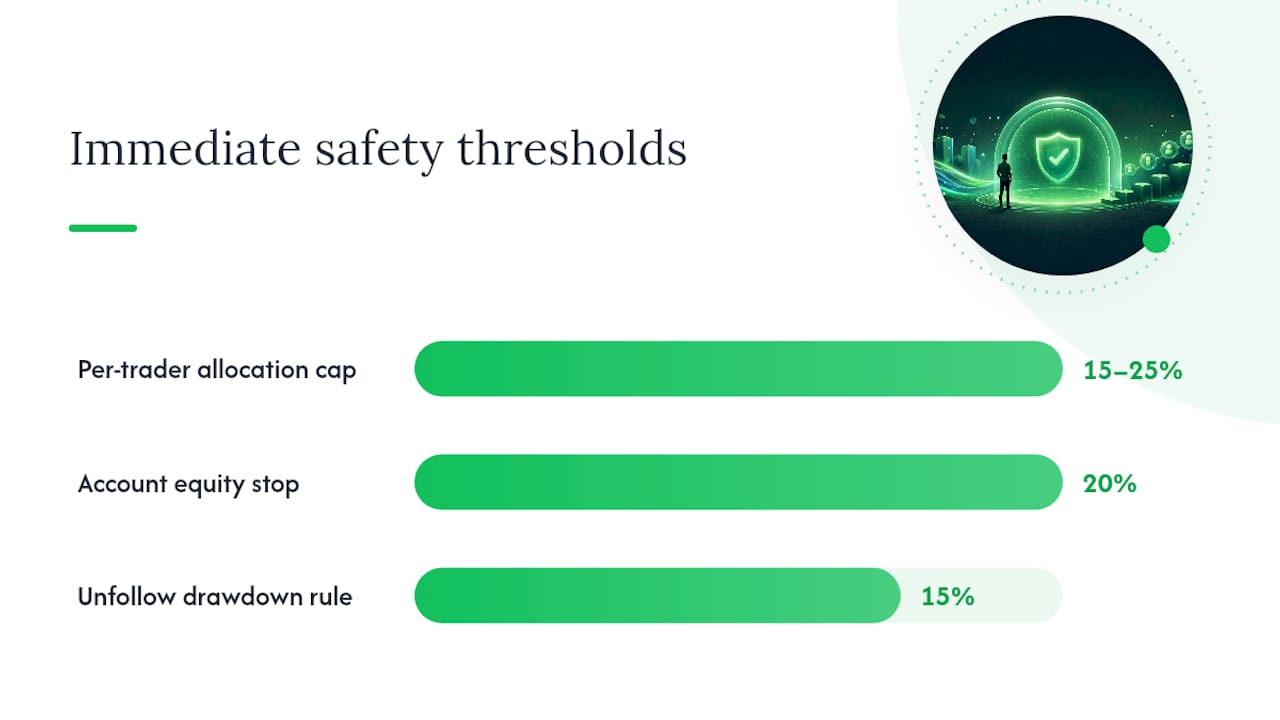
Immediate safety settings to apply on any platform:
- Per-trader allocation cap: maximum 15–25% of copy capital.
- Equity stop at the account level: close all copied positions if total account equity drops 20% from starting value.
- Profit-share disclosure: confirm the exact percentage before copying begins.
- Two-factor authentication: enable on the platform account before funding.
What beginners consistently get wrong — and how to avoid it
The behavioral errors that derail copy trading portfolios are predictable. They appear in the same pattern across experience levels, and awareness alone is rarely enough to prevent them.
Longer windows of 12–24 months predict forward outcomes more reliably than trailing 30-day performance. The leaderboard ranking is a lagging indicator, not a forward signal.
Emotional sizing after early gains is the second common error. The allocation caps in this guide exist precisely to prevent this.
Ignoring execution slippage is quieter but equally damaging. Copiers who never compare their actual fills to the lead trader's reported fills do not know whether they are receiving the strategy's returns or a degraded version of them. Running a demo first and checking fills weekly during the first month makes this visible before it compounds.
Two practical habits prevent most of these errors. First, precommit to rebalancing dates in a calendar before you fund the account. A scheduled quarterly review removes the temptation to make reactive changes based on short-term performance. Second, set automated unfollow triggers wherever the platform allows it.
Snipethem gives you a ready-made starting point for meme-coin copy trading
For traders who want to apply the guide's framework to Solana meme coins specifically, Snipethem provides a structured entry point. The platform's 24-hour access model means you can test a specific trader's approach with a defined commitment in SOL, review the results, and decide whether to renew — without locking into a long-term subscription. Trader statistics and live analytics are visible before purchase, supporting the selection filter process described in this guide.
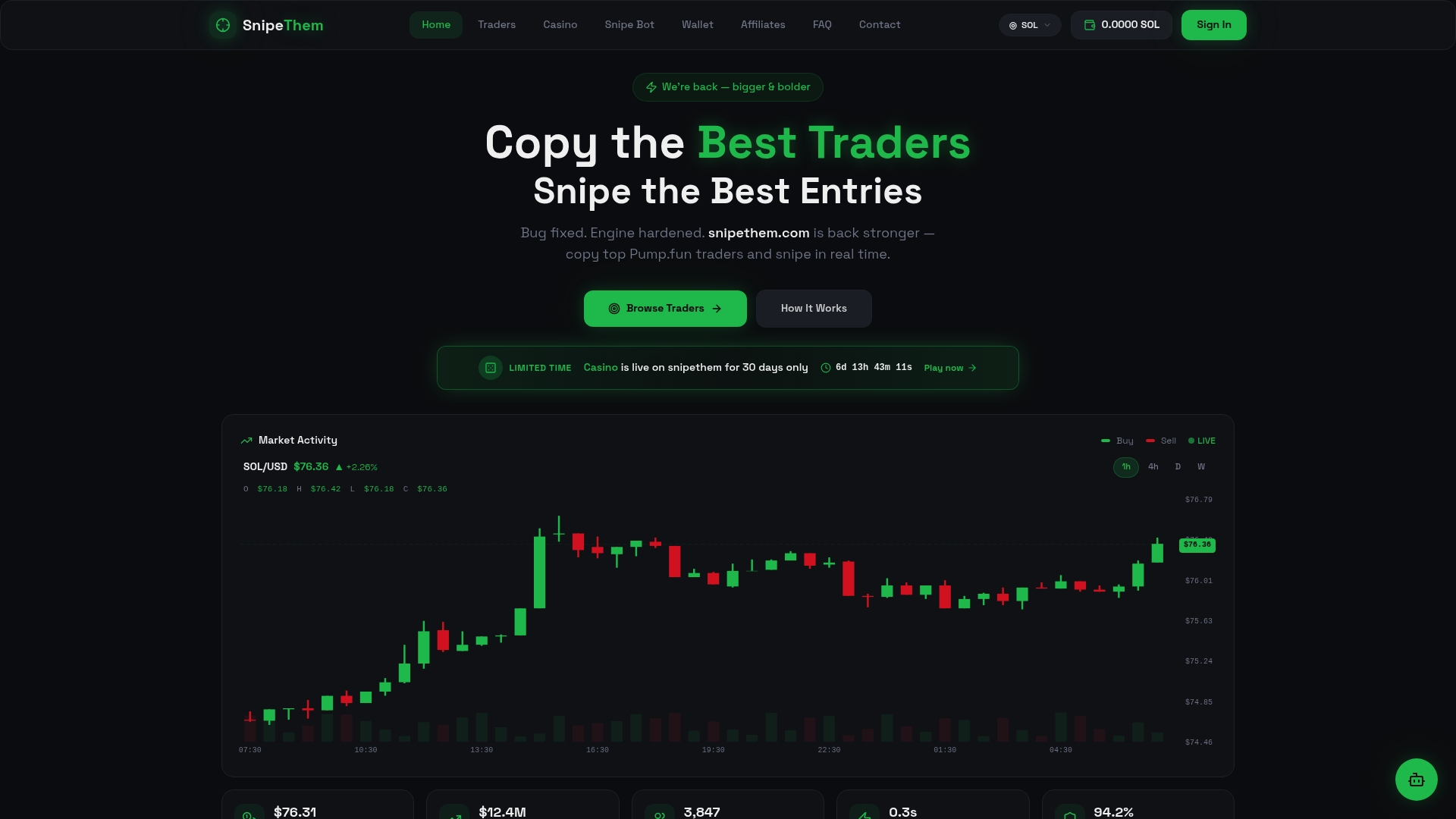
The sniper bot executes copied trades with a reported 0.3-second response time, which directly addresses the latency concern that makes high-frequency strategies problematic on slower platforms. For beginners ready to move from the checklist to live action, the Snipethem trader marketplace is where to start: review the rankings, apply your metrics filter, and purchase 24-hour access to one or two traders before scaling up. Meme-coin markets carry elevated volatility; start small, apply the mechanical stop rules, and treat the first 24-hour window as a paid demo.
Sources
- Bybit Copy Trading Deep Guide 2026: Pick, Size, Monitor
- Forexbrokers
- How to Copy Trade Cryptocurrency: Complete Guide for 2026 – LedgerMind
- What is copy trading and how does it work? | Pepperstone
- Academic study (INFORMS) on performance persistence and selection biases
- Copy trading
This article is general information, not a substitute for advice from a qualified financial advisor. Consult a qualified financial professional about your own circumstances before acting on anything here.