

Copy trading lets you automatically mirror another trader's live positions in your own account, proportionally resized to your chosen allocation. The single best first step for any beginner is to open a demo copy-trading account, practice with simulated funds, and only move to a live allocation once you understand how the replication works. One critical point before anything else: automation does not remove market risk. Every copied trade can lose real money, so only allocate capital you can afford to lose entirely.
Three trust signals worth anchoring to from the start: Investor defines the practice and emphasizes that your funds stay in your own account (custody stays with you, not the leader); reputable platforms publish transparent trader performance metrics including drawdown and win rate; and demo accounts let you test the full copy workflow before committing real capital.
- Your funds remain in your own account at all times — the platform mirrors trades, not custody.
- Demo accounts are available on most regulated platforms and cost nothing to use.
- Transparent trader statistics (drawdown, sample size, win rate) are the primary safeguard against poor leader selection.
Key Takeaways
Copy trading is delegated execution, not passive income — beginners who treat it as a learning tool with strict allocation controls and a demo-first approach consistently manage risk better than those who skip those steps.
| Point | Details |
|---|---|
| Demo before live capital | Run the full copy workflow in demo mode for at least two weeks before committing real funds. |
| Diversify across leaders | Copy 2–5 traders with different styles; no single leader should hold more than 40–50% of your copy budget. |
| Verify trader statistics | Check drawdown, sample size, and win rate — prioritize leaders with at least 6 months of data and 100+ trades. |
| Confirm all fees upfront | Spreads, performance fees, and withdrawal costs reduce net returns; calculate fee drag before selecting a platform. |
| Snipethem for meme-coin access | Snipethem offers 24-hour paid access to top Pump.fun traders with automated snipe-bot replication on Solana. |
Table of Contents
- What is copy trading, and how does it differ from related approaches?
- How does copy trading actually work under the hood?
- What types of assets and copy-trading setups are available?
- How to start copy trading: a step-by-step checklist
- What are the real pros, cons, and risks of copy trading?
- How do you choose a copy-trading platform that is right for you?
- What fees and minimums should you expect from copy-trading platforms?
- Is copy trading actually profitable for beginners?
- How Snipethem approaches copy trading for retail crypto traders
- A perspective on using copy trading responsibly as a beginner
- Snipethem's 24-hour copy access: a direct entry point for meme-coin traders
- Sources
What is copy trading, and how does it differ from related approaches?
Copy trading is a form of social trading where you automatically replicate another investor's trades in your own brokerage account, in real time, scaled to your allocation. Investor.gov describes it as a mechanism where the copier retains full custody of their funds while the platform handles the mirroring.
A compact example makes this concrete. When the leader closes the trade, yours closes automatically.
Copy trading is frequently confused with three related approaches, and the distinctions matter:
- Trading signals: A signal service sends you an alert (entry price, stop-loss, target). You decide whether to act. Copy trading removes that decision — execution is automatic.
- Trading bots: A bot executes a pre-programmed algorithm in your account. There is no human leader whose judgment you are following; the logic is fixed code. SignalBots' beginner guide clarifies this distinction clearly, noting that copy trading mirrors a live human's decisions, while bots run independent rule sets.
- Managed accounts: A fund manager or advisor holds discretionary authority over your funds, often in a pooled structure. In copy trading, you hold your own account and can stop copying at any time.
The custody boundary is the key trust differentiator. You are not handing money to a leader — you are instructing your platform to replicate their trades in your own account, which you control.
How does copy trading actually work under the hood?
Live trades are mirrored and resized to your settings the moment a leader opens a position. The execution flow runs through several steps that happen in seconds, and understanding each one helps beginners set realistic expectations.
- Leader opens a trade. The leader's broker or platform records the new position — asset, direction (buy/sell), size, and entry price.
- The copy service reads the signal. The platform's copy engine detects the new position, typically via API or a proprietary bridge.
- The trade is resized. The platform calculates your proportional position size based on your allocation method (see below) and your account balance.
- The order is placed in your account. Your platform submits a market or limit order on your behalf. This step introduces latency and potential slippage.
- Positions are managed according to your rules. Stop-loss levels, take-profit targets, and maximum drawdown limits you configured apply from this point forward.
Slippage and latency are worth understanding before you start. Slippage occurs when your order fills at a slightly different price than the leader's, because markets move between the moment the signal is read and the moment your order executes. High-frequency leaders or those trading illiquid assets tend to produce more slippage for copiers. Latency — the delay between leader execution and your execution — compounds this effect.
Allocation methods vary by platform. Three common approaches:
- Proportional scaling: Your position size mirrors the leader's as a percentage of their account. If the leader uses 5% of their capital, you use 5% of your allocated copy amount.
- Fixed-lot allocation: You set a fixed contract size per trade regardless of the leader's sizing. Simpler, but it can over- or under-expose you relative to the leader's actual risk.
- Per-trade allocation: You define a fixed dollar amount per trade. Useful for strict capital control but can diverge from the leader's intended risk profile.
Pro Tip: To reduce slippage impact, prefer leaders whose account size is similar to yours, or those who trade lower-frequency strategies with fewer than 10 trades per week. High-frequency leaders generate more slippage for copiers because each trade compounds the execution gap.
What types of assets and copy-trading setups are available?
Copy trading is not limited to one asset class or one technical model. The setup you encounter depends on the platform and the assets you want to replicate.
Common copy-trading models:
- Platform-native social copy: The platform hosts both leaders and copiers, handles all execution internally, and provides a built-in leaderboard. Most beginner-friendly.
- MT4/MT5 bridged copy: A third-party copy service connects to MetaTrader accounts via bridge software. More flexible, but requires more technical setup.
- Account-following services: You link your account to a leader's account through an API key. Common in crypto.
- API-based mirroring: Fully automated replication through direct API connections, often used by institutional or advanced retail traders.
Assets typically available for copying:
- Stocks and ETFs (equity copy trading on regulated platforms)
- Forex currency pairs (the most common copy-trading asset class)
- Commodities (gold, oil, indices)
- Crypto assets (Bitcoin, Ethereum, and altcoins on crypto-native platforms)
- Meme coins and DeFi tokens (available on specialized platforms like Snipethem, which focuses on Pump.fun traders on the Solana blockchain)
Crypto and meme-coin copy trading carry meaningfully higher volatility than forex or equity copying. Tighter per-trade allocation caps and shorter copy windows (such as the 24-hour access model) are practical controls for this asset class.
How to start copy trading: a step-by-step checklist
To start, follow these steps in order — demo first, then a small live allocation. Skipping the demo phase is the most common beginner mistake, and it is entirely avoidable.
- Choose a platform. Verify regulatory status, fee structure, supported assets, and whether the platform publishes transparent leader statistics (drawdown, win rate, sample size). Investing notes that minimums range from $1 to $200 depending on the platform, so match the minimum to your starter budget.
- Open a demo account. Most regulated platforms offer simulated copy trading. Use it to test the full workflow: find a leader, allocate, watch trades replicate, and observe how your balance moves.
- Test copying in demo mode. Run the demo for at least two weeks. Track how closely your simulated results match the leader's published performance.
- Open a live account and complete verification. Most regulated platforms require identity verification (KYC) before funding.
- Fund with a small starter amount. Start with an amount you are genuinely comfortable losing entirely. This is not a figure to optimize — it is a risk boundary.
- Choose 2–5 traders to copy. Copying a single leader concentrates all your risk on one person's judgment. Daytrading diversifying across multiple traders as a standard risk-reduction practice.
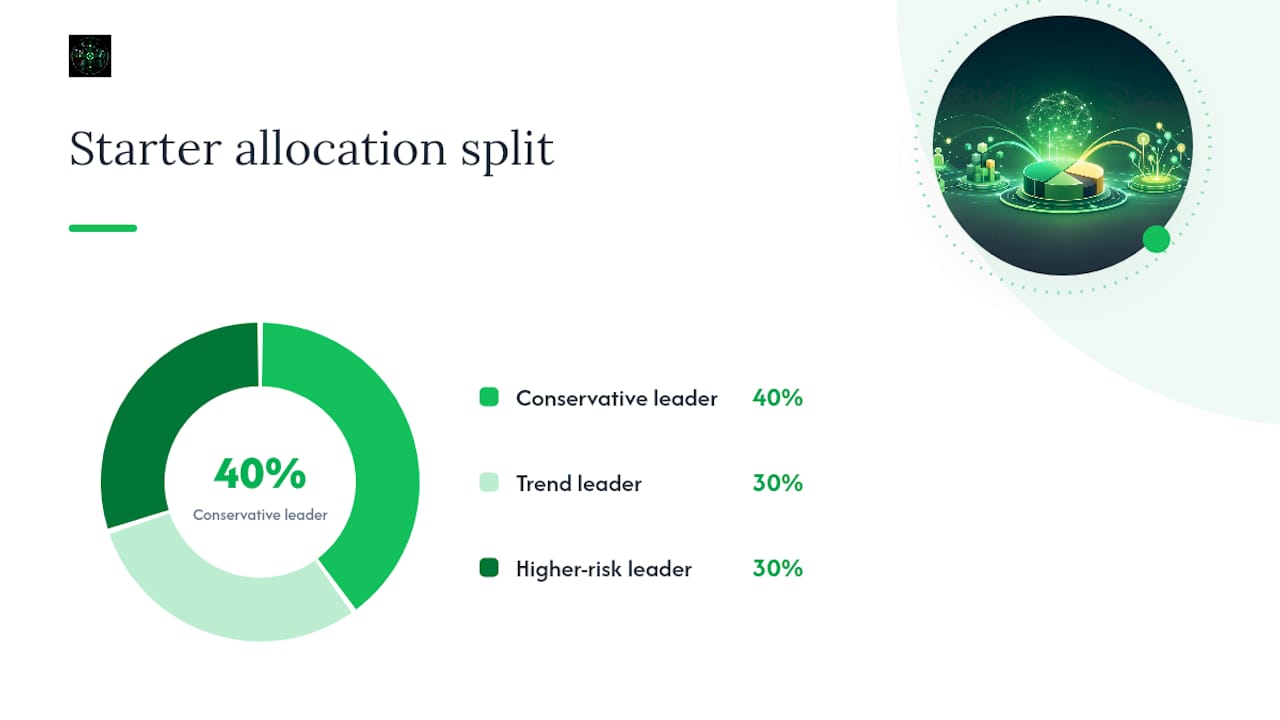
- Allocate per-trader amounts. Divide your capital across your chosen leaders. A sample allocation matrix:
| Leader Type | Allocation | Rationale |
|---|---|---|
| Conservative, low-drawdown leader | 40% | Anchor position; limits downside |
| Trend-following, medium-frequency leader | 30% | Captures directional moves |
| Higher-risk, meme-coin or small-cap leader | 30% | Speculative upside, capped exposure |
- Set stop-loss and maximum drawdown rules. Most platforms let you set a per-leader stop: if your copied allocation loses X%, copying stops automatically. Use this.
- Monitor and rebalance monthly. Review each leader's recent performance, not just their all-time stats. Replace underperforming leaders after a fair evaluation window (at least 6–12 weeks of live data).
Avoid putting your entire balance on one leader. Even a leader with a strong 12-month track record can experience a drawdown that wipes a concentrated position.
Pro Tip: Always start in demo mode and keep a simple journal: note which leaders you copied, why you chose them, and what happened. This habit accelerates learning faster than any tutorial.
What are the real pros, cons, and risks of copy trading?
Copy trading offers delegated execution and a learning path, but carries full market risk and platform risk. Understanding both sides before committing capital is not optional — it is the baseline for responsible participation.
Pros:
- No need for real-time market monitoring once copying is configured
- Beginners can observe professional-grade strategies in live conditions
- Diversification across multiple leaders is straightforward
- Low minimum entry points on many platforms make it accessible
- Transparent leader statistics (on good platforms) support informed selection
Cons:
- You bear full market risk on every copied trade
- Past performance does not predict future results — a leader's track record can change
- Platform outages or API failures can delay or prevent trade execution
- Over-concentration in one leader amplifies losses when that leader underperforms
- Social-proof traps: leaderboards often surface leaders with short, cherry-picked winning streaks
Risk-mitigation steps:
- Diversify across at least two or three leaders with different styles (trend, mean-reversion, conservative).
- Set a per-leader allocation cap — no single leader should control more than 40–50% of your copy budget.
- Enforce a stop-loss limit per leader so copying halts automatically if losses reach a defined threshold.
- Verify the leader's sample size: a 3-month track record with 20 trades is far less reliable than 12 months with 200 trades.
- Prefer platforms that offer demo accounts and publish clear fee disclosures before you deposit.
Leverage deserves a specific warning. Many copy-trading platforms allow leaders to trade with leverage, which amplifies both gains and losses. Always check whether a leader's strategy involves leverage and factor that into your allocation decision.
Hidden fees are a related concern. Performance fees (a percentage of profits paid to the leader or platform), wider spreads on copied trades, and withdrawal fees can reduce net returns significantly. Verify all fee types before copying.
How do you choose a copy-trading platform that is right for you?
Pick platforms that are regulated, transparent about leader statistics, offer demo mode, and match the assets you want to copy. That four-part filter eliminates most poor choices before you read a single feature comparison.
Must-have criteria:
- Regulatory authorization in your jurisdiction (FCA, SEC-registered, CySEC, ASIC, or equivalent)
- Demo account with full copy-trading functionality
- Transparent leader metrics: historical return, maximum drawdown, win rate, average trade duration, and sample size (number of trades and months active)
- Clear fee disclosure before account opening
- Minimum copy amount compatible with your budget
Nice-to-have criteria:
- MT4/MT5 compatibility or API access for advanced users
- Social or community features (comments, leader Q&A)
- Mobile app with real-time notifications
- Automatic stop-copy rules (drawdown-triggered)
Vantage Markets' copy-trading platform page illustrates what a well-structured beginner experience looks like: low entry barriers, detailed signal-provider profiles, and a clear workflow for starting a copy trade.
Trader statistics to inspect before copying:
| Metric | What it tells you | Red flag |
|---|---|---|
| Historical return | Overall profitability over the sample period | Very high returns over a short period |
| Maximum drawdown | Worst peak-to-trough loss in the sample | Drawdown above 30–40% |
| Sample size | Number of trades and months of data | Fewer than 3 months or fewer than 50 trades |
| Win rate | Percentage of trades closed in profit | Very high win rates (often unsustainable) |
| Average trade duration | How long positions are typically held | Very short durations may indicate high slippage risk |
Investing consistently flags trader transparency — specifically drawdown and sample size — as the most predictive metrics for avoiding poor leader selection.
Pro Tip: When possible, verify a leader's performance figures on a third-party tracking tool rather than relying solely on the platform's own leaderboard. Platforms have an incentive to surface their best-performing leaders; independent data surfaces the full distribution.
What fees and minimums should you expect from copy-trading platforms?
Fees and minimums vary widely across platforms and can materially reduce net returns, so confirm them before you start copying. A platform that looks attractive on headline return figures may deliver significantly less after fee drag.
Common fee types:
- Spreads: The difference between the buy and sell price on each trade. Wider spreads on copied trades reduce profitability directly.
- Commissions: A per-trade fee charged by the platform or broker.
- Performance fees: A percentage of profits paid to the leader or platform, typically ranging from 10% to 30% of net gains.
- Platform subscription fees: Some platforms charge a monthly or annual access fee.
- Withdrawal fees: Fees charged when you move funds out of the platform.
Two sample fee scenarios:
| Scenario | Fee structure | Gross return | Net return after fees |
|---|---|---|---|
| Conservative platform | Tight spreads, no performance fee, no subscription | 12% annual | Spread drag reduces returns |
| Aggressive platform | Wider spreads + 20% performance fee on gains | 12% annual | ~8–9% (spread drag + performance fee) |
The difference between these two scenarios on a $1,000 account is roughly $20–30 per year — modest in absolute terms, but meaningful as a percentage of returns at small account sizes.
Minimum copy amounts range from as little as $1 on some platforms to $200 or more on others, according to Investing.com's platform comparison. For small accounts, a high minimum copy amount limits how many leaders you can copy simultaneously, which directly constrains diversification. If your starting budget is $200 and the minimum per leader is $100, you can copy at most two leaders — a concentration risk worth factoring into platform selection.
Is copy trading actually profitable for beginners?
Copy trading can be profitable, but results vary. Many copiers underperform headline leader returns after fees, allocation sizing differences, and slippage. The gap between a leader's published return and what a copier actually receives is a structural feature of the model, not an exception.
Practical answers to common questions:
Is copy trading good for beginners? Yes, as a learning tool and a way to participate in markets without needing to build a trading strategy from scratch. TradingView/ForexLive's beginner guide frames it as a way to learn by watching real trades in live conditions — a meaningful advantage over paper theory alone. The caveat is that automation does not reduce market risk or substitute for understanding what you are copying.
Is it actually profitable? It depends on leader selection, fee structure, and market conditions during the copy period. Judging a leader's performance over multiple market cycles — or at minimum 6–12 months of live data — gives a more reliable signal than a 30-day leaderboard snapshot.
The same leader over 200 trades across different market conditions is a meaningfully different data point. Short sample sizes are one of the most common failure modes in leader selection.
When a leader's performance deviates significantly from their historical pattern — a sudden drawdown spike, a change in trade frequency, or a shift in asset class — the appropriate response is to pause copying and reassess, not to wait for a recovery that may not come.
A leader's past return describes what happened under specific market conditions, not a forecast of what will happen under yours.
How Snipethem approaches copy trading for retail crypto traders
How Snipethem maps to the beginner checklist:
- Low-friction access: Users purchase a one-time SOL fee for 24-hour access to a specific trader's history, lowering the commitment threshold compared to long-term subscription models.
- Curated leader access: The platform surfaces top Pump.fun traders ranked by performance statistics, giving beginners a filtered starting point rather than an unranked open marketplace.
- Real-time replication: The snipe-bot mirrors trades automatically, with the platform's 0.3-second response time designed to minimize execution latency on Solana.
- Analytics and market data: Live market analytics and trending token data are available alongside trader rankings, supporting informed allocation decisions.
- Quick-stop controls: Users can review and adjust copy settings within the 24-hour window, providing a natural circuit breaker.
Pro Tip: Match the platform's intended use case to your goal. Snipethem is designed for retail crypto and meme-coin traders who want short-term, curated access to top Pump.fun strategies — not for long-term equity or forex copy trading. If your goal is learning general trading principles, start with a demo on a multi-asset platform first; if your goal is meme-coin exposure with automated replication, Snipethem's model fits that profile directly.
Country-specific legal and tax treatment of crypto copy trading varies; consult a qualified financial or tax professional in your jurisdiction before trading.
A perspective on using copy trading responsibly as a beginner
The most useful thing copy trading did early on was make the cost of impatience visible. Chasing a leader who had just posted a strong week — without checking their drawdown history or sample size — produced a loss that a two-minute review of their statistics would have prevented.
Three quick principles that hold up in practice:
- Do start with a demo period, even if the platform makes it easy to skip. The demo reveals how slippage and allocation sizing affect your actual results versus the leader's published numbers.
- Don't chase recent top performers. A leader at the top of a weekly leaderboard has often just had an unusually good run. Their 30-day return is not a reliable predictor of the next 30 days.
- Do treat early losses as tuition. The first allocation that underperforms teaches more about leader selection than any tutorial — provided the allocation was small enough that the lesson is affordable.
The demo period is not a formality. It is the only low-cost way to discover whether a platform's execution quality, fee structure, and leader statistics match what they advertise.
Snipethem's 24-hour copy access: a direct entry point for meme-coin traders
For retail traders who want direct, automated access to top Pump.fun strategies without a long-term subscription, Snipethem offers a clear entry point. The model is straightforward: pay a one-time SOL fee for 24-hour access to a curated trader's full trade history, then let the snipe bot replicate their real-time positions automatically.
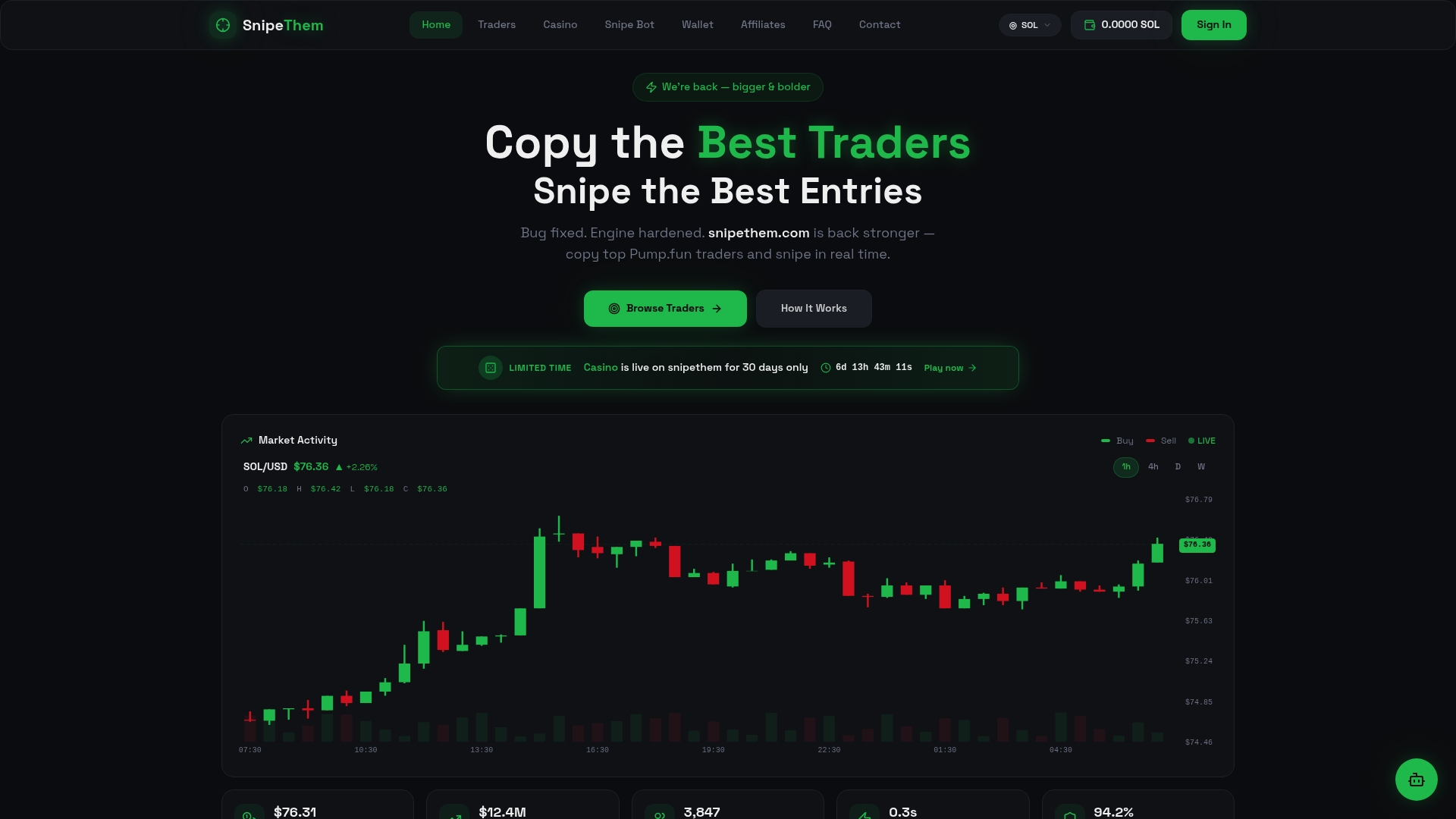
The pricing structure keeps the commitment threshold low. A single 24-hour access purchase lets you evaluate a trader's live performance before deciding whether to renew. Premium and exclusive trader access is available for users who want priority access to top-ranked leaders. Before committing to a live purchase, review the top Pump.fun traders on Snipethem to compare performance statistics, win rates, and trade frequency. Start with the lowest-cost access tier, observe how the bot executes in real conditions, and check the analytics dashboard before scaling up.
Meme-coin trading is speculative by nature. Tokens on Pump.fun can lose the majority of their value within a single trading session, and even a high-success-rate platform cannot eliminate that underlying market risk. Allocate only what you can afford to lose, and treat the first 24-hour access purchase as a learning exercise, not a return-generating deployment.

Sources
This article is general information, not a substitute for advice from a qualified financial advisor. Consult a qualified financial professional about your own circumstances before acting on anything here.