
The way to avoid FOMO crypto trading is to remove the decision entirely: pre-commit to entry and exit rules before you feel anything, automate the boring parts with dollar-cost averaging and limit orders, and force a delay of 24 to 72 hours before acting on any unplanned trade. This article covers three systems: preset risk rules, order-based automation, and a waiting period. Then it gives you a checklist and the exact steps to take when a pump is happening right now.
TL;DR:
- Using preset risk rules and limit orders can prevent impulsive buys during hype, reducing emotional decision-making and catching reversals early.
- Implementing a 24 to 72-hour waiting period before acting on unplanned trades helps break the cycle of immediate FOMO responses.
- Automating entries through dollar-cost averaging and trailing stops minimizes emotional influence and enforces discipline in volatile markets.
- Setting fixed checking windows and turning off price alerts can lower compulsive market monitoring and emotional triggers.
- Building a written, rule-based trading plan with clear entry, exit, and risk parameters improves consistency and reduces impulsive FOMO trades.
Table of Contents
- What FOMO In Crypto Actually Is And Why It Costs You
- How Does FOMO Actually Take Over A Trade?
- Which Systems Actually Remove Emotion From The Trade?
- What Daily Habits Actually Lower Your FOMO Exposure?
- How Do You Build A FOMO-Resistant Trading Plan?
- Can Automation And Copy-Trading Reduce FOMO Without Creating New Risk?
- What Do I Actually Do When The Feeds Light Up?
- A Practical Next Step: Automating The Rules You Already Set
- Sources
What FOMO In Crypto Actually Is And Why It Costs You
FOMO in crypto is the urge to buy or sell driven by social proof and regret aversion rather than analysis, amplified by markets that never close. You watch a coin rip 40% while your feed fills with screenshots, and the fear of missing further gains overrides whatever plan you had that morning.
This isn't a fringe problem. Survey data cited by Coin Bureau shows the majority of retail crypto investors admit to acting on FOMO, with a large share reporting it happens frequently and that it hurt their portfolios. Crypto's structure makes this worse than in stocks: 24/7 trading means there's no closing bell to force a pause, and social platforms turn every green candle into a broadcast event. Retail traders chasing pumps tend to buy near local tops and sell near local bottoms, the exact opposite of what a plan would tell them to do.
How Does FOMO Actually Take Over A Trade?
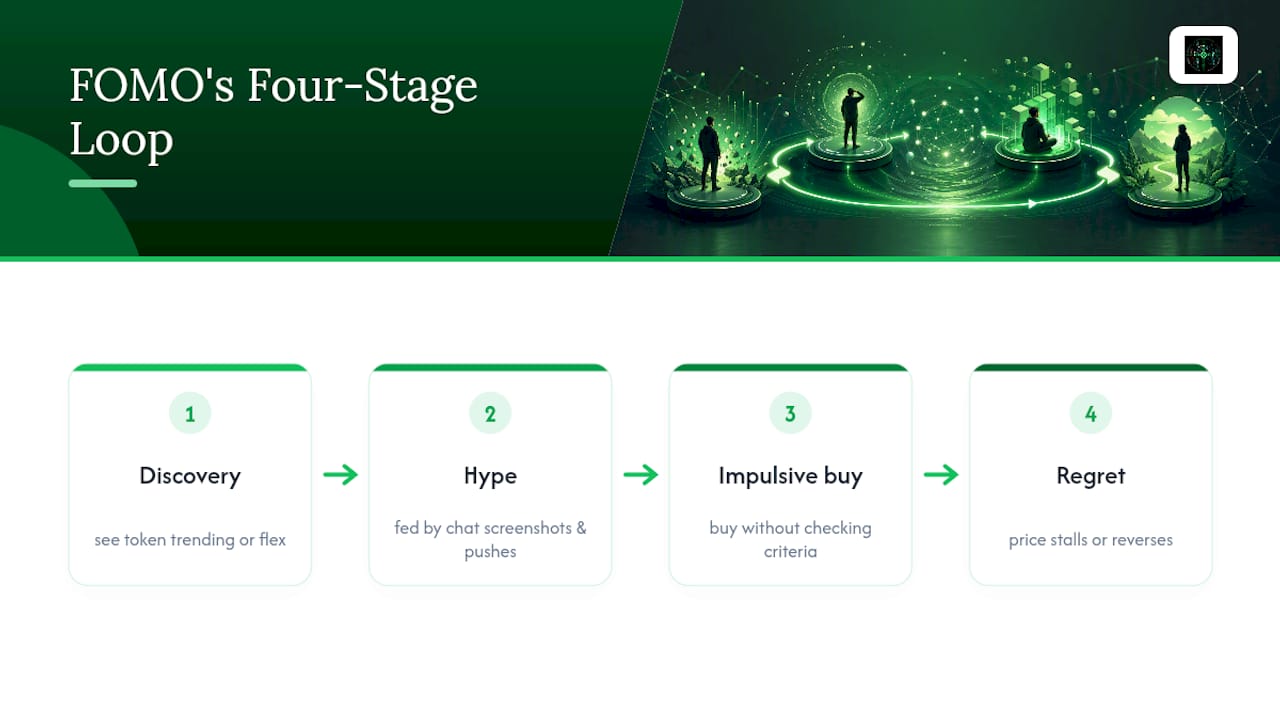
FOMO follows a predictable sequence: discovery, hype, impulsive buy, regret. You see a token trending or a trader flexing gains. Hype builds through repetition, chat screenshots, and countdown-style urgency. You buy without checking your own criteria. Price often stalls or reverses shortly after, and regret sets in, sometimes followed by a second bad decision to "average down" or chase the next one.
A few cognitive biases drive that middle step. Loss aversion makes the pain of missing a gain feel sharper than a comparable loss would. Anchoring locks your sense of "cheap" or "expensive" to whatever price you first saw, even if it's already up 200%. Confirmation bias then makes you notice every bullish comment and ignore every warning.
Social triggers are the delivery mechanism. Influencer posts timed near local tops, chat screenshots of paper gains, and push notifications for price spikes all hit at the exact moment your judgment is weakest. Yellow links heavy social media exposure directly to a higher likelihood of blind crowd-following and worse trade timing. Recognizing which stage you're in, discovery versus hype versus the itch to buy, is often enough to slow the sequence down.
Which Systems Actually Remove Emotion From The Trade?
Three mechanical systems do most of the work: dollar-cost averaging, preset rules, and order-based execution. Each trades off differently, so the right combination depends on how much control you want to hand off.
Dollar-cost averaging (DCA) means buying a fixed dollar amount on a fixed schedule regardless of price. It won't beat a lump sum in every backtest, but its real value is behavioral: it makes it structurally impossible to buy an entire position at a single euphoric top. Yellow notes this trade-off directly. You give up some theoretical upside for a large reduction in the odds of a catastrophic, emotionally-timed entry.
Preset rules work by answering questions in advance, before hype hits. Write down your entry criteria, your max risk per trade (a common guideline is a small percentage of your portfolio on any single volatile position), a daily loss cap that ends your session, and a waiting period of several days for anything you didn't plan to buy that morning.
Order types execute the discipline you already decided on. Limit orders stop you from market-buying into a vertical candle. Stop-losses placed just below your last confirmed support, rather than an arbitrary percentage, protect against the setup being wrong. Trailing stops let winners run without requiring you to watch the chart, a practice Tapbit describes as "trading the chart, not the feed."
- Set a limit order at your planned entry instead of chasing the market price
- Cap position size before you open the chart, not after
- Place stops at structural invalidation points, not round numbers
- Use a trailing stop to lock in gains without constant monitoring
- Pair it with a trailing take profit so exits follow rules, not emotion
Pro Tip: Write your stop-loss level on the same note where you write your entry reason. If you can't justify the stop with the same logic that got you in, the trade idea probably isn't ready yet.
What Daily Habits Actually Lower Your FOMO Exposure?
Small environmental changes cut FOMO exposure more than willpower ever will, mostly because they remove the trigger before it reaches you.
- Set fixed checking windows, two or three times a day, instead of leaving charts open in a background tab.
- Turn off price-spike push notifications; they're engineered to interrupt you at the worst possible moment.
- Curate your information sources down to a short, trusted list instead of an open-ended feed.
- Separate your watchlist from group chats, since chats reward hype and watchlists reward patience.
- Use a 90-second physiological reset when tempted: breathe slowly, name the trade setup out loud, and ask whether you'd take this entry if you'd never seen anyone mention it.
Khaleej Times points to grounding routines and scheduled review windows as measurable reducers of both anxiety and compulsive checking. A weekend digital detox from crypto Twitter or Telegram groups, even just one day a week, tends to reset the baseline faster than most people expect.
How Do You Build A FOMO-Resistant Trading Plan?
A written plan beats a mental one because it's harder to rationalize around at 11 p.m. when a coin is pumping. Build a template with these fields and fill it in before you place a trade, not during:
- Reason for the trade: the specific signal, not "it's going up"
- Signal source: chart pattern, on-chain data, or a vetted trader you follow, not a screenshot
- Entry price and position size: as a percent of total portfolio, capped in advance
- Stop-loss and take-profit levels: set before entry, tied to structure
- Daily session cap: a maximum number of trades or a dollar loss limit that ends the day
For sizing, many traders reference a fractional Kelly approach, betting a smaller, fixed fraction of the theoretical optimal size to survive strings of losses. Our Kelly criterion guide walks through the math with examples.
Every filled template becomes a trade-journal entry. Record your emotional state at entry alongside the numbers. Yellow.com cites journaling practices modeled on Dr. Brett Steenbarger approach, essentially self-administered cognitive behavioral therapy, as one of the more reliable ways to catch repeat mistakes. Review the journal weekly, not just after a loss.
Pro Tip: Grade each trade on rule adherence, not profit. A losing trade that followed every rule is a success by the only metric that compounds over time.
Can Automation And Copy-Trading Reduce FOMO Without Creating New Risk?
Automation enforces pre-commitment mechanically. Scheduled buys, limit orders, and trailing stops all execute the plan you set when you were calm, not the one you'd choose mid-pump.
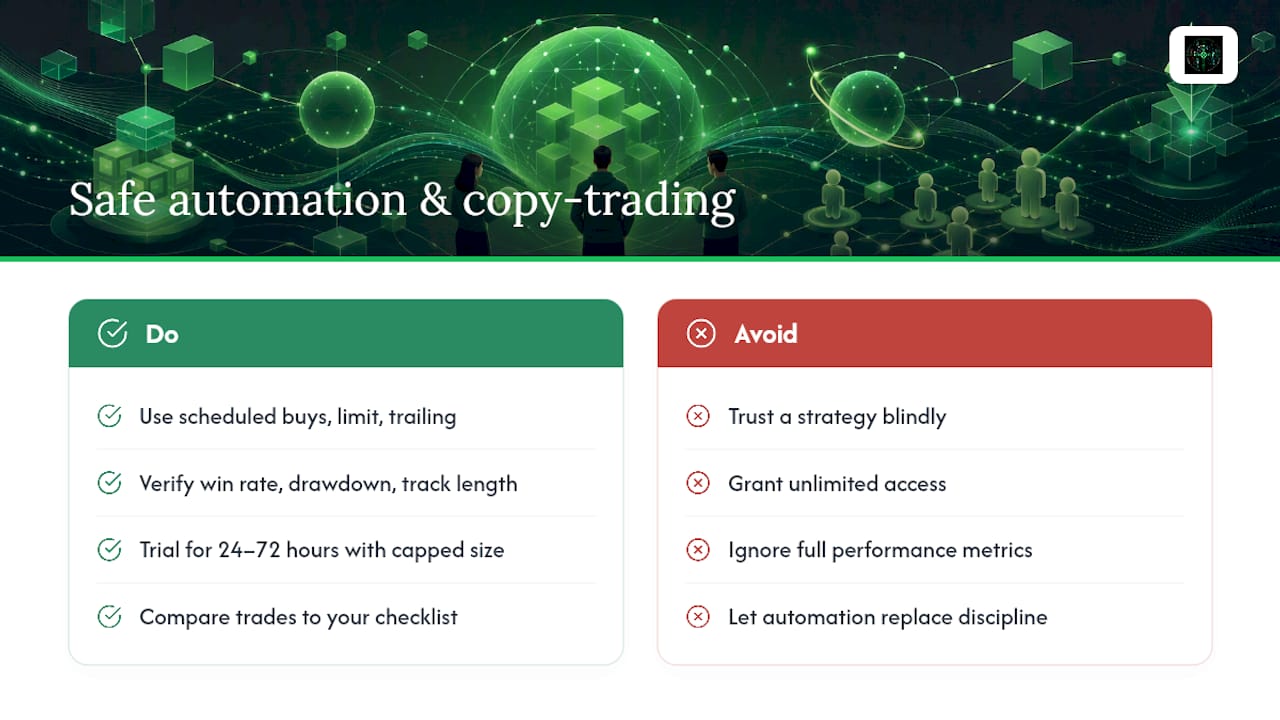
Copy-trading adds a layer worth scrutinizing before you follow anyone. Check historical win rate, drawdown depth, and how long that track record actually runs, not just a highlight screenshot. Our guide to copy-trading risks covers what to verify before granting access.
The guardrail that matters most: treat any new copy-trading relationship as a time-limited trial, 24 to 72 hours with a capped position size, and compare the resulting trades against your own checklist. If the automated strategy breaks your predefined rules, pause it. Automation should enforce discipline, not replace it with a new form of blind trust.
What Do I Actually Do When The Feeds Light Up?
When a coin starts trending and my notifications stack up, I stop scrolling first. That's step one, always. Then a 90-second reset: breathe, name the setup out loud, ask if I'd want this trade with zero social context.
Next, I pull up my own checklist. Does the entry meet my criteria, or am I inventing a reason after the fact? If it doesn't pass, I write it down for the weekly review instead of the trade log. Stepping away isn't failure. Scheduled reviews catch more good opportunities than panic entries ever have, and the plan adapts a little every week rather than aiming for a perfect run that never happens.
— dang
A Practical Next Step: Automating The Rules You Already Set
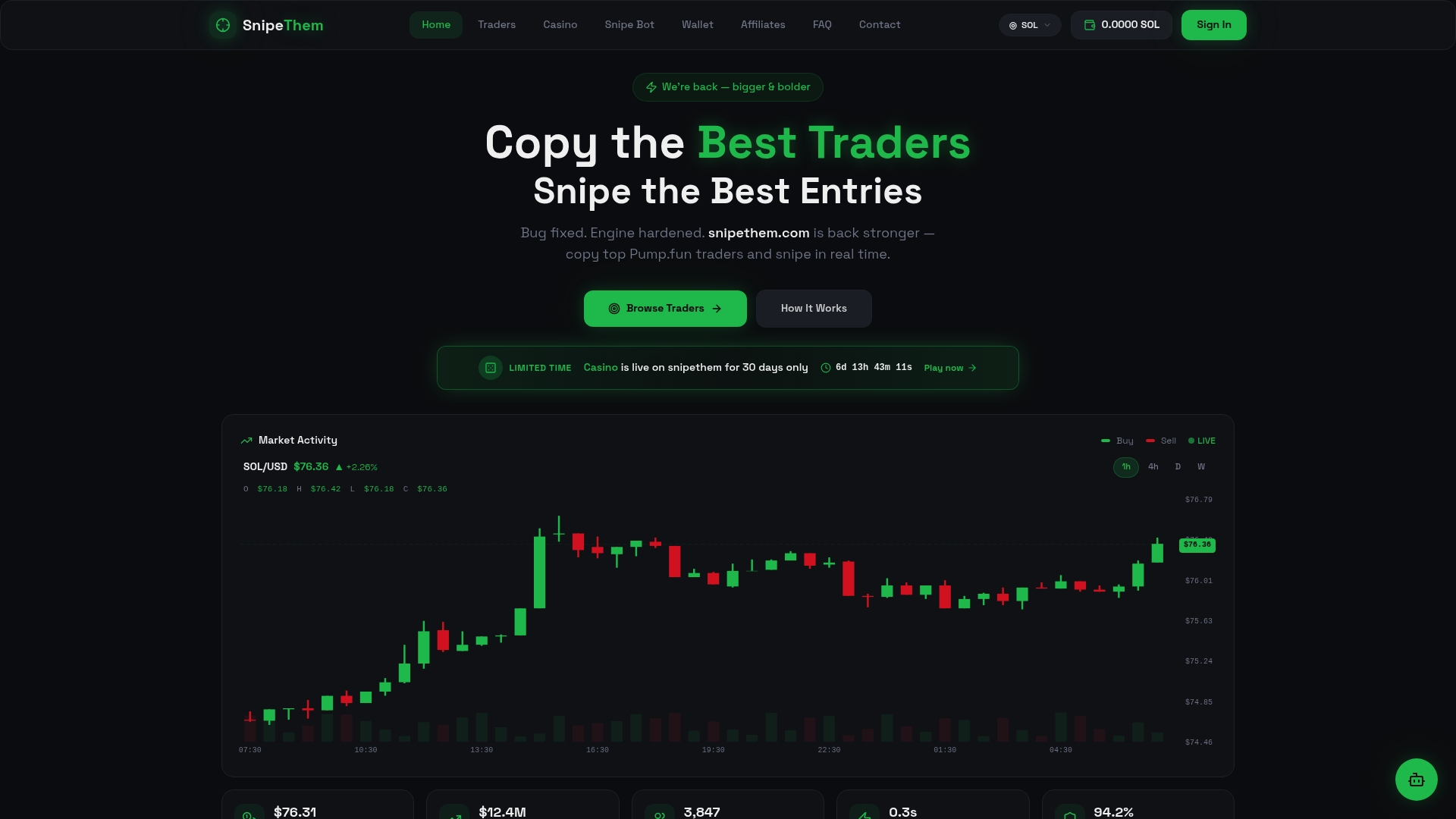
Snipethem gives you a way to put automation behind the exact discipline this article describes, letting you copy-trade top Pump.fun performers with a 0.3-second response time instead of manually chasing a chart while your emotions run the show. Before following anyone, apply the same guardrails covered above: verify a trader's historical win rate and drawdowns, cap your exposure to a fixed, small percentage of your portfolio, and run any new access as a time-limited test rather than an open-ended commitment.
None of that replaces your checklist. It just gives the checklist a faster, steadier way to execute. If you want to see how the automation and trader rankings work in practice, check out Snipethem and start with a capped, short test window before scaling anything up.
Sources
- Emotional traps in crypto investing | Coin Bureau
- Yellow
- Mastering Crypto FOMO: Trading Psychology & Risk Control | Tapbit
- How to stay calm when crypto markets turn brutal | Khaleej Times