

A trailing take profit (TTP) locks in gains automatically by moving your profit target upward as price rises, then executing a sell when price reverses by a defined distance. Use it when you expect a trend to extend beyond a fixed target but want protection against a full reversal. Avoid it on low-liquidity instruments or during high-impact news events where price gaps can cause significant slippage.
The two industry-standard parameters you will encounter on most platforms are the activation price (the level at which the TTP becomes active) and the trailing distance (the callback amount, expressed as a price difference or percentage). A third parameter, the trailing step, controls how frequently the system updates the trailing price as the market moves.
Key Takeaways
A trailing take profit captures more of a trend than a fixed exit, but only when the trailing distance is calibrated to the instrument's actual volatility.
| Point | Details |
|---|---|
| TTP stays pending until activated | Funds are not reserved during the pending phase, creating execution risk if balance is consumed elsewhere. |
| Trailing distance is the critical variable | Set the callback at 1.5× to 2× ATR for the trading timeframe; a trail set too tight exits on normal noise. |
| Combine with fixed TPs for reliability | Sell partial positions at fixed targets and apply TTP to the remainder for a balanced exit structure. |
| Test platform behavior before live use | Activation rules, edit behavior, and minimum order sizes vary by platform and must be verified in a sandbox. |
| Bots require persistent state management | Log every TTP state transition and include balance checks to prevent execution failures in automated systems. |
Table of Contents
- What Is a Trailing Take Profit and How Does It Work?
- Trailing take profit vs. trailing stop-loss: which one fits your exit?
- How to set a trailing take profit: parameters and worked examples
- What brokers and exchanges actually support, and common workarounds
- How to combine a trailing take profit with other exit rules
- Risks, slippage, and common mistakes when using trailing take profits
- Practical checklist before you go live with a trailing take profit
- How trailing take profits behave with automated trading systems
- The case for TTP in trending crypto markets, and when to skip it
- Sources
What Is a Trailing Take Profit and How Does It Work?
A static take profit closes your position at a single fixed price. A trailing take profit does something more adaptive: it starts pending, activates when price reaches a defined trigger level, and then tracks price movement in the profitable direction. According to Altrady's documentation, the TTP price can only move in the favorable direction (upward for long trades), and funds are not reserved until the trailing stop actually executes. That distinction matters operationally, as covered in the execution section below.
Three main variants appear across trading platforms:
- Fixed-amount trail: The stop price stays a fixed dollar or coin amount below the TTP price peak. Simple to calculate, but it does not adjust for changing volatility.
- Percentage trail: The callback is expressed as a percentage of the current TTP price. Gate's Help Center explains that this percentage determines the dynamic trigger price: if the TTP price peaks at $100 and the callback rate is 3%, the stop triggers at $97.
- ATR-based trail: The trailing distance is set as a multiple of the Average True Range, scaling automatically to recent volatility. A TradingView indicator for Dynamic Take Profit Stop Loss demonstrates this with an internal efficiency engine that expands or contracts TP targets based on recent price efficiency and ATR multipliers.
A fourth approach uses standard deviation to place TP levels at statistically significant swing points, as shown in the Dynamic Take Profit & Signals script on TradingView. Multi-target setups combine a series of fixed TPs at earlier levels with a TTP on the remaining position, capturing partial gains while leaving room for an extended move.
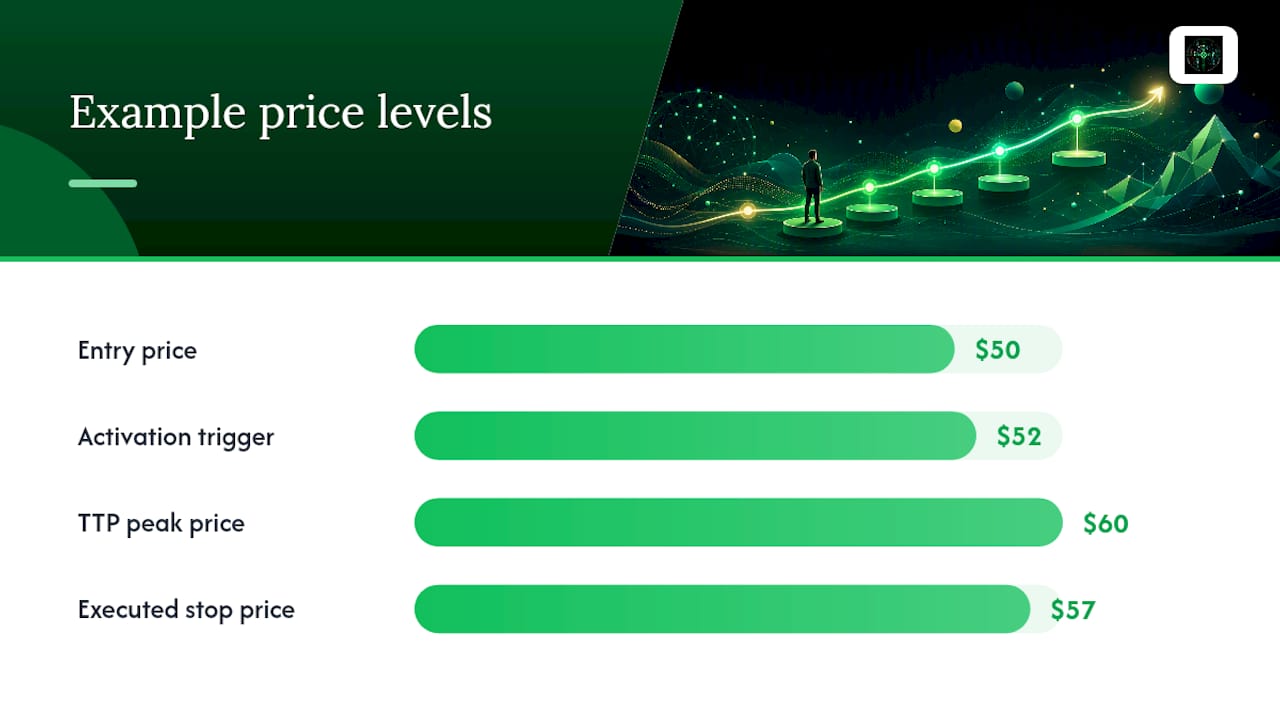
Visualizing the mechanics helps. Imagine price climbing from $50 to $60 after your activation trigger at $52. The TTP price follows to $60. Price then drops to $57. If your callback is $3, the stop executes at $57. Price never dropped below $57 before that reversal, so the order fills there, not at $50 where you entered.
Trailing take profit vs. trailing stop-loss: which one fits your exit?
These two order types are frequently confused because both trail price. The functional difference is in what they protect against and when they execute.
A trailing stop-loss is designed to limit downside. It activates immediately when placed (or at a defined trigger), sits below the current price for a long trade, and converts to a market order when price falls by the callback amount. It does not wait for a profit target to be reached first.
A trailing take profit, by contrast, stays pending until price reaches the activation level. Only after that trigger does it begin trailing. The sell executes when price reverses by the callback distance from the peak TTP price. The TTP is a profit-capture tool; the trailing stop-loss is a loss-limitation tool.
| Feature | Trailing Take Profit | Trailing Stop-Loss |
|---|---|---|
| Primary purpose | Capture extended gains | Limit downside loss |
| Activation | After price hits trigger level | Immediate or at trigger |
| Execution direction | Sells when price reverses from peak | Sells when price drops by callback |
| Funds reserved | Not until trailing stop fires | Depends on broker/exchange |
| Best use case | Trending markets, extended moves | Volatile markets, loss protection |
Use a TTP alone when you want to ride a trend and exit only after a confirmed reversal. Use a trailing stop-loss alone when your primary concern is capping losses on an open position. Use both together when you want a floor on losses and a dynamic ceiling on gains: the trailing stop-loss protects the downside while the TTP handles the profit exit.
How to set a trailing take profit: parameters and worked examples
Four parameters define every TTP order. Getting them right before you go live is the difference between a clean exit and a premature one.
Activation price: The price at which the TTP transitions from pending to active. Set this above your entry for a long trade. Bitsgap's documentation describes the activation step as the first configuration decision, because the TTP does nothing until this level is reached.
Trailing distance: The callback amount (price or percentage) that determines how far price must reverse from its peak before the order executes.
Trailing step: The minimum increment by which the TTP price updates as the market moves. A smaller step tracks price more closely; a larger step reduces update frequency and can smooth out minor fluctuations.
Quantity: The size of the position the TTP covers. In multi-target setups, this is the remaining quantity after earlier fixed TPs have been filled.
Step-by-step for a long trade
- Enter a long position at $100.
- Set activation price at $105 (5% above entry).
- Set trailing distance at 3% (callback rate).
- Set trailing step at 0.5%.
- Price rises to $105: TTP activates.
- Price continues to $112: TTP price = $112; stop price = $112 × (1 − 0.03) = $108.64.
- Price rises further to $118: TTP price = $118; stop price = $118 × 0.97 = $114.46.
- Price reverses to $114.46: order executes at $114.46.
Numeric progression table
For a short trade, the logic inverts: the TTP price can only move downward as price falls, and the stop executes when price rises by the callback amount from the TTP price trough.
Pro Tip: Align your trailing distance with the instrument's Average True Range on your trading timeframe. A distance of 1.5× to 2× ATR gives the trade room to breathe while still capturing the bulk of the move.
QuantifiedStrategies confirms that choosing the right trailing distance is the single most critical decision in TTP setup, and that a trail set too tight will prematurely close profitable trades.
What brokers and exchanges actually support, and common workarounds
Native TTP support varies significantly across platforms. Exchanges that offer it natively (such as those using smart order systems) handle activation, trailing, and execution server-side, which means the order persists even if your connection drops. Platforms without native support require workarounds.
Because funds are not reserved during the pending phase, another order or withdrawal can consume the balance before the TTP executes, causing a fill failure.
Common workarounds when native TTP is unavailable:
- Conditional OCO (One-Cancels-the-Other) orders: Set a limit sell at a fixed TP and a stop-loss below entry. Manually adjust the stop upward as price rises. This is manual trailing and requires active monitoring.
- Server-side bots: Automated trading bots can poll price data and submit market or limit orders when trailing conditions are met. The bot must maintain state (current peak price, callback distance, activation status) across restarts.
- Third-party automation platforms: Services that connect to exchange APIs and offer TTP logic as a configurable module, executing orders via the exchange's standard order types.
Test any workaround for minimum order size compliance and API rate limits before using it on a full-sized position. Some platforms impose activation time windows or restrict editing a trailing order once it has become active.
How to combine a trailing take profit with other exit rules
Layered exit strategies tend to outperform single-exit approaches in trending markets because they capture guaranteed partial gains while preserving exposure for larger moves.
A practical pattern used by active traders:
- Sell 30% of the position at the first fixed TP (e.g., +5% from entry).
- Sell another 30% at a second fixed TP (e.g., +10% from entry).
- Apply a TTP with a 3% callback to the remaining 40%, activating at the second TP level.
This structure locks in gains on the majority of the position while the TTP handles the tail end. If price reverses immediately after the second TP, the TTP exits close to that level, and the overall trade is still profitable.
Pairing a TTP with a protective stop-loss on the full position adds another layer. The stop-loss sits below entry (or at breakeven after the first TP fills) and closes the entire remaining position if price collapses before the TTP activates. This prevents a scenario where price never reaches the activation level and then falls sharply.
Conservative scaling does the opposite: larger early TPs, smaller TTP allocation, lower variance in outcomes.
Risks, slippage, and common mistakes when using trailing take profits
"A trailing take profit that is set too tight does not protect profits — it simply converts a winning trade into a smaller one, often exiting just before the real move begins." This is the core tension in TTP design: the tighter the trail, the more certain the exit, but the less of the trend you actually capture.
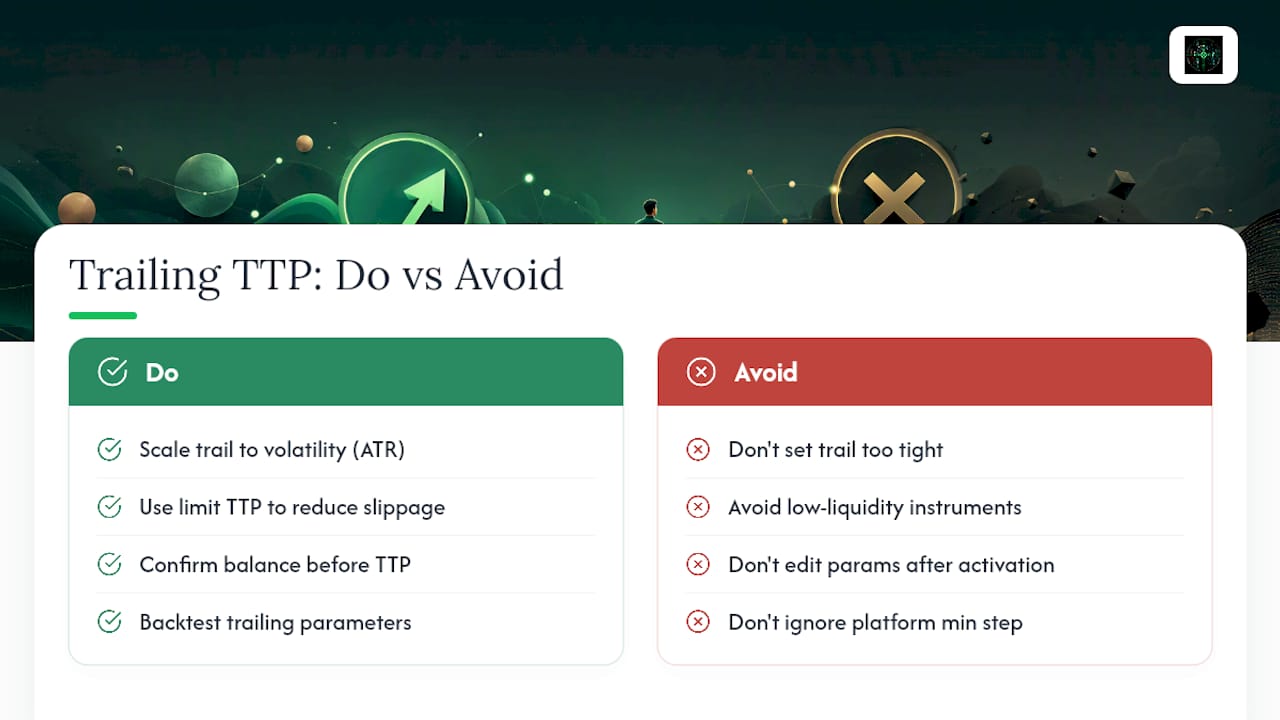
Whipsaw and premature exit are the most common failure modes. Volatile instruments with wide intraday ranges will trigger a tight callback repeatedly, exiting positions during normal price fluctuation rather than genuine reversals. The ATR-based approach addresses this by scaling the trailing distance to recent volatility, reducing the probability of a noise-driven exit.
Slippage and liquidity gaps affect execution quality, particularly in crypto markets during high-volume events. A TTP that converts to a market order during a fast move may fill several percentage points below the stop price. Limit-order variants reduce slippage risk but introduce the possibility of a missed fill if price moves through the limit too quickly.
Insufficient available balance is a platform-specific risk. Because the TTP stays pending and funds are not reserved, a separate order or withdrawal can deplete the account before the trailing stop executes. The result is a canceled or partially filled TTP at the worst possible moment.
Operator errors include editing trailing parameters after activation (which some platforms handle unpredictably), setting a trailing distance below the platform's minimum step, and applying TTP to instruments with low liquidity where the bid-ask spread alone can trigger the callback. QuantifiedStrategies also notes, in its analysis of profit targets generally, that rigid exit rules can cut large winners short — a caution that applies equally to TTP when the callback is set without reference to the instrument's actual volatility profile.
Practical checklist before you go live with a trailing take profit
Before activating a TTP on a live position, work through each of these points:
- Confirm the trailing distance is at least 1.5× the instrument's ATR on your trading timeframe.
- Verify your available balance covers the full position size, accounting for any other open orders that could consume funds before the TTP executes.
- Test the order type in a paper trading environment or with a minimum position size to confirm activation behavior, trailing step updates, and fill execution on your specific platform.
- Document the platform's behavior when you edit a TTP after activation. Some systems reset the trailing peak; others reject the edit entirely.
- Avoid adjusting trailing parameters mid-trade unless the platform explicitly supports it and you have tested the outcome.
- Set a protective stop-loss below entry (or at breakeven) as a fallback in case the TTP activation price is never reached.
How trailing take profits behave with automated trading systems
Bots introduce a layer of operational complexity that manual traders do not face. A TTP integrated into an automated strategy must track state across the full order lifecycle: pending, active (trailing), and executed. If the bot restarts mid-trail, it must recover the current peak TTP price and callback distance from the exchange API or a persistent log, not recalculate from scratch.
Race conditions are a real concern. If a bot submits a TTP and simultaneously manages other orders on the same balance, the fund-reservation gap (funds not reserved until the trailing stop fires) can cause the TTP to fail at execution. The bot must include a balance check before any order submission that could reduce available funds while a TTP is active.
cTrader community discussions document a related pattern: bots that pause trading after reaching daily or weekly profit targets. When a TTP is active at the time a profit-target pause triggers, the bot must decide whether to cancel the TTP, let it run, or hold it in a suspended state. Failing to handle this edge case can result in the TTP executing after the pause period ends, at a price far from the original trailing peak.
The Dynamic Take Profit Stop Loss indicator on TradingView illustrates how adaptive TP logic can be encoded: the efficiency engine adjusts the TP distance based on recent price efficiency, which a bot can replicate by recalculating ATR and efficiency multipliers on each bar close.
Pro Tip: Log every state transition (pending → active → executed or canceled) with a timestamp and the price at each event. This log is the only reliable way to audit whether your TTP logic is performing as designed across different market conditions.
An operational checklist for bot-based TTP usage:
- Persist the current TTP peak price and callback distance to a database or file on every update.
- Include a balance check before any order that could reduce available funds while a TTP is active.
- Handle minimum order size failures explicitly: if the remaining quantity falls below the platform minimum, cancel the TTP and log the event.
- Test the bot's behavior when the daily profit-target pause triggers while a TTP is in progress.
- Simulate API disconnection mid-trail and confirm the bot recovers state correctly on reconnect.
The case for TTP in trending crypto markets, and when to skip it
The trailing take profit is most defensible in markets with sustained directional momentum, where price tends to make new highs before reversing. Crypto trending phases, particularly in Solana-based tokens during high-volume periods, fit this profile. In those conditions, a fixed take profit consistently leaves gains on the table, while a TTP with a well-calibrated callback captures a larger portion of the move.
The argument against TTP is equally clear in choppy, range-bound conditions. When price oscillates within a narrow band, the activation trigger fires, the TTP activates, and the first minor reversal executes the order near the activation level, producing a negligible gain. A fixed TP placed at the range high would have performed better. Low-liquidity altcoins during news events present a similar problem: the spread alone can trigger the callback, and slippage on the market order wipes out the gain the TTP was designed to protect.
The practical conclusion is that TTP is a conditional tool, not a default exit strategy. It earns its place when the instrument has demonstrated trending behavior on the relevant timeframe, when liquidity is sufficient to support clean execution, and when the trailing distance has been calibrated to actual volatility rather than a round number chosen for convenience.
Sources
The following sources informed this guide and are worth consulting directly for platform-specific implementation details:
- Smart Orders: Trailing Take Profit | Altrady
- Trailing Take Profit | Bitsgap
- How to Set Up Trailing Orders / Trailing Take-Profit | Gate Help Center
- Trailing Take-Profit Order
- Dynamic Take Profit Stop Loss
This article is general information, not a substitute for advice from a qualified financial advisor. Consult a qualified financial professional about your own circumstances before acting on anything here.