

Start a focused crypto trading journal now: capture the minimum fields, pick a capture method that matches your trade volume, and run a 30-minute weekly review. Investopedia, tradejournal.ai, and LedgerMind all converge on the same conclusion, that traders who track decisions, not just profit and loss, improve faster and validate strategies with data instead of guesswork.
Three steps to take today:
- Choose a capture method: manual notes, a CSV spreadsheet, or auto-sync, based on your weekly trade count.
- Record 5 to 8 core fields per trade: symbol, entry, exit, size, risk, and a one-line reason for the trade.
- Block 30 minutes this Sunday for your first weekly review.
Key Takeaways
Consistent trade journaling, matched to your trading volume and reviewed on a fixed weekly cadence, is what turns raw crypto trade history into a measurable, improvable edge.
| Point | Details |
|---|---|
| Match method to volume | Use manual notes under 10 trades/week, CSV between 10 and 40, and auto-sync above 40. |
| Track funding separately | Perpetual funding can represent 10 to 20% of gross P&L over months, so isolate it from fees. |
| Review on a fixed schedule | Run a 30-minute weekly review and a 2-hour monthly deep dive for statistical confidence. |
| Compute expectancy per setup | Wait for enough trades per setup before trusting the expectancy number. |
| Consider Snipethem for meme-coin copy trading | Its real-time trader replication and 24-hour access windows suit high-volume Pump.fun traders. |
Table of Contents
- Why Keep a Crypto Trading Journal?
- What Features Should a Crypto Trading Journal Have?
- How Do I Set Up a Crypto Trading Journal?
- How Often Should You Review Your Trading Journal?
- How Do You Choose the Right Crypto Journal Platform?
- How Do You Validate a Strategy Using Expectancy?
- Does Journaling Help With Crypto Tax Filing?
- Why Automation Beats Manual Tracking for Active Traders
- A Copy-Trading Platform Built for Fast-Moving Meme Coins
- Frequently Asked Questions
- Sources
Why Keep a Crypto Trading Journal?
A trading journal is the highest-leverage habit available to a crypto trader, according to Tradejournal. It records the mechanics of a trade alongside the reasoning behind it, which turns scattered results into a pattern you can actually study.
The benefits compound over weeks, not days:
- Strategy visibility: you see which setups actually make money instead of relying on memory.
- Habit formation: consistent logging builds the discipline that separates repeatable edge from luck.
- Emotional control: writing down the "why" exposes impulsive entries before they become a pattern.
- Tax readiness: a clean trade log speeds up crypto tax filing later, since every entry and exit is already timestamped.
Traders who journal consistently tend to see measurable improvement within one to three months, according to DayTradingToolkit's guide to trading journals.
Pro Tip: Don't design the perfect journal on day one. Start with a small set of fields you can fill in quickly per trade, then expand once the habit sticks after four to six weeks.
What Features Should a Crypto Trading Journal Have?
Not every spreadsheet or app qualifies as a real crypto trading log. At minimum, insist on these capabilities before you commit to a tool:
- Core capture fields: symbol, entry/exit price, position size, initial risk in R, funding paid or received, fill source (maker or taker), contract type, and a one-sentence post-trade note.
- Automation and exchange integrations: read-only API sync for centralized exchanges plus wallet-address import for decentralized trades.
- Analytics that go beyond raw P&L: win rate, average win/loss, expectancy, and MAE/MFE (maximum adverse and favorable excursion).
- Replay or backtest functionality so you can review execution quality, not just outcomes.
- Tagging and filters by session, setup type, and contract type (spot versus perpetual).
- Security basics: read-only API keys only, plus CSV export for local backup.
Perpetual funding deserves special attention. Funding payments can represent 10 to 20% of gross P&L over several months in active perp trading, which means a journal that lumps funding in with trading fees will quietly hide whether your strategy actually works.
How Do I Set Up a Crypto Trading Journal?
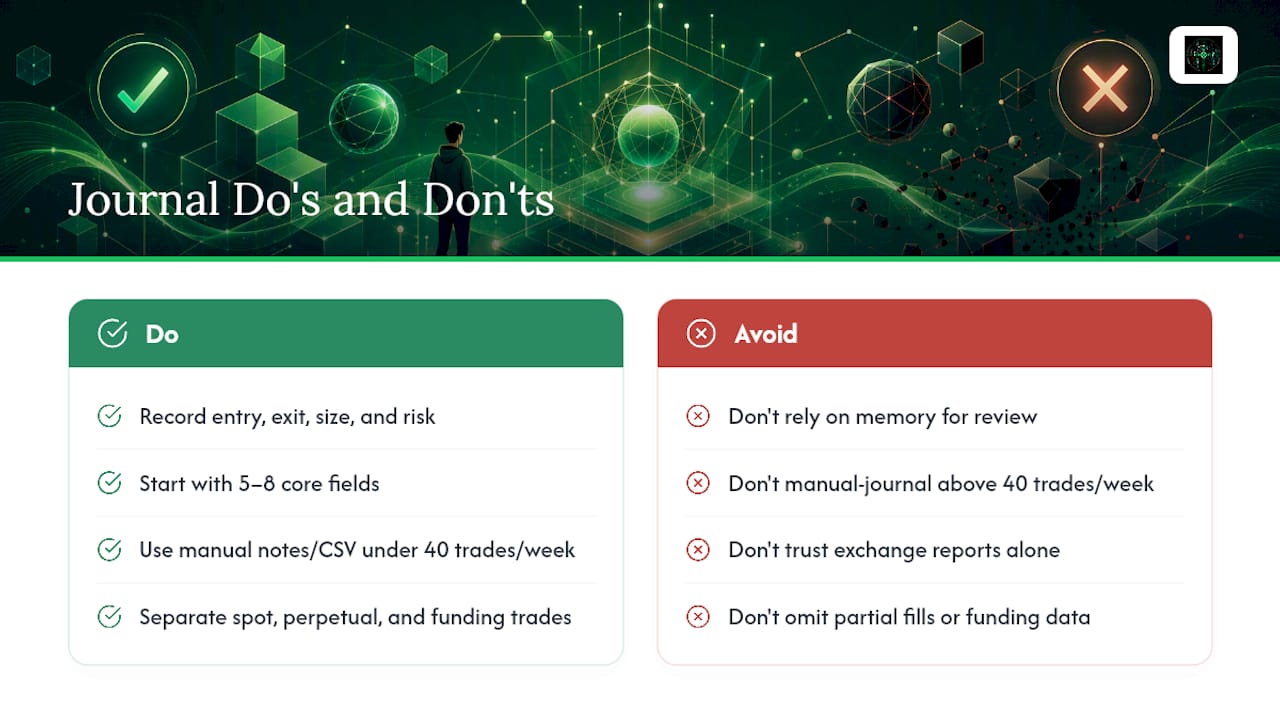
Match your capture method to trade volume first. Fewer than 10 trades a week, manual notes work fine. Between 10 and 40, a CSV with weekly reconciliation keeps pace. Above 40 trades a week, auto-sync through a read-only API or wallet-address import becomes necessary just to preserve data integrity across partial fills.
Follow this sequence:
- Pick your capture method based on the volume thresholds above.
- Set your minimum fields and build a simple pre-trade and post-trade template.
- Connect exchanges and wallets using read-only keys, never trade-enabled ones, and tag every entry as spot or perp.
- Establish your review rhythm: a quick daily check, a 30-minute Sunday review, and a two-hour monthly deep dive.
Pro Tip: Automate everything you can sync automatically, but never automate the one-sentence note explaining why you took the trade. That single line preserves the decision context that raw numbers can't capture.
How Often Should You Review Your Trading Journal?
Weekly reviews catch problems early; monthly reviews reveal whether your edge is real. Each cadence looks at different things.
Your Sunday review should cover rule-adherence rate, your best and worst setups from the week, funding drag, time-of-day performance, and an honest execution grade. The 30-minute weekly review is the highest-ROI cadence for active traders, balancing enough sample size with fast turnaround.
Monthly, dig into expectancy by setup, maximum drawdown, and profit factor. You generally need 30 to 50 trades before a setup's pattern becomes statistically meaningful, and 50 to 100 for strong confidence.
| Review Type | Frequency | What to Check |
|---|---|---|
| Daily check | Every trading day | Quick scan for open positions and funding accrual |
| Weekly review | 30 minutes, Sunday | Rule adherence, best/worst setups, funding drag |
| Monthly deep dive | 2 hours, monthly | Expectancy by setup, drawdown, profit factor |
| Statistical confidence | After 30–50 trades | Pattern reliability per setup |
One field deserves its own line item: "Followed plan? Yes/No." After 50 trades, compare P&L between compliant and non-compliant trades to see exactly what rule-breaking costs you in dollar terms.
How Do You Choose the Right Crypto Journal Platform?
Run every candidate platform through this checklist before committing:
- Automation and exchange coverage: does it support your exchanges and wallets natively?
- Funding and partial-fill handling: does it separate funding from fees and consolidate partial fills correctly?
- Analytics depth: can it compute expectancy and MAE/MFE, not just win rate?
- Replay or backtest capability: can you rewind and study execution quality?
- Security: does it require only read-only API keys?
- Data export: can you pull a clean CSV backup at any time?
- Price fit: does the free tier or paid plan match your actual trade volume?
Spreadsheets work well under 40 trades a week and cost nothing beyond your time. Dedicated apps add analytics and replay features once volume or complexity outgrows manual tracking. Auto-sync platforms make sense once reconciliation itself becomes a weekly chore.
Before committing to any vendor, run a one-week test: import a CSV of recent trades or connect a read-only key, then run a full Sunday review against that sample.
How Do You Validate a Strategy Using Expectancy?
Expectancy tells you, in dollar terms, what each trade in a strategy is worth on average. The formula, laid out clearly by Investopedia's guide to trading journals, is:
Expectancy = (Win Rate × Average Win) − (Loss Rate × Average Loss)
Expectancy comes out to (0.40 × $150) − (0.60 × $75), or $60 minus $45, for a positive expectancy of $15 per trade. That number confirms the strategy has a real edge even though it loses more often than it wins.
Pro Tip: Calculate expectancy per setup, not just across your whole account. A single strong setup can mask a weak one when you only look at the blended number, so wait until you have 30 to 50 trades in a given setup before trusting the result.
Does Journaling Help With Crypto Tax Filing?
A well-kept crypto trading log doubles as the backbone of your tax records. Every entry already contains the timestamp, asset, size, and price data that tax software and accountants need to calculate gains and losses, so you're not scrambling through exchange exports at filing time.

The overlap matters most for active traders juggling multiple exchanges and wallets. If your journal already separates spot trades from perpetual contracts and tracks funding payments as a distinct line item, that same structure maps directly onto how many jurisdictions require crypto gains to be categorized. Funding payments, staking rewards, and trading fees often get treated differently under local tax rules, so a journal that already isolates these categories saves significant reconciliation work later.
Exchange-native tax reports frequently miss transfers between wallets or fail to capture cost basis correctly when assets move across platforms. A trading journal that logs every transaction independently of the exchange gives you a second source of truth to check against, which catches errors before they turn into filing mistakes.
This is one of the strongest arguments for auto-sync tools over manual spreadsheets. When a platform pulls trade history directly from an exchange's API or a wallet address, it captures the exact fill prices and fees the tax authority will eventually want to see, rather than relying on a trader's memory of what happened weeks earlier. Consult a tax professional in your jurisdiction for how to categorize specific transaction types, since rules vary considerably by country and by whether you're trading as an individual or a business entity.
Why Automation Beats Manual Tracking for Active Traders
Automated, integration-first journaling wins for high-frequency traders because manual entry breaks down exactly when you need data the most. Discretionary traders still benefit from a human layer: the "why" behind a trade matters as much as the numbers themselves.
*— dang.
A Copy-Trading Platform Built for Fast-Moving Meme Coins
If your trading volume comes from sniping meme coins on Pump.fun rather than swing trades on a centralized exchange, the journaling criteria above point toward a platform built for that specific speed. Snipethem fits several of the checklist items directly:
- Automation and real-time replication: the platform mirrors a top trader's moves as they happen, with a 0.3-second response time that matters when meme coins move in seconds, not minutes.
- Trader analytics and rankings: you can review a trader's win rate and history before paying for access, which functions like a pre-trade due diligence step.
- Copy-trading access sized for high-volume traders: 24-hour access windows let you test a trader's strategy without a long-term commitment.
Treat any copy-trading purchase the way you'd treat a new data feed: verify what you're getting before you scale up. A practical test is to buy a 24-hour access window from the Top Pump.fun Traders to Copy page, log every replicated trade in your own journal, and run your standard Sunday review against that trader's actual history. If the numbers hold up against your expectancy calculations, you have a repeatable resource. If they don't, you've lost 24 hours, not your account.
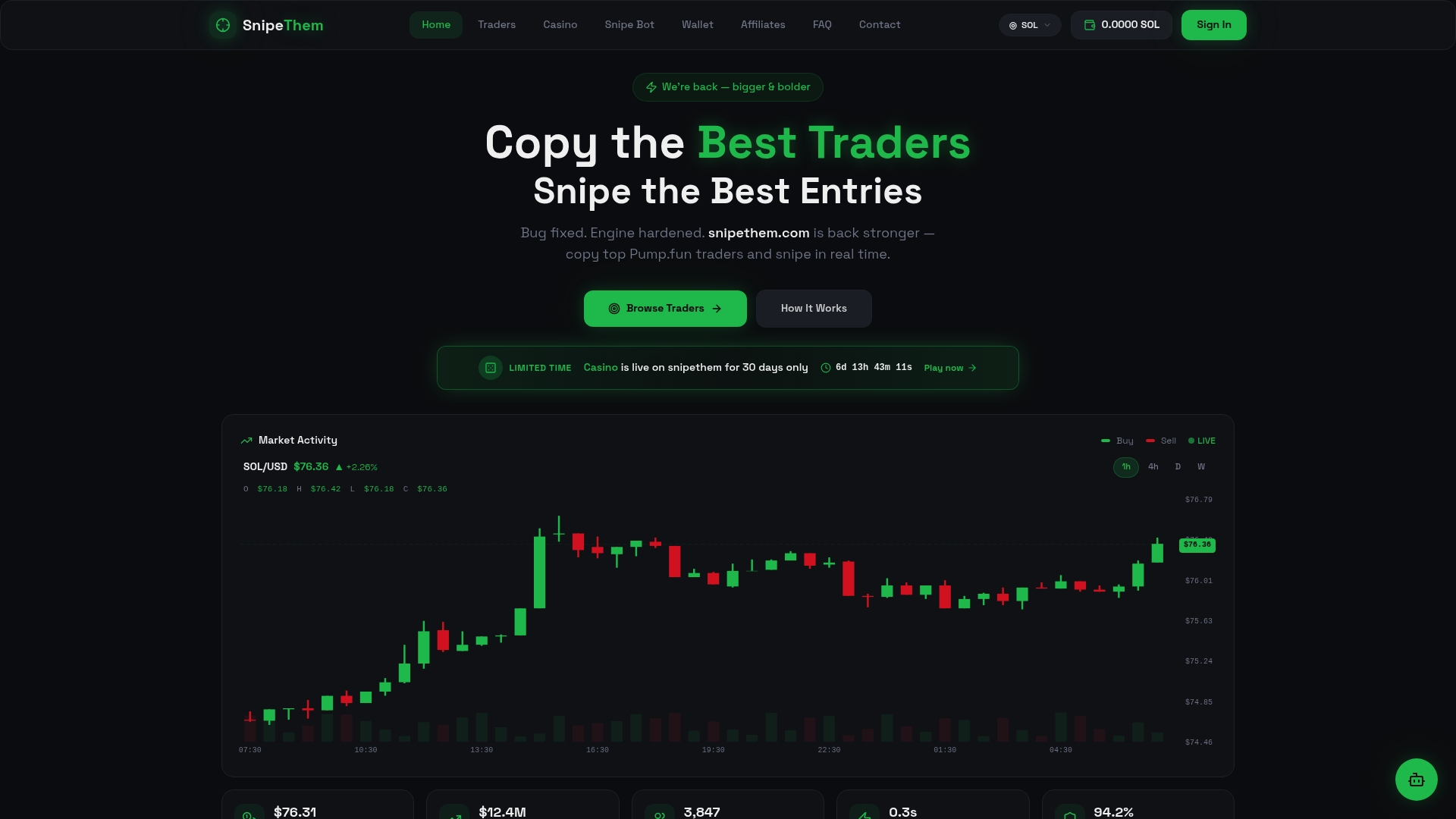
Explore the full platform at Snipethem to see how real-time trader replication pairs with the journaling habits covered in this guide.
Frequently Asked Questions
What is trade journaling in crypto trading?
Trade journaling crypto means recording every trade's mechanics (entry, exit, size, risk) along with the reasoning behind it, so you can review patterns and validate strategies with data instead of memory.
How many fields should a beginner track per trade?
Start with 5 to 8 core fields, such as symbol, entry, exit, position size, risk, and a one-sentence note on why you took the trade. Add more fields once the habit is consistent after four to six weeks.
Do I need an automated crypto trading journal?
Below 40 trades a week, manual notes or a CSV work fine. Above that volume, auto-sync through a read-only API or wallet-address import becomes necessary to keep partial fills and funding data accurate.
How does journaling help with crypto taxes?
A journal that already separates spot trades, perpetual contracts, and funding payments gives you a ready-made record for tax filing, and it also catches discrepancies that exchange-native reports sometimes miss.
What is expectancy and why does it matter?
Expectancy is the average dollar result per trade, calculated as (win rate × average win) minus (loss rate × average loss). A positive expectancy confirms a strategy has real edge, even if it loses more often than it wins.
Sources
- Why you need a Forex trading journal (Investopedia)
- The Trading Journal: Your Most Powerful Tool for Improvement | DayTradingToolkit