
Yes, Telegram sniping can be made significantly safer, though never risk-free. The single most important rule is to treat every bot-connected wallet as disposable: fund it only with what you can afford to lose, keep it separate from your main holdings, and layer on verification, revocation, and 2FA habits around it. The rest of this guide breaks down exactly how.
TL;DR:
- Always create a separate, low-funded wallet for sniping and revoke all permissions after each trading session to minimize potential exploit damage.
- Verify bot authenticity through official channels, avoid sharing seed phrases, and run initial trades at minimal sizes to detect suspicious behavior early.
- Enable Telegram two-factor authentication, update to official app versions, and regularly review active sessions to safeguard your accounts.
- Use manual checks combined with automated scans to evaluate token contracts and set pre-arranged take-profit and stop-loss levels to avoid emotional mistakes during volatile trades.
- Avoid publicly sharing wallet addresses to prevent targeted scams or front-running, and participate in trading groups cautiously by only through verified links and avoiding sensitive details.
Table of Contents
- What Does Telegram Sniping Safety Actually Require?
- How Do You Set Up an Isolated Wallet and Manage Approvals?
- How Can You Vet a Telegram Sniper Bot Before Trusting It?
- What Bot Settings Actually Reduce Your Risk?
- How Do You Lock Down Your Device and Account?
- What Should You Do If You Suspect a Compromise?
- How Snipethem Builds Safety Into Its Platform
- Why Publicly Sharing Your Wallet Address Is Riskier Than It Looks
- How to Interact Safely in Telegram Sniping Communities
- How to Report a Suspicious Bot or Group Admin
- A Realistic Take on Speed Versus Safety
- Try Snipethem's Safety-First Setup With a Small Trial
- Where to Verify the Details Yourself
- Sources
What Does Telegram Sniping Safety Actually Require?
Telegram sniping safety comes down to five habits working together, not any single tool or setting. A dedicated wallet limits exposure. Verifying the bot's authenticity before connecting funds prevents phishing losses. Pre-set take-profit and stop-loss levels remove emotion from fast-moving trades. Revoking token approvals after sessions closes off a common drain vector. Two-factor authentication on Telegram and your exchange accounts locks down the account layer that everything else depends on.
None of these steps eliminates the underlying risk of a rug pull or a compromised smart contract. What they do is shrink the blast radius when something does go wrong, which is the realistic goal for anyone running sniper bots on volatile new tokens.
Here is the priority order to work through before you connect a single dollar of real funds:
- Create a dedicated trading wallet. Never link a wallet holding your primary savings to a sniper bot. Fund it with a small trial amount, no more than you would spend testing any new piece of financial software.
- Verify the bot's authenticity. Confirm the username against the project's official website and pinned channel messages, not a link sent to you in a direct message.
- Enable Telegram two-factor authentication and secure your device. Telegram's SRP-based two-factor authentication system adds a password layer beyond your phone number, and it takes two minutes to set up.
- Update to current, official Telegram clients. MTProto's security guidelines explicitly note that client-side checks against replay and tampering attacks only work when you are running an official, up-to-date build.
- Pre-configure take-profit and stop-loss levels inside the bot before trading, rather than planning to exit manually. Manually managing exits during a rapid price swing is one of the most common ways traders give back gains.
- Revoke approvals and rotate keys after each session. Tools like Revoke.cash or a chain explorer let you see and cancel any lingering permissions a bot's smart contract still holds over your wallet.
Skipping step one is the mistake that turns a bad trade into a wallet-draining event. Skipping step six is what turns a one-time bot exploit into a recurring one, because old approvals stay live long after you have stopped using the bot.
Pro Tip: Set a calendar reminder to check your approvals weekly, not just after a bad trade. Dormant approvals from bots you forgot about are a bigger risk than the one you are actively watching.
How Do You Set Up an Isolated Wallet and Manage Approvals?
Generate a brand-new wallet specifically for sniping instead of importing the seed phrase from your main holdings wallet. This single decision does more for your safety than any bot setting, because it caps your maximum possible loss at whatever you choose to fund that wallet with.

A workable funding split looks like this: keep your sniping wallet stocked with only what you plan to actively trade this week, run your test trades with micro amounts first, and move any profits out to cold storage as soon as they clear, rather than letting gains accumulate in a hot wallet connected to a bot. Security researchers who track Solana-based Telegram trading bots consistently point to this pattern of isolation and limited funding as the baseline that separates careful traders from the ones who lose everything to a single exploit.
Checking and managing approvals differs slightly by chain:
- On EVM chains (Ethereum, Base, Arbitrum), open Etherscan or a chain-specific explorer, search your wallet address, and review the "Token Approvals" section, or use Revoke.cash directly for a cleaner interface.
- On Solana, Solscan shows active program authorizations tied to your wallet; revoke or limit anything you no longer recognize.
- Set spending caps where the interface allows it, rather than granting unlimited approval to a bot's contract, even if unlimited is the default suggestion.
Guides that cover top Telegram sniping bots generally recommend running this revocation check after every active session, not just when something feels wrong.
Hardware wallets like a Ledger or Trezor matter for storage, not for sniping itself. Once profits leave your hot wallet, a hardware device is the right place to park them long-term. But hardware wallets introduce a signing delay that makes them impractical as the live, connected wallet for a bot executing trades in fractions of a second. Use them as your vault, not your trading terminal.
One insight worth sitting with: every millisecond of latency a centralized bot server saves you by executing faster comes with a corresponding increase in exposure if that server itself gets compromised. Speed and isolation pull in opposite directions, and the wallet-splitting habit above is how you buy back some of the isolation you lose by using a fast, centralized bot in the first place.
How Can You Vet a Telegram Sniper Bot Before Trusting It?
Confirm the bot's official username directly from the project's website and its pinned channel post, then bookmark it. Never trust a username sent to you cold in a DM, even if the sender claims to be an admin or support staff. Cloned bots with nearly identical names to popular tools are one of the most common traps in Telegram trading groups, and the fake often shows up in search results right alongside the real one.
Watch for these red flags before you connect any wallet:
- Any request for your seed phrase or private key, ever. No legitimate bot needs it.
- Unusual or escalating fee requests that were not part of the original terms.
- No visible update history or changelog, suggesting an abandoned or unmaintained project.
- Sudden admin changes in the group, especially right before a coordinated push toward a "new official link."
- Pressure to act immediately, framed as a limited-time opportunity.
Beyond the red-flag check, look for signals of real transparency. Bots with open-source code, third-party audits, or listings in independent directories give you something concrete to verify instead of just trusting the group's word for it. A rundown of sniping bots and their safety profiles is a useful cross-reference before committing funds, and bots with a large, consistent, long-running user base are generally a safer bet than ones that appeared last week with an aggressive marketing push.
Compromise happens even to established bots, not just new scams. Community incident reports show that attackers have drained bot wallets after breaching the bot's backend infrastructure, which is exactly why vetting reduces risk without ever eliminating it.
Pro Tip: Run your first three trades through any new bot at the smallest size the interface allows, and watch the transaction pattern closely. A bot that behaves oddly with $10 will behave the same way with $1,000, just with worse consequences.
What Bot Settings Actually Reduce Your Risk?
Anti-rug and honeypot checks built into most sniper bots scan for red flags like locked liquidity, ownership renouncement, and suspicious transfer restrictions in a token's contract. They catch a meaningful share of obvious scams, but they are pattern-matching tools, not guarantees. Combine any automated check with a manual look at the contract yourself whenever you have the time, especially for a token you plan to size up on.
Pre-committing your take-profit and stop-loss levels before a trade executes is the setting that does the most to protect your discipline. Research on Telegram bot trading risk points to manual exit management during volatile launches as one of the biggest sources of avoidable loss. Once a token is pumping or dumping in real time, your judgment is compromised by adrenaline, not improved by it.
MEV protection is the other lever worth understanding. When a bot broadcasts your transaction to the public mempool, other bots can see it and jump ahead of you, a practice known as front-running. Options to mitigate this include:
- Private RPC endpoints, which route your transaction away from the public mempool entirely.
- Bundling or private mempool submission, similar in spirit to Flashbots on Ethereum, which shields the transaction until it lands.
- Priority fee tuning, paying slightly more to reduce the window where your trade sits exposed.
Industry roundups on Solana sniper bot performance consistently flag private RPC routing as a core differentiator between bots built for serious use and ones that leave you exposed to faster competitors. Solana's sub-second finality changes this calculation compared with EVM chains, where blocks take longer and front-running windows are wider.
Slippage and gas settings involve a real tradeoff between speed and price certainty. Here is a conservative starting point for high-risk snipes:
| Setting | Conservative default | What it protects against |
|---|---|---|
| Slippage tolerance | 5 to 10% | Failed transactions on volatile new tokens |
| Priority fee | Moderate to high | Losing the execution race to faster bots |
| Take-profit | Pre-set, tiered | Emotional decision-making mid-trade |
| Stop-loss | Pre-set, tight | Holding a losing position too long |
Tighter slippage settings will fail more often on brand-new tokens with thin liquidity. Wider settings execute more reliably but expose you to worse fill prices. Start conservative and adjust only after you understand how a specific bot behaves.
How Do You Lock Down Your Device and Account?
Set a Telegram two-factor authentication password and a recovery email as your first move, using the SRP-based system Telegram builds into its account settings. This single step blocks the majority of casual account takeover attempts, since a stolen SIM or phone number alone is no longer enough to get in.
From there, a short list of habits keeps your setup tight:
- Review your active sessions in Telegram's settings periodically, and terminate anything you do not recognize or no longer use.
- Run only official Telegram clients, and update them whenever a new build is available, since MTProto's security model depends on current client-side checks to catch tampering.
- Never click a link from an unknown sender promising early access to a token or bot, and never paste your seed phrase anywhere, including into a bot's chat window under any pretext.
- Use a password manager for exchange and wallet-related logins instead of reusing passwords across platforms.
- Keep your phone and computer's operating system current, since outdated software is where most malware gains its foothold.
Set a recurring reminder, monthly is reasonable, to change sensitive passwords, revoke sessions you no longer recognize, and run an anti-malware scan on any device you use for trading.
Pro Tip: If you ever see a login session from a city or device you don't recognize, treat it as an active breach, not a curiosity. Terminate it immediately and change your password before doing anything else.
Telegram's cloud chats use client-server encryption, while secret chats add end-to-end encryption with additional key management. Knowing which mode you are in matters if you are ever discussing sensitive wallet details, though the better habit is simply never discussing seed phrases or private keys in any chat, encrypted or not.
What Should You Do If You Suspect a Compromise?
Speed matters more than anything else once you suspect a bot or wallet has been compromised. Work through these steps in order:
- Stop funding the wallet immediately and halt any active bot sessions tied to it.
- Revoke every approval tied to that wallet using a revocation tool or chain explorer, even ones that seem unrelated to the suspected issue.
- Move any remaining funds to a fresh, uncompromised wallet, ideally cold storage, as soon as you can execute the transaction safely.
- Document everything: transaction hashes, timestamps, screenshots of bot messages, and the wallet addresses involved. This record matters if you contact an exchange or file a report later.
- Contact the exchange if funds moved through one, and flag the transaction to chain analytics services that track stolen funds across wallets.
- Consider your jurisdiction's reporting options. Law enforcement processes for crypto theft vary widely by country, and some have dedicated cybercrime units while others have none.
Once the immediate bleeding stops, harden your setup: rotate every key associated with the incident, tighten your funding limits going forward, and revisit your bot vetting process with a more skeptical eye than before.
How Snipethem Builds Safety Into Its Platform
Snipethem was built around the same isolation principle this guide recommends: keep trading activity separate from your core holdings, and never ask users to hand over a main wallet's seed phrase to chase speed. The platform's copy-trading bot lets you replicate a top Pump.fun trader's real-time activity with a reported 0.3-second response time and a 94.2% success rate on tracked trades, figures that matter less as marketing claims and more because faster, more consistent execution reduces the window where MEV bots or slippage can work against you.
Preset take-profit and stop-loss configuration is built into the trading flow rather than left to manual management mid-trade, which lines up directly with the exit-discipline advice covered earlier. Snipethem's 24-hour trial access also gives you a low-cost way to test a trader's strategy with a small allocation before committing more capital, which is exactly the small-amount testing habit this guide recommends applying to any bot.
No platform, Snipethem included, can fully eliminate smart-contract risk or the possibility of a rug pull on an underlying token. What a well-built platform can do is remove some of the manual failure points, like forgotten exits or slow execution, that turn ordinary risk into avoidable loss.
Why Publicly Sharing Your Wallet Address Is Riskier Than It Looks
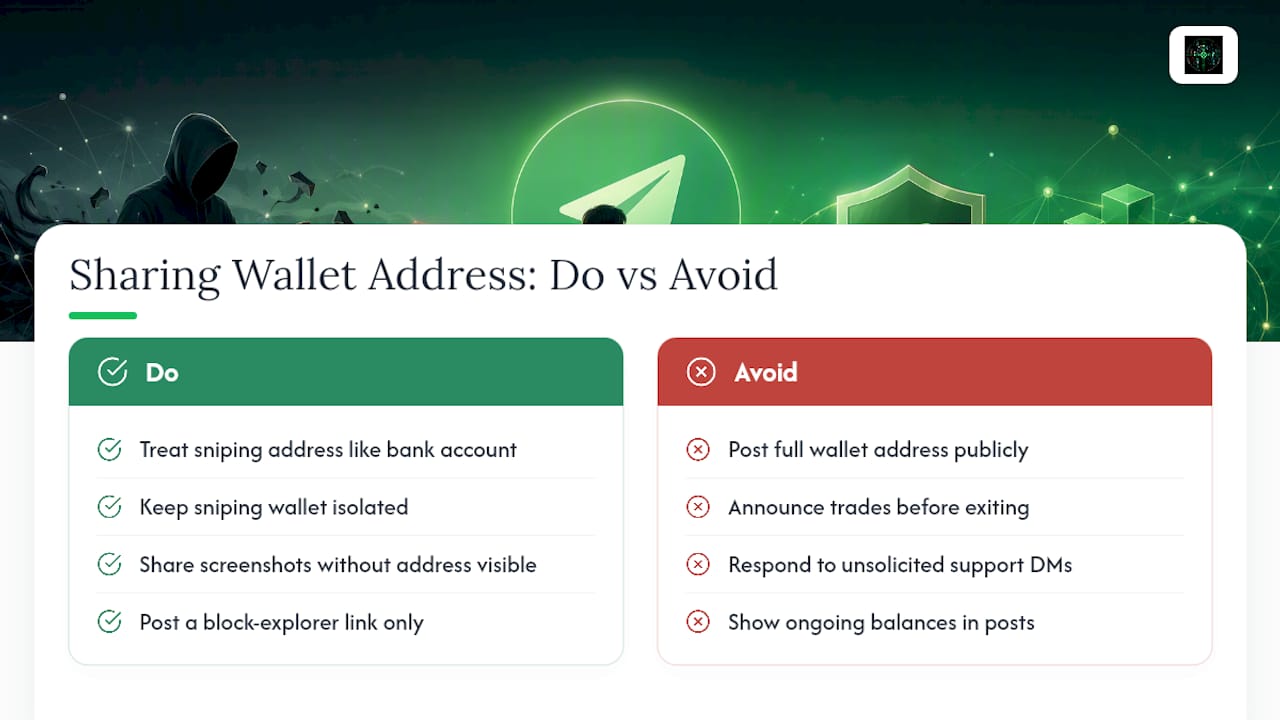
Your wallet address is not sensitive the way a password is, but treating it as harmless to broadcast anywhere is a mistake plenty of traders make. Posting your address in a public Telegram group to "prove" a trade or flex a gain hands anyone watching a complete, permanent view of your transaction history, balances, and trading patterns.
That visibility creates two concrete problems. First, it makes you a target for social engineering: scammers monitor active wallets in trading groups and follow up with fake "support" messages tailored to the specific tokens you hold, which makes the pitch far more convincing than a generic phishing attempt. Second, it lets other traders front-run your known positions if they can predict your next move, particularly if you have a pattern of announcing trades before you actually exit them.
The safer habit is to treat your sniping wallet's address the way you would treat a bank account number: fine to use, not something to volunteer publicly. If you want to share a win in a community channel, screenshot the trade result without the full address visible, or use a block explorer link that shows the transaction without drawing attention to the wallet's ongoing balance.
This matters more for a dedicated sniping wallet than it might seem, precisely because you are already isolating it from your main holdings. Undermining that isolation by broadcasting the address defeats part of the purpose of separating the wallets in the first place.
How to Interact Safely in Telegram Sniping Communities
Trading communities on Telegram are genuinely useful for spotting trends and learning from more experienced traders, but the same openness that makes them valuable also makes them a favorite hunting ground for scammers. A few habits keep participation useful without exposing you unnecessarily.
Join groups through links posted on a project's verified website or official social accounts, not through invite links forwarded by strangers or found in unrelated chats. Once inside, resist the urge to respond to unsolicited direct messages from anyone claiming to be an admin, even if their profile picture and name match the real one closely. Admin impersonation is common enough that legitimate admins in well-run groups will often post reminders that they never DM first.
Avoid discussing specific holdings or wallet balances in open chat, for the same reasons covered above. If you want feedback on a trade, describe the setup generically rather than posting the transaction with your wallet visible.
Treat any group that pressures fast action, whether that is a "limited time" bot access or a token about to "moon", with more suspicion, not less. Legitimate opportunities rarely depend on you deciding within sixty seconds. Finally, keep your notification settings tuned so you are not tempted to act on every ping in a fast-moving group at 3 a.m. when your judgment is at its weakest.
How to Report a Suspicious Bot or Group Admin
Reporting suspicious activity does more good than it might seem, both for you and for the next trader who almost falls for the same setup. Telegram has a built-in reporting function accessible from any chat or bot profile: tap the three-dot menu, select "Report," and choose the category that fits, whether that is scam, spam, or fake account impersonation.
For bots specifically, report through the bot's profile rather than just the group it operates in, since Telegram treats bot accounts separately from regular users for moderation purposes. Include screenshots if you have them, particularly of any request for a seed phrase or unusual fee, since concrete evidence speeds up review far more than a description alone.
If the incident involves stolen funds, pair your Telegram report with a note to the relevant chain's analytics trackers and, if funds passed through an exchange, a report to that exchange's security or compliance team using the transaction hash as your reference point. Community-run directories and forums that track known scam bots are also worth a post, since your report can flag the bot before someone else connects a wallet to it.
Do not engage directly with a suspected scam admin beyond what is needed to gather evidence. Confronting them rarely produces useful information and sometimes prompts them to delete messages you might have wanted to document first.
A Realistic Take on Speed Versus Safety
Every guide, including this one, will tell you to slow down and verify. Most traders will not fully do it, because the entire appeal of sniping is speed, and safety habits feel like friction working against the reason you showed up.
The honest middle ground is choosing your friction deliberately. Spend the two minutes setting up 2FA and a dedicated wallet once, and you never have to think about it again. Skip it, and you are gambling that this particular bot, this particular week, will not be the one that goes wrong.
A common pattern among traders who get burned: they test a bot carefully with a small amount, it works, and three weeks later they are running larger sizes through the same wallet without ever revisiting the approvals sitting on it. The fix is not more caution. It is a recurring habit that does not depend on remembering to be careful.
— dang
Try Snipethem's Safety-First Setup With a Small Trial
Snipethem gives you a faster route to the copy-trading discipline this article recommends than piecing together separate bots, wallet trackers, and manual exit rules on your own. The platform's wallet flows are built around the same separation principle covered throughout this guide, and preset take-profit and stop-loss configuration is part of the trade setup rather than something you have to remember to add later.
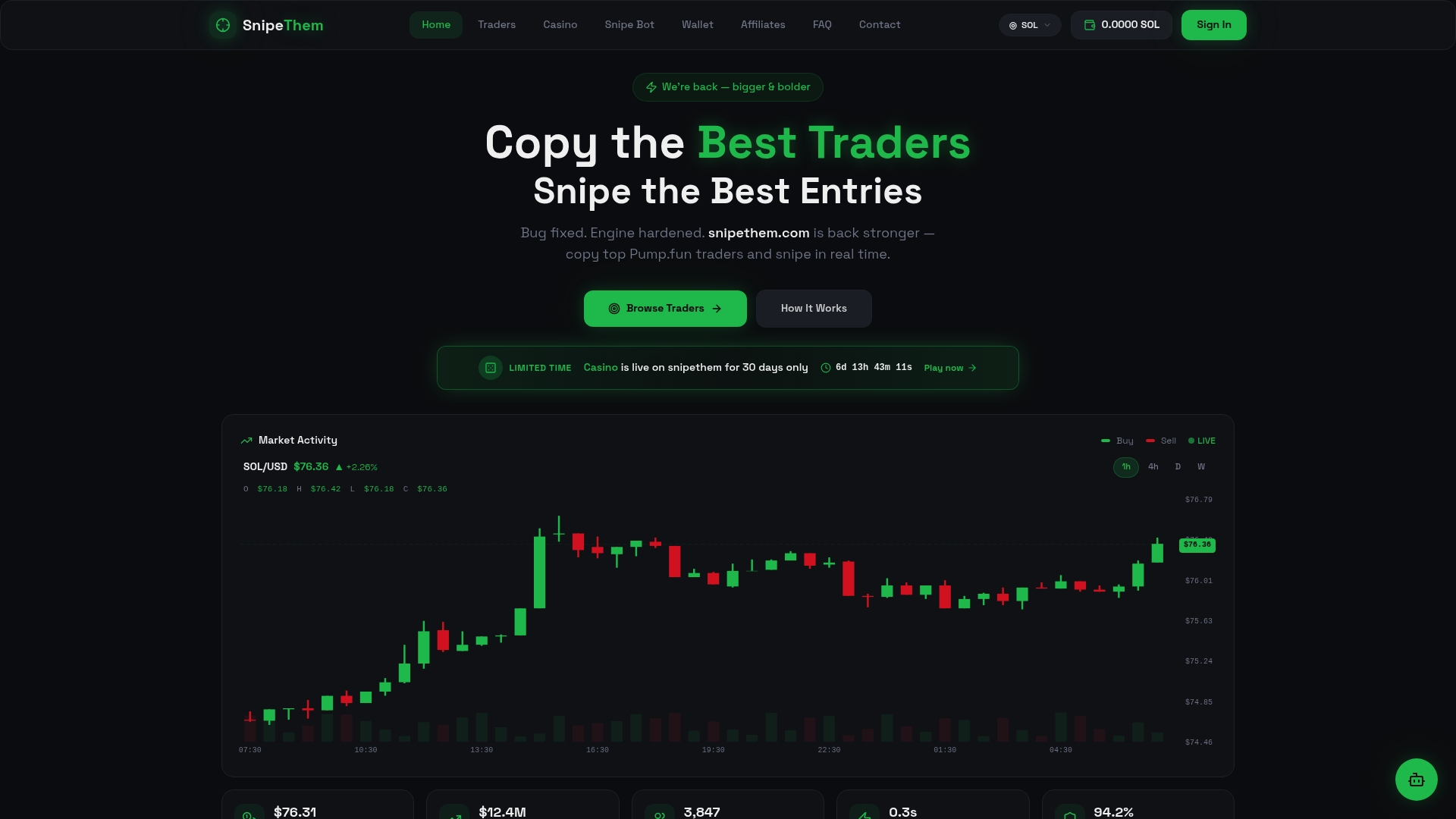
Start by browsing top Pump.fun traders and testing a 24-hour access window with a small allocation, the same small-amount approach recommended earlier in this guide. If you want the mechanics of setup and preset configuration first, the bot's product page walks through how wallet isolation and exit rules work before you commit any funds.
No platform removes smart-contract risk or rug-pull exposure entirely, Snipethem included, and treating any tool as a guarantee rather than a risk-reduction layer is its own kind of mistake. Visit Snipethem to see current trader rankings and decide whether a small trial fits your approach.
Where to Verify the Details Yourself
A short set of primary sources covers most of what this guide draws on, and each is worth bookmarking alongside your trading setup.
Telegram's own documentation on end-to-end encryption and MTProto explains exactly how secret chats and cloud chats differ, while the MTProto security guidelines lay out what an up-to-date client actually protects against. For account-level protection, Telegram's SRP-based 2FA documentation walks through setup in detail.
On the practical side, CoinGecko's overview of Solana Telegram trading bots and Hacken's research on Telegram bot trading risks are solid starting points for understanding what goes wrong and why. For revocation and contract inspection, Revoke.cash and chain explorers like Etherscan and Solscan remain the standard tools for checking exactly what permissions your wallet has granted.
Sources
- MTProto security guidelines — Telegram Core
- Solana Telegram trading bots — CoinGecko Learn
- Telegram crypto trading bots risks — Hacken
- Top Solana sniper bots in 2026 — RPC Fast