
Mirror trading replicates a predefined algorithmic strategy, while copy trading proportionally copies a live human trader's actual trades. Mirror trading suits people who want rule-based discipline with minimal decision-making, while copy trading fits those who want visibility into a real trader's reasoning and are willing to accept the risk that comes with following a person rather than a system.
TL;DR:
- Mirror trading relies on automated, rules-based strategies with limited control over individual trades, making it suitable for rule followers.
- Copy trading involves copying real traders' live decisions proportionally, offering transparency and manual override options.
- Regulation warns that the label "copy" or "mirror" trading often overlaps, with automated services sometimes requiring portfolio management authorization.
- Success depends more on verified track records, drawdown levels, and risk management than on win rates or marketing claims.
- Testing both methods through small allocations or trial windows helps assess execution speed, strategy behavior, and trader transparency before larger investments.
Table of Contents
- Mirror Trading vs Copy Trading: How Mirror Trading Works
- Mirror Trading vs Copy Trading: How Copy Trading Works
- Comparing Mirror Trading and Copy Trading Side by Side
- The Real Tradeoffs: Benefits and Drawbacks of Each Method
- How to Choose: A Practical Checklist for Picking Your Approach
- What Regulators Say About Imitative Trading
- How Snipethem Applies These Concepts in Practice
- Setting Up Your First Mirror or Copy Allocation
- Why Snipethem Fits Traders Weighing Mirror vs Copy Approaches
- Why the "Which One Is Better" Question Misses the Point
- Sources
Mirror Trading vs Copy Trading: How Mirror Trading Works
Mirror trading, at its core, connects a trading account to a predefined algorithmic strategy rather than to a person. You select a system, often built from technical indicators, backtested rules, or an Expert Advisor running on a platform like MetaTrader, and your account automatically replicates every signal that strategy generates. There's no trader on the other end making judgment calls in real time. There's a rules engine doing it.
This matters because it changes what you can actually control. You typically set allocation size, maximum drawdown limits, and risk parameters per strategy. What you usually can't do is override a single trade mid-execution, since the whole point of the model is removing that kind of emotional interference.
Platforms vetting these strategies before listing them usually look at:
- Historical track record length, ideally spanning multiple market cycles, not just a bull run
- Maximum drawdown during the worst stretch, not just average returns
- Whether backtested results have been validated against live, forward-tested performance
- Position sizing rules and how the strategy behaves during volatility spikes
The Wikipedia entry on mirror trading notes the practice actually predates modern copy trading and helped shape how automated strategy replication eventually evolved into the follower based models common today.
Mirror Trading vs Copy Trading: How Copy Trading Works
Copy trading flips the model. Instead of following an algorithm, you select one or more human traders and your account proportionally mirrors their live trades based on your allocated capital. When they open a position, yours opens too, scaled to your account size. When they close it, yours closes.
The proportional part matters. If a lead trader risks 2% of their account on a trade, your account risks roughly 2% of yours, not a fixed dollar amount. That scaling is what separates copy trading from simply following someone's public trade alerts.
You generally retain more granular control than with mirror trading:
- Manual override to close a copied position early if you disagree with it
- Per trader allocation limits, so no single trader dominates your portfolio
- Stop losses set at the copier level, independent of what the lead trader uses
- Full visibility into entry and exit prices, trade history, and sometimes direct commentary from the trader you're following
SmartAsset's breakdown of copy trading points out that success here depends heavily on trader selection and platform quality, not just the mechanics. Common evaluation metrics include win rate, drawdown history, number of active copiers, and trading frequency, though none of these alone tells the full story.
Comparing Mirror Trading and Copy Trading Side by Side
The cleanest way to separate these two methods is to stop thinking about labels and start thinking about who or what is actually making the decisions. That's the distinction regulators themselves lean on. IOSCO's 2024 consultation groups both under the umbrella term "online imitative trading strategies" and explicitly warns that the names get used interchangeably, even when the underlying execution models differ.
Here's how the two approaches stack up across the factors that actually affect your money:
- Automation level. Mirror trading is system driven end to end. Copy trading is person driven, meaning a human's decisions, including bad ones, flow directly into your account.
- Control and intervention. Mirror trading lets you switch strategies or adjust risk parameters, but not touch individual trades. Copy trading usually lets you close a specific position manually.
- Transparency and explainability. Mirror trading can be a black box. You see the strategy's rules, but not necessarily why each signal fired. Copy trading shows you exactly what a real person did and often why.
- Risk management ownership. With mirror trading, responsibility sits mostly with the strategy's backtested risk logic. With copy trading, it sits with the lead trader's judgment plus whatever guardrails you set yourself.
- Best fit by trader type. Beginners who want to learn from watching real decisions tend to prefer copy trading. Systematic traders who already trust rules over intuition tend to prefer mirror trading.
Pro Tip: Don't judge either method by win rate alone. A trader with a 70% win rate but one catastrophic loss can wipe out months of gains, which is exactly why drawdown and Sharpe ratio matter more than headline percentages.
The overlap is real, too. OPO Finance's comparison describes mirror trading as replicating a strategy or algorithm rather than a person's exact moves, which is the sharpest technical line between the two, even when marketing copy blurs it.
The Real Tradeoffs: Benefits and Drawbacks of Each Method
Neither method is free of risk, and neither guarantees profit. That's worth stating plainly before comparing the upsides.
Mirror trading's advantages come from removing the human element:
- Discipline by design, since a backtested strategy doesn't panic sell or chase a loss
- Historical performance data you can actually stress test before committing money
- Lower emotional interference, because you're not watching a person's live decision-making and second guessing it
Its downsides come from the same source:
- Model risk, meaning a strategy that worked in past conditions can fail when markets shift
- Lower explainability, since you often can't see why a specific signal triggered
- Limited per-trade control, so a string of bad signals plays out fully before you can intervene
Copy trading's advantages lean toward transparency:
- You see a real person's entries, exits, and sometimes their stated reasoning
- Genuine educational value for newer traders trying to learn pattern recognition
- Granular allocation control across multiple traders instead of one strategy
Its downsides are just as real:
- Full dependency on one person's judgment, which can degrade during a losing streak or a life event that affects their focus
- Possible overtrading if the lead trader increases frequency to chase recovery after losses
- The persistent misperception that a high past win rate means guaranteed future profit, which SmartAsset explicitly warns against
How to Choose: A Practical Checklist for Picking Your Approach
Start with three honest questions: how much time do you want to spend monitoring positions, are you trying to learn or just trying to earn, and how much transparency do you actually need to sleep at night. Your answers point you toward one method more than the other.
Before committing capital, work through this due diligence list:
- Track record length. Anything under six months of live performance is too thin to judge.
- Maximum drawdown during the worst historical stretch, not just the best month.
- Sharpe ratio or another risk-adjusted return measure, since raw returns hide how much risk was taken to get there.
- Execution latency between the lead trade and your account's replication.
- Total fees, including platform access costs and any performance-based cuts.
- Regulatory authorization status in your jurisdiction.
Questions worth asking the platform or trader directly:
- Is your track record audited or independently verified, or is it self-reported?
- What happens to my open positions if you stop trading or the platform goes offline?
- Are you authorized to provide portfolio management services where I'm located?
For allocation, a few rules of thumb hold up well: start with a small percentage of your total capital, spread it across more than one strategy or trader rather than going all in on one, and always set a personal stop loss independent of whatever the lead trader or strategy uses. Snipethem's beginner setup guide walks through this same sequencing for anyone starting from zero.
What Regulators Say About Imitative Trading
Regulators don't treat "mirror trading" and "copy trading" as neatly separate categories, and that ambiguity is exactly where risk hides. IOSCO's 2024 consultation lumps both under "online imitative trading strategies" precisely because the terms get used interchangeably across platforms and jurisdictions, even though the execution models differ in practice.
The FCA's guidance on copy trading adds a sharper point: some services marketed as copy trading actually function as mirror trading once you look at how orders execute, and platforms that automatically execute signals into your account may fall under portfolio management rules. That classification isn't a technicality. It determines whether a provider needs specific authorization, what disclosures they owe you, and whether the service is even suitable for your risk profile.
Regulators consistently flag the same risk clusters:
- Mislabeling of services, where "copy trading" is used as a catch-all marketing term for something more automated
- Model risk in mirror strategies that haven't been stress tested across different market regimes
- Outright scams dressed up as high win rate traders with no verifiable track record
Before funding any account, check whether the platform is regulated in a jurisdiction that matters to you, and ask whether performance records are audited or purely self-reported. Those two checks alone eliminate a large share of bad actors in this space.
How Snipethem Applies These Concepts in Practice
Snipethem operates in the copy trading category, but with a mirror trading style execution layer underneath it. This is a useful real-world example of why the terminology gets muddled. Users buy 24-hour access to a specific trader's live history on Pump.fun, then configure a snipe bot that replicates that trader's strategy in real time, at a claimed 0.3-second response time.
That combination matters. The trader selection piece is pure copy trading: you're choosing a human track record, not an anonymous algorithm. The execution piece, the automated bot replicating trades the moment they happen, is closer to mirror trading's system-driven speed. Snipethem cites a reported success rate, though such platform-reported statistics should be approached cautiously by asking for underlying data, sample size, and verification whether audited or self-reported.
For deeper reading on execution mechanics, Snipethem's primer on real-time trade mirroring and its risk checklist for following a trader both cover what documents or verification you should request before committing capital to any 24-hour access window.
Setting Up Your First Mirror or Copy Allocation
Before touching a strategy or trader, complete KYC verification, fund your account, and set your baseline risk tolerance. That groundwork determines how much room you have to experiment safely.
From there, the sequence is straightforward:
- Pick one strategy or trader based on track record length and drawdown history, not just recent gains.
- Set your allocation amount, starting small relative to your total capital.
- Set a personal stop loss independent of whatever the strategy or trader uses.
- Enable monitoring alerts so you're notified of every executed trade, not just checking in manually.
Pro Tip: If a platform offers a 24-hour trial or short access window, use it as a live stress test before committing to a longer allocation. A single day rarely proves long-term skill, but it does reveal execution speed and whether the setup behaves the way it's described.
For the first two to four weeks, watch drawdown trends, how often the strategy or trader adjusts position sizing, and whether your own stop losses are actually triggering when they should.
Why Snipethem Fits Traders Weighing Mirror vs Copy Approaches
Snipethem gives you a lower cost way to test both models without committing to a long-term subscription or an all-or-nothing bet on one trader. Instead of locking into a monthly plan, you pay a one-time fee in SOL for 24-hour access to a specific top trader's history on Pump.fun, then decide whether to renew based on what you actually saw.
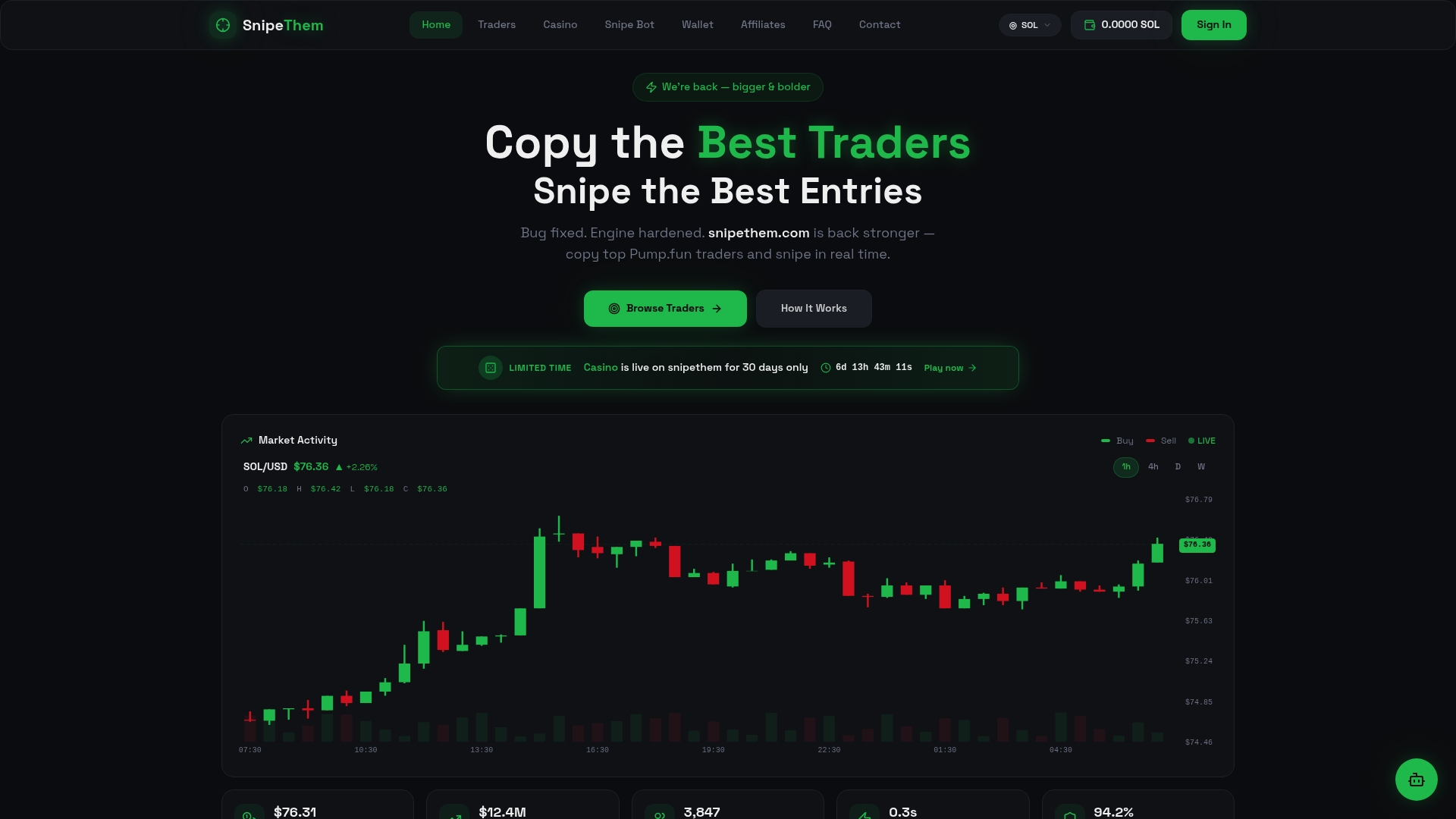
That structure suits exactly the reader working through this comparison. You get copy trading's transparency, real trader histories, rankings, and statistics, paired with mirror trading's execution speed through Snipethem's automated snipe bot, which replicates signals at a claimed 0.3-second response time. You're not choosing one model over the other. You're testing both against real market conditions before scaling up.
If you're ready to see how a top trader's live history performs before allocating real capital, browse available traders on Snipethem and start with a single 24-hour access window. It's a practical way to apply everything covered above, track record length, drawdown, execution latency, without overcommitting on day one.
Why the "Which One Is Better" Question Misses the Point
Most comparisons frame mirror trading and copy trading as a binary choice, better versus worse, safer versus riskier. That framing is lazy, and it ignores what the regulatory language actually tells us. When IOSCO groups both under "imitative trading strategies," it's making a quiet but important point: the label on the platform matters less than the execution model underneath it.
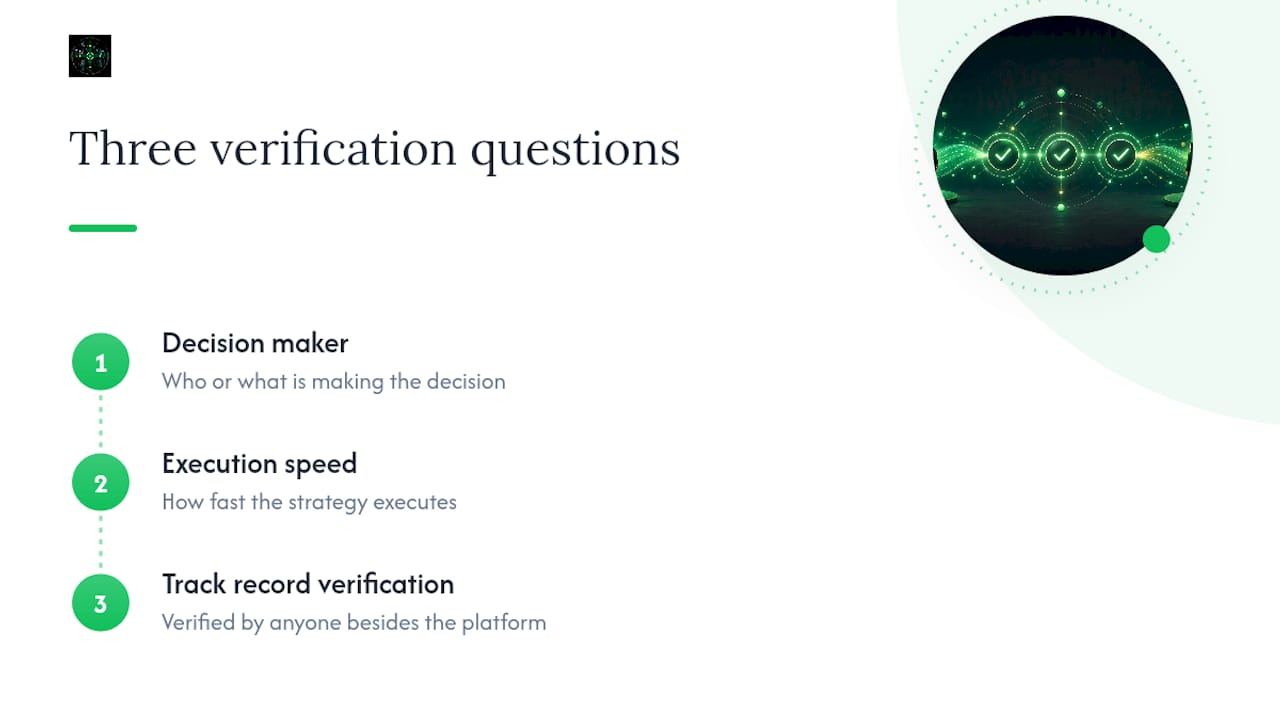
The more useful question isn't which method wins. It's whether you can actually answer three things about whatever you're using: who or what is making the decision, how fast it executes, and whether the track record behind it has been verified by anyone other than the platform selling it. A mirror strategy with an unverified backtest is just as risky as a copy trader with a cherry-picked highlight reel. Both fail the same test.
What gets underestimated most is how much the "human versus algorithm" framing obscures the real risk, which is verification, not method. A disciplined trader who's brutally transparent about losses is often a better bet than a slick algorithm running on backtested data nobody's stress tested against a real crash. And a rules-based strategy with an audited five-year track record can outperform a charismatic trader riding a hot streak that hasn't been tested by a down market yet.
If there's one habit worth taking from this entire comparison, it's this: stop asking whether something is called mirror trading or copy trading, and start asking for the drawdown numbers, the sample size, and whether anyone besides the seller has verified them.
— dang
This article is general information, not a substitute for advice from a qualified financial advisor. Consult a qualified financial professional about your own circumstances before acting on anything here.
Sources
- Online imitative trading strategies: copy trading, mirror trading, social trading — IOSCO (2024)
- Copy trading — Financial Conduct Authority (FCA)
- What is Copy Trading and Should You Do It? — SmartAsset