

Real-time trade mirroring copies a leader's executed fills into a follower's account almost instantly, typically within a fraction of a second. The system watches a trader's live orders and reproduces them in your own account, at the same price and direction, without you clicking a button.
The verdict: it works well for automation, scaling across accounts, and borrowing execution skill you haven't built yourself. It works poorly when latency lags or when the leader's losses become your losses at the same ratio, second for second. Distribution typically runs through a broker feed, a WebSocket connection, or a webhook signal, and platforms like Snipethem apply the same logic to meme-coin traders on Pump.fun rather than traditional equities or forex.
Before adopting any mirroring service, weigh these basics:
- Confirm whether fills come from a verified broker feed or a self-reported signal.
- Check the platform's stated latency and whether it's measured end-to-end.
- Look for regulatory or registration status, similar to a FINRA BrokerCheck lookup for traditional firms.
- Decide your position sizing rule before you turn mirroring on, not after.
Key Takeaways
Real-time trade mirroring works when fill detection is fast and verified, but it magnifies a leader's losses just as quickly as it captures their wins.
| Point | Details |
|---|---|
| Verify fill source | Broker-sourced fills beat self-reported signals for accuracy and fraud resistance. |
| Latency drives outcomes | Sub-second detection and execution matter most for scalping and thin-liquidity crypto trades. |
| Set sizing rules upfront | Choose match ratio, fixed size, or a multiplier before turning mirroring on, not after. |
| Test before scaling | Paper-test, then run a capped live trial, then verify audit logs before increasing size. |
| Snipethem targets meme-coin speed | The platform pairs a 0.3-second response time with trader rankings for Pump.fun-based mirroring. |
Table of Contents
- How Does Real-Time Trade Mirroring Actually Work?
- Which Trading Strategies Work Best With Live Copying?
- What Are the Advantages and Risks of Mirror Trading?
- How Do You Choose a Trader or Platform to Mirror?
- How Snipethem Applies These Standards to Meme-Coin Mirroring
- What Retail Traders Consistently Get Wrong About Mirroring
- Get Real-Time Access to Top Pump.fun Traders
- Frequently Asked Questions
- Sources
How Does Real-Time Trade Mirroring Actually Work?
Every mirroring setup follows a leader/follower model. A trader you're copying (the leader) places an order, it fills on their broker or exchange, and your account (the follower) receives a copy of that same trade. The mechanics between "leader fills" and "your position opens" are where quality separates from noise.
Here's the order lifecycle, step by step:
- The leader's order fills on their exchange or broker.
- The mirroring system detects that fill.
- The signal fans out to every subscribed follower account.
- Each follower's platform places a matching order, sized to that account's rules.
- Exit signals, including stop-loss and take-profit triggers, propagate the same way.
Fill detection happens through two main approaches. Direct broker API or WebSocket connections pull the actual executed fill straight from the source, which tends to be more accurate for genuine real-time mirroring because there's no middleman interpreting the trade. Webhook or signal-based methods instead rely on the leader's platform pushing out a message when it places an order, which introduces a small window where the signal and the actual fill can diverge, especially in fast-moving markets.
Latency comes from three separate sources: detection latency (how fast the system notices the leader's fill), network delay (how fast that signal reaches your account), and broker processing time (how fast your own order executes once it arrives). Add them together and you get total slippage exposure. Professional trade-copier services frequently advertise sub-second or low-millisecond replication as a core differentiator for execution-sensitive strategies, and for good reason: a half-second delay on a thin order book can mean a materially worse entry price.
Sizing rules matter just as much as speed. Most systems let you choose a match ratio (copy the same percentage of account size), a fixed size (always trade a set amount regardless of the leader's size), or a per-account multiplier that scales the leader's position up or down. Partial fills complicate this, since a leader's order might fill in three pieces at three prices, and your system needs to replicate that sequence rather than average it. Take-profit and stop-loss propagation follows the same logic, often supporting staged exits like a partial close at the first target, a move to breakeven, and a full close at the second target.
Pro Tip: Ask any mirroring platform whether stop-loss orders propagate as live orders or only trigger after the fact. A stop that only "fires" once your system notices the leader has already exited can leave you holding the position longer than intended.
Which Trading Strategies Work Best With Live Copying?
Not every strategy translates cleanly into copy live trades. The strategy's sensitivity to timing determines whether mirroring helps or quietly erodes your edge.
- Trend-following and breakout strategies tolerate mirroring well because entries and exits happen on larger price moves, so a fraction of a second rarely changes the outcome. These strategies need reliable fills and order types that preserve the original entry logic, but they're forgiving of minor delays.
- Scalping and short-duration strategies are the opposite case. When a trader profits from a few ticks of movement, timing copy trades within milliseconds becomes critical, and even small latency gaps can turn a winning setup into a losing one.
- Algorithmic and rule-based strategies bring a different risk: parameter stability. A system that performed well historically can fail once market conditions shift, and mirroring someone's algorithm doesn't protect you from overfitting baked into their original backtest. Verified, audited performance history matters more here than raw win rate.
- Crypto and meme-coin strategies carry challenges the traditional markets don't. Thin liquidity means a leader's fill price and your fill price can diverge sharply on the same order. Mempool reordering and MEV (miner/validator extractable value) risk mean that even a technically fast mirror can still land behind a bot that reprices the trade first. This is precisely the environment Snipethem was built around, since Pump.fun tokens often trade on liquidity pools where a one-second delay can mean a completely different entry.
What Are the Advantages and Risks of Mirror Trading?
The appeal of real time copy trading is straightforward: it automates a decision-making process you'd otherwise have to do manually, it scales across as many accounts as your capital allows, and it gives you access to execution skill you may not have developed yourself. Good platforms also generate audit logs, so you can review exactly when a trade copied and at what price, which is useful for troubleshooting and for tax records.
The risks are just as real:
- Mirrored losses. You inherit the leader's drawdowns at whatever ratio you've set, with no independent judgment applied in the moment.
- Data or leaderboard manipulation. A leaderboard built on self-reported numbers is only as trustworthy as the reporting, which is why broker-sourced fills carry more weight than screenshots.
- Latency-induced slippage. A hundred milliseconds can be the difference between a fill and a missed entry in thin crypto liquidity.
- Mismatched symbol specs. Your broker's tick size, minimum order size, or available pairs may not line up exactly with the leader's platform.
On the compliance side, confirm any platform's registered status where applicable, similar to how a FINRA firm lookup verifies a traditional broker's history and complaint record. Jurisdictional rules vary widely for crypto trading specifically, so check local regulations before committing capital. Practical mitigations include per-trade caps, manual approval gates for large trades, daily loss limits, and favoring leaders with verified, audited trade histories over self-reported win rates.
How Do You Choose a Trader or Platform to Mirror?
Turning evaluation criteria into an actual checklist keeps you from getting sold on marketing copy instead of substance.
- Verify how fills are sourced. Ask directly: are these broker-confirmed fills, or self-reported signals?
- Check latency claims. Ask for average end-to-end latency, not just "detection speed," since the two aren't the same number.
- Review trade-history depth. A trader with three winning weeks tells you less than one with months of verified, drawdown-inclusive history.
- Confirm risk-policy transparency. Does the platform disclose maximum drawdown, position sizing defaults, and stop-loss enforcement rules?
- Understand the fee model. One-time access fees, subscription costs, and performance-based cuts all change your break-even math differently.
- Look for audit logs. You should be able to see exactly when your account copied a trade and compare that timestamp against the leader's fill.
Ask any platform or trader directly: "How do you verify fills?" and "What is your average end-to-end latency?" If the answer is vague, that's information too.
A sensible onboarding sequence looks like this: paper-test the setup first, then run a capped live test with a small position size, then verify the audit logs against your own broker statement, and only then scale up gradually. This sequence catches configuration mistakes before they cost real money.
Pro Tip: Treat your first week of live mirroring like a systems check, not a profit opportunity. You're testing whether fills, sizing, and exits behave the way the platform says they will.
Red flags worth walking away from: unverifiable performance claims, opaque fee structures, no stop-loss propagation, and no per-account controls that let you cap risk independently of the leader's own sizing.
How Snipethem Applies These Standards to Meme-Coin Mirroring
Snipethem builds its platform around the same technical priorities covered above, applied specifically to Pump.fun traders on Solana. The platform advertises a 0.3-second response time and a 94.2% success rate for its snipe bot offering, positioning speed as the core differentiator in a market where liquidity can vanish in seconds.
Here's how that maps to the checklist:
- Trader access model: users purchase 24-hour access to a specific trader's history, rather than committing to an open-ended subscription.
- Snipe bot mechanics: automatic configuration lets a follower replicate a leader's real-time trading strategy without manually placing each order.
- Market analytics: live tracking of trending tokens and trader rankings gives context beyond the raw copy signal.
- Per-trade visibility: trader statistics and rankings let you evaluate a leader's track record before committing SOL to unlock their history.
Snipethem's combination of fast execution and trader-ranking transparency reflects the same principle serious mirroring platforms build around: speed only matters if it's paired with a way to verify who you're actually copying.
The platform overview shows how these pieces connect, from trader discovery through live execution.
What Retail Traders Consistently Get Wrong About Mirroring
Most guides on this topic obsess over win rate and treat latency as a footnote. That's backwards. A leader with a strong track record is worthless to you if your copy consistently lands a beat behind theirs, because in thin crypto liquidity, that beat is the difference between their entry price and yours.
The bigger blind spot is sizing. Traders fixate on which leader to follow and barely think about match ratio versus fixed sizing, yet that single setting determines whether a bad week bruises your account or breaks it. Copying someone at full match ratio without a daily loss cap is not automation. It's delegation without a safety net.
What actually deserves priority: confirm fill verification first, test latency second, and only then evaluate a leader's historical win rate. Skill you're borrowing means nothing if the pipe delivering it is slow or unverifiable. Mirroring is a tool for scaling good judgment, not a substitute for having any.
Get Real-Time Access to Top Pump.fun Traders
Snipethem gives you 24-hour access to a specific trader's history for a one-time SOL fee, instead of locking you into an open-ended subscription just to test whether a strategy fits your risk tolerance.
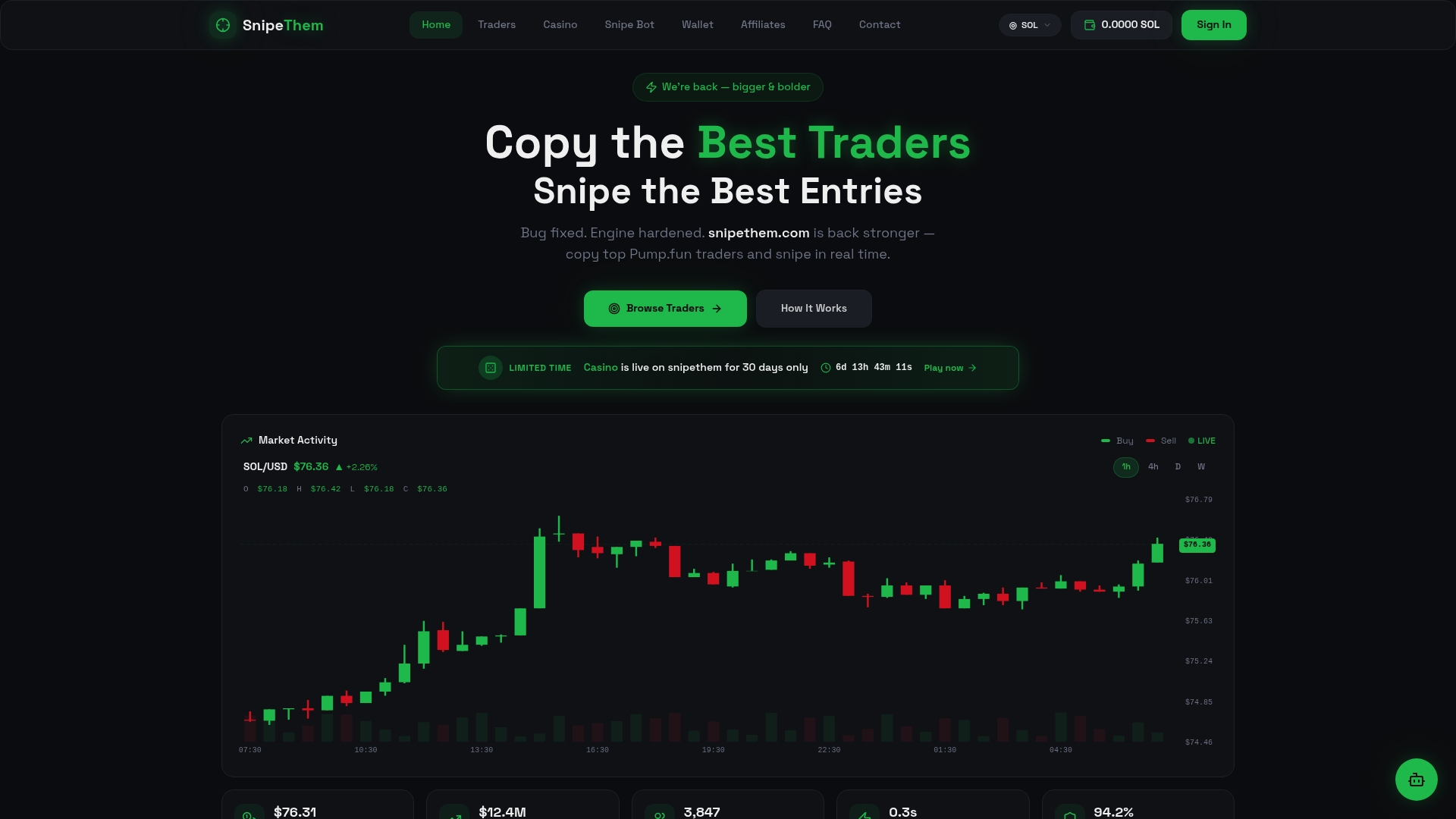
That structure matters if you've read this far: you now know to check fill verification, latency, and sizing rules before committing to any mirroring setup, and Snipethem's trader rankings page lets you review a trader's stats before you unlock their history rather than after. The platform's snipe bot applies the 0.3-second response time to Pump.fun order flow specifically, where thin liquidity punishes slow execution harder than in traditional markets. If you're ready to test a leader's track record with a capped, time-limited trial instead of an ongoing commitment, start by browsing the current top traders and pick one whose stats match the risk profile you settled on earlier.
Frequently Asked Questions
What is real-time trade mirroring? Real-time trade mirroring is an automated process that replicates a leader trader's executed fills into a follower's account as those fills happen, rather than on a delay.
How is trade mirroring different from copy trading? The terms often overlap, but "mirroring" typically implies the fastest, most direct replication method, usually via broker feeds or WebSocket connections, while broader copy trading can include signal-based or delayed methods.
Does latency really matter that much for crypto mirroring? Yes. Thin liquidity on meme-coin pairs means a fraction-of-a-second delay can produce a meaningfully worse fill price, especially during fast token launches.
Can I lose money with real-time trade mirroring? Yes. You inherit the leader's losses at whatever ratio you've configured, and slippage from latency can make your results worse than the leader's own performance.
How do I verify a trader's performance before mirroring them? Prioritize platforms that source fills directly from a broker or exchange feed rather than relying on self-reported screenshots, and review drawdown history alongside win rate.
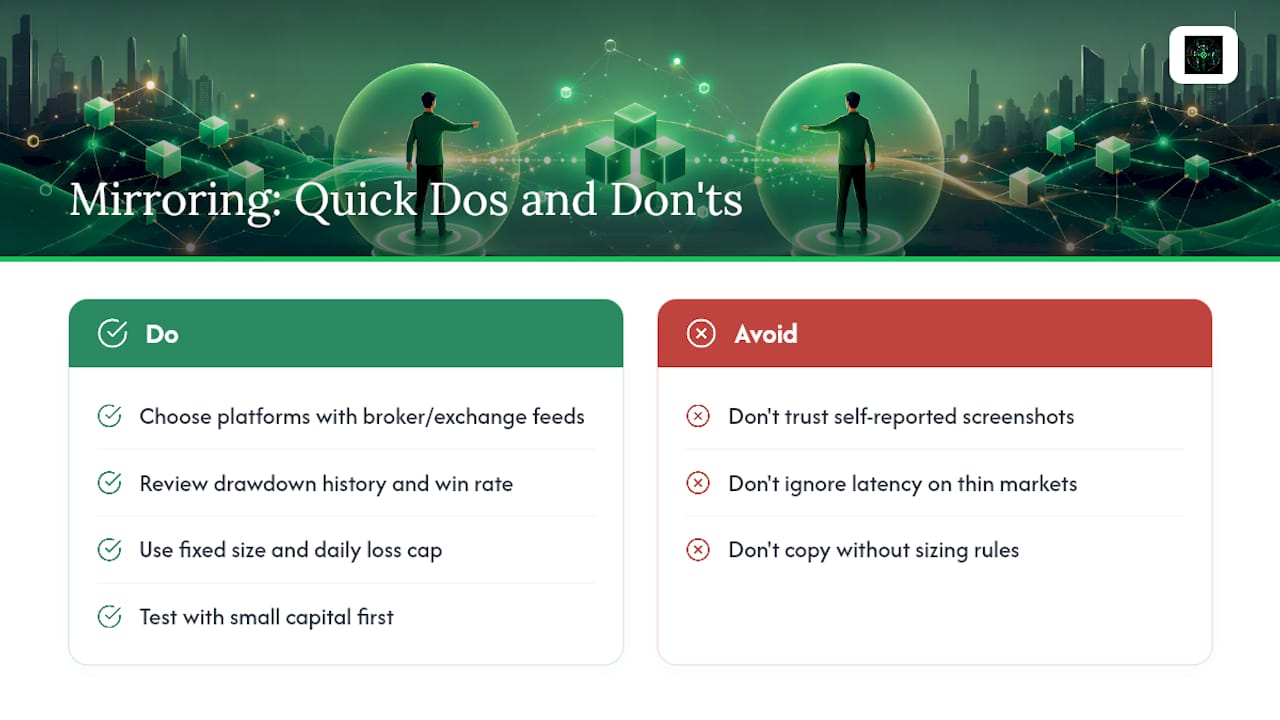
What sizing method should beginners use? A fixed size with a strict daily loss cap gives you the most predictable risk exposure while you learn how a specific leader trades.