

AMMs price trades algorithmically against a shared pool, while order books match individual buy and sell orders at whatever price both sides agree on. For small swaps in liquid pairs, AMMs usually deliver comparable or better execution with far less friction. For larger trades, order books often provide better execution. The full decision checklist follows below.
TL;DR:
- Trades above $100,000 generally perform better on order books or hybrid solutions, as AMMs with larger sizes incur significant slippage and price impact.
- Small to medium trades under $10,000 rarely see a difference between AMMs and order books, with typical slippage remaining manageable within pools like a $10 million stablecoin pool.
- Liquidity providers face impermanent loss and arbitrage risks, which grow with large, directional price moves, while MEV attacks target visible AMM trades in mempools.
- High-frequency trading favors order books due to latency advantages and discrete tick boundaries that cause unpredictable slippage spikes on AMMs.
- Hybrid trading approaches, combining order books and AMMs with smart routing, optimize costs and execution quality across different asset sizes and market conditions.
Table of Contents
- AMM vs Order Book: How Automated Market Makers Set Prices
- AMM vs Order Book: How Limit Orders and Price-Time Priority Work
- Order Book vs AMM: Side-By-Side Comparison
- Execution Quality by Trade Size: What the Numbers Actually Show
- The Real Costs: Impermanent Loss, LVR, and MEV Extraction
- Latency, Ticks, and Why Institutions Still Favor Order Books
- Hybrid Exchanges and Smart Order Routing
- Your Pre-Trade Checklist for Sizing Execution Right
- How Copy-Trading Abstracts the Execution Layer
- A Hybrid Habit Worth Building
- A Different Route: Automated Copy-Trading With Snipethem
- Sources
AMM vs Order Book: How Automated Market Makers Set Prices
An automated market maker replaces a matching engine with a formula. The original and still most common version is the constant-product invariant, expressed as x·y=k, where x and y are the reserves of two assets in a pool and k stays fixed as trades occur. Every swap shifts the ratio between the two reserves, and that shift is the price move. There's no order to match, no counterparty to find. The pool is always the counterparty.
Stable-asset pools use flatter curves tuned for assets that trade near parity, like two dollar-denominated stablecoins, which lets them offer far less slippage near the peg than a constant-product curve would. Weighted pools extend the idea to more than two assets with custom ratios, closer to an index fund than a spot market.
Concentrated liquidity, introduced by Uniswap v3, changed the capital math entirely. Instead of spreading liquidity evenly across every possible price from zero to infinity, liquidity providers pick a specific price range to fund. Capital inside that range works far harder, since it's not sitting idle at prices that will likely never trade. Uniswap v4 pushed this further with hooks that let pools customize fee logic and behavior per pair. Both designs, along with smart-contract market makers described in AMM taxonomy research, can even approximate limit-order behavior, though that adds real complexity to the underlying contracts.
Where AMMs tend to shine:
- Long-tail tokens with no natural market maker willing to quote both sides
- Stable-asset swaps where curves like Curve's are purpose-built for minimal slippage
- Permissionless listing, since anyone can seed a pool without needing exchange approval
- Passive liquidity provision for traders who want yield without active management
AMM vs Order Book: How Limit Orders and Price-Time Priority Work
An order book is a live ledger of intentions. The bid is the highest price a buyer will pay, the ask is the lowest a seller will accept, and the gap between them is the spread. Depth describes how much size sits at each price level away from that spread, and the mid-price is simply the midpoint between best bid and best ask.
Traders choose between two basic order types. A market order executes immediately against whatever depth is available, accepting the price that depth offers. A limit order sits in the book at a chosen price and waits, filling only if the market comes to it. Most venues enforce price-time priority: orders at the best price fill first, and among orders at the same price, whoever arrived first gets filled first. Advanced order types, like stop-limits or trailing stops, build on this same queue logic.
The catch for decentralized order books is throughput. Posting, canceling, and updating orders on-chain for every price tick would overwhelm most blockchains, which is why most on-chain order book designs use:
- Off-chain order relay with on-chain settlement, keeping the matching fast and the final trade trustless
- Batch auctions that clear multiple orders at a single price rather than continuous matching
- Hybrid sequencers that mimic centralized-exchange speed while settling on a base layer
The trade-off is real: full on-chain order books offer transparency but historically struggled with the latency that active market makers need. This is a large part of why order book decentralized exchanges evolved differently from AMMs in the first place.
Order Book vs AMM: Side-By-Side Comparison
The two models diverge on nearly every axis that matters for execution quality.
| Factor | AMM | Order Book |
|---|---|---|
| Liquidity source | Pooled deposits from LPs | Active bids and asks from makers |
| Price discovery | Formula reacts to trade flow | Live negotiation between buyers and sellers |
| Price control | None; you accept the curve's quote | Full; set your own limit price |
| Slippage behavior | Deterministic, worsens with pool depth ratio | Depends on book depth at each price level |
| Order types | Market swap only (or limit via added complexity) | Market, limit, stop, and other conditional types |
| Primary risk | Impermanent loss, LVR for LPs | Adverse selection, unfilled limit orders |
| Best-for size | Small to medium tickets, long-tail assets | Large or staged tickets, major pairs |
This comparative structure, echoed in Coinotag's AMM versus order book breakdown, boils down to a few practical consequences:
- AMM slippage is predictable and calculable before you trade; book slippage depends on who else showed up
- Order books reward patience through limit orders; AMMs charge you the curve's price no matter when you click
- LPs in AMMs earn fees passively but absorb pricing risk that active market makers on order books can manage in real time
Pro Tip: Don't judge a pool by its total value locked alone. Check the reserve ratio near your trade size using the pool's own interface, since a $50 million pool skewed 95/5 can offer worse effective depth than a $10 million pool split evenly.
Execution Quality by Trade Size: What the Numbers Actually Show
Trade size is the single biggest variable in this whole comparison, and the thresholds shift depending on how liquid the specific asset is.
Sub-$10,000 trades on established pairs rarely notice the difference between models. A $5,000 swap through a $10 million constant-product pool moves the price by a fraction of a percent, well within typical slippage tolerance.
$10,000 to $100,000 trades start exposing AMM curve math. Take a $2 million pool split evenly at $1 million per side.
$100,000-plus trades almost always benefit from order book execution or a hybrid approach, a threshold practitioner guides consistently point to for large-ticket sizing.
Routing tactics that consistently reduce cost:
- Split the order into smaller tranches instead of executing all at once
- Route through an aggregator that scans both pools and books for the cheapest combined path
- Set a slippage tolerance tight enough to protect you, but not so tight it causes repeated failed transactions
- Check current mempool activity before submitting, since a crowded mempool raises MEV exposure
- Compare the quoted slippage against the actual price impact after the fact to calibrate future trades
Statistic Callout: A single-sided swap around a few percent of one reserve in a constant-product pool produces notable price impact before fees, as determined by the x·y=k formula.
The Real Costs: Impermanent Loss, LVR, and MEV Extraction
Liquidity providers face a cost that never shows up on a dashboard until it's too late: impermanent loss. It happens when the price ratio between pooled assets moves after you deposit, leaving you with more of the asset that fell and less of the one that rose, compared to simply holding both. Large, one-directional price moves are what make LPing underperform a buy-and-hold strategy.

Loss-Versus-Rebalancing, or LVR, is the sharper metric for concentrated liquidity positions. It measures the gap between what an LP earns and what a perfectly rebalanced portfolio would have earned, capturing the value that arbitrageurs and fast traders extract every time the pool's price lags the broader market.
MEV compounds this. Because AMM trades sit visible in the mempool before confirming, a bot can spot a pending swap, buy ahead of it, let the swap execute at a worse price, then sell immediately after: the sandwich attack.
Practical mitigations worth adopting:
- Use private transaction relays or RPC endpoints that shield pending trades from public mempools
- Set tighter slippage tolerances on volatile or thinly traded pairs
- Concentrate LP positions in tighter ranges only when you can actively manage them
- Favor pairs and pools with audited, well-reviewed trader histories before committing size
Latency, Ticks, and Why Institutions Still Favor Order Books
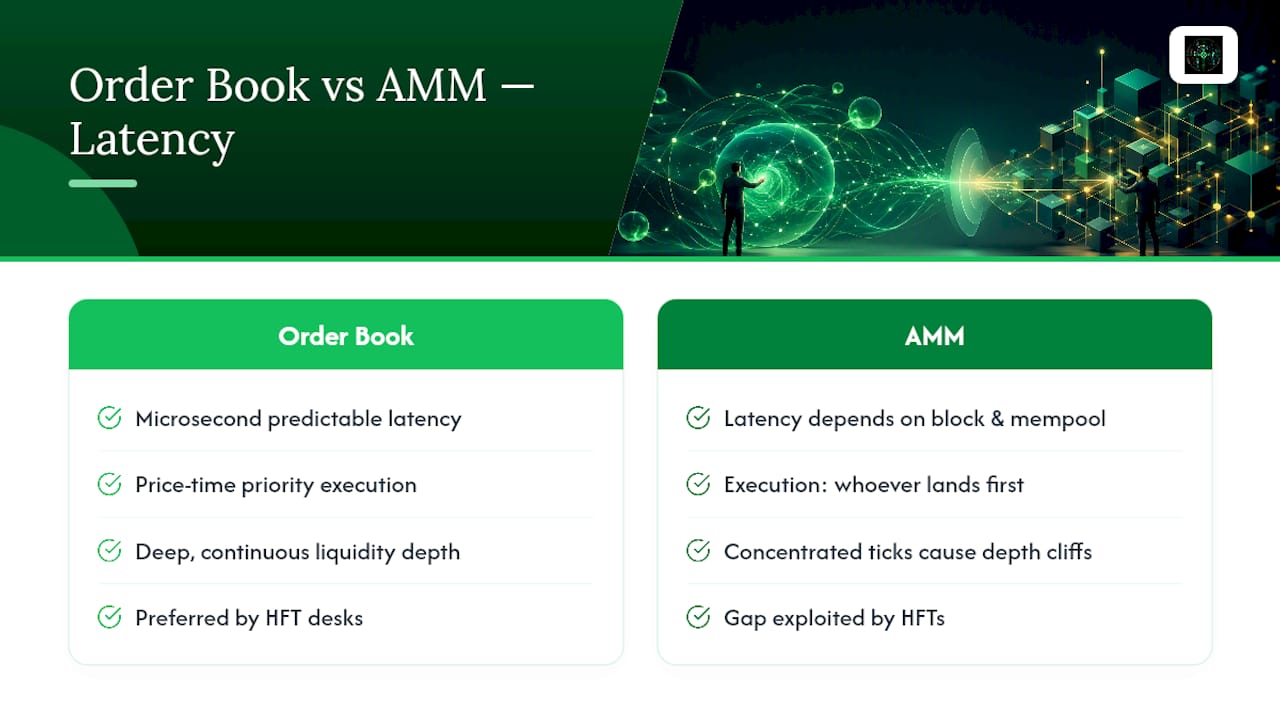
Institutional desks care about microseconds. A central limit order book with price-time priority gives a predictable execution queue; an AMM's execution depends on block time and whoever's transaction lands first in the mempool. That gap is exactly what high-frequency traders exploit.
Concentrated liquidity adds another wrinkle: discrete tick boundaries mean depth can cliff off suddenly once price crosses an underfunded range, producing slippage spikes that look nothing like a smooth curve on paper. HFT desks watch tick distribution closely for exactly this reason.
Newer AMM designs are narrowing the gap with dynamic fees and just-in-time liquidity, but for latency-sensitive strategies, deep order books remain the more mature architecture.
Hybrid Exchanges and Smart Order Routing
Most serious execution today doesn't pick one model exclusively. Hybrid venues pair an order book with an AMM pool sitting underneath as backup liquidity, so if the book is thin at your size, the pool fills the gap instantly instead of leaving you waiting.
Aggregators take this further, slicing a single order across several pools and books simultaneously to minimize blended cost, a routing behavior documented across DEX architecture comparisons.
Rules of thumb for routing:
- Favor pools for small size, illiquid tokens, or when speed matters more than a few basis points
- Favor books for large size, major pairs, or when you need a specific entry price
- Let an aggregator decide by default; override it manually only when you understand the pool's reserve depth better than the router does
Your Pre-Trade Checklist for Sizing Execution Right
Before committing meaningful size, run through this sequence:
- Measure effective depth at your exact trade size, not the pool's total value locked or the book's headline volume
- Pick your routing: split across tranches, use an aggregator, or go direct if depth is deep enough
- Set slippage tolerance deliberately and check mempool congestion before submitting
- Review the fill afterward against your quoted price to catch patterns worth adjusting next time
How Copy-Trading Abstracts the Execution Layer
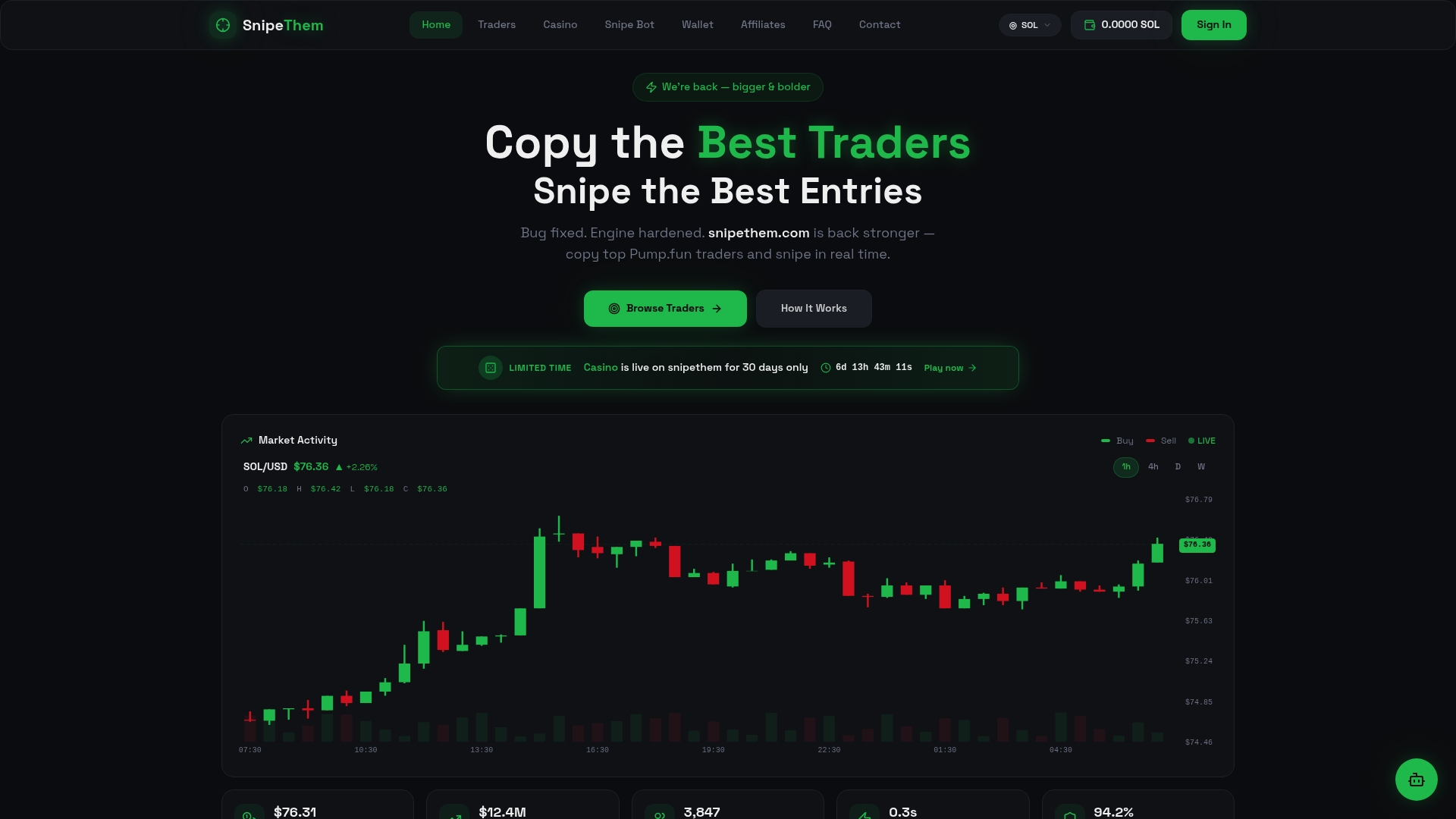
Copy-trading platforms sit on top of this entire decision framework rather than replacing it. Snipethem, built around replicating Pump.fun trader activity in real time, reports a 0.3-second response time and a 94.2% success rate, figures that matter directly to execution quality since delayed fills widen the gap between a leading trader's entry and yours.
When a followed trader executes against an AMM pool, timing determines your slippage; when they work an order book, order slicing and mirroring speed determine how closely your fill matches theirs. Fast replication narrows that gap on either venue type.
A Hybrid Habit Worth Building
The traders who consistently execute well use order books for major positions and larger trades where precise price control matters, and use AMMs for altcoin discovery, smaller entries, and passive LP yield where speed and access are prioritized. Before scaling into either, always validate with a small test order. The market will tell you more in one trade than any calculator will.
— dang
A Different Route: Automated Copy-Trading With Snipethem
Everything above assumes you're manually deciding between pools and books, sizing trades, and watching slippage yourself. That's real work, and it's exactly the overhead Snipethem was built to remove. Instead of running the checklist solo, you get instant access to the trade history of top-performing Pump.fun traders and let a snipe bot mirror their entries and exits automatically, with the platform's 0.3-second response time closing much of the gap between their fill and yours.
This is a genuinely different category from manual execution, closer to leveraging someone else's market read than replacing your own order-routing decisions. If you're newer to the approach, copy trading for beginners is a reasonable place to start before browsing the top Pump.fun traders available to copy and choosing a track record that fits your risk appetite.
Sources
- AMM taxonomy and design — arXiv
- Order book vs AMM microstructure & HFT arbitrage guide — Exmon Academy
- Order book vs Automated Market Maker — Coin Bureau