

In this context, breakout trading crypto means paying for 24-hour access to a top trader's live positions on Pump.fun, or automating that same replication through a snipe bot so your orders fire the moment theirs do. The fastest way to test the concept is to buy a single 24-hour access window or run a snipe bot in simulation mode before committing real capital. Two risks decide whether this works for you: slippage between the leader's fill and yours, and the timing and pricing exposure that securities regulators have flagged in copy trading generally.
- What it means here: paid, time-boxed copy access or bot-automated replication of a trader's Solana memecoin activity.
- First move: buy a short access window or enable bot simulation mode before risking size.
- Core risk: IOSCO's guidance on imitative trading warns that timing and pricing gaps between leader and follower are structural, not incidental.
Key Takeaways
Breakout trading crypto through paid copy access works best when execution speed, strict risk controls, and trader diversification are treated as one combined system, not three separate decisions.
| Point | Details |
|---|---|
| Define the strategy correctly | Treat it as paid, time-boxed replication of a trader's live Pump.fun activity, not passive investing. |
| Prioritize execution speed | Favor platforms using full-tx websocket feeds and multi-submit relay racing to land trades inside the first few blocks. |
| Apply follower-side controls | Set allocation caps, per-trade stop-loss and take-profit levels, and diversify across three to five traders. |
| Confirm breakouts with volume | Watch for sustained volume growth across multiple wallets, not a single spike followed by a rapid collapse. |
| Start small on Snipethem | Test a single trader through Snipethem's 24-hour access or simulation-mode snipe bot before scaling position size. |
This article is general information, not a substitute for advice from a qualified financial advisor. Consult a qualified financial professional about your own circumstances before acting on anything here.
Table of Contents
- How does breakout trading crypto work through copy access?
- What determines whether your fills match the leader's?
- What are the real risks and how do you control them?
- How do you pick a trader and configure your access?
- What should you check in the five minutes before going live?
- What breakout patterns and indicators actually confirm a move?
- How much should you risk on a single breakout trade?
- What confirms a breakout instead of a fakeout?
- How does crypto breakout trading differ from stocks and forex?
- Get Started With Snipethem's 24-Hour Trader Access
- Sources
How does breakout trading crypto work through copy access?
Three roles make up the transaction: the lead trader whose wallet activity gets watched, the follower who pays for visibility into that activity, and the platform that connects the two and executes the replication. None of this is passive investing. It's closer to shadowing a day trader's screen in real time, except the "screen" is a public Solana wallet and the shadowing happens in fractions of a second.
- The lead trader builds a track record on Pump.fun by buying and selling memecoins during their bonding curve phase, and that history becomes the product being sold.
- 24-hour access typically unlocks a live feed of the trader's wallet, a scrollable trade history, and settings to auto-replicate future trades for the access window.
- The bonding curve determines price mechanically as buy volume increases, and once a token crosses Pump.fun's graduation threshold, it migrates to PumpSwap, changing the liquidity profile followers are trading against.
The graduation moment matters more than most new users realize. Entry before graduation means trading against the curve's deterministic pricing; entry after means trading against an open market with different depth and volatility. A trader's edge often lives in knowing which side of that line to be on, which is exactly what a 24-hour access window is supposed to reveal, and what tools like Snipethem's trader marketplace are built to surface.
What determines whether your fills match the leader's?
Speed is the entire game once you've picked a trader to follow. The gap between "the leader bought" and "you bought" is measured in blocks, not minutes, and that gap is where most of the value of copy trading either survives or evaporates.
Observation latency comes first. A platform watching the blockchain through a full-transaction websocket feed, such as Helius Geyser's transactionSubscribe, sees a leader's swap almost as it happens. A platform polling on a timer sees it late, sometimes a full block or more behind, and that delay compounds every downstream cost.
Landing the follow-on transaction is the second bottleneck. Fast copy-trading stacks route the same transaction through multiple submitters at once, racing engines like Jito bundles, Helius Sender, NextBlock, Astralane, and Zeroslot to see which lands first, since multi-engine racing measurably improves first-block inclusion odds.
- Full-tx websocket feeds beat polling for observation speed.
- Multi-submit racing across relays reduces the odds of missing the first one or two blocks entirely.
- Tip budgets buy priority, but every dollar spent racing for inclusion is a dollar off net returns.
A concrete number worth knowing: research on sniper and bundle bots on Solana found they typically execute their entry within the first 1 to 5 blocks after launch, roughly 0.4 to 2 seconds, which is the exact window a slow follower loses. If your platform's response time isn't close to that, you are structurally behind before your order is even sent. Snipethem markets a 0.3-second response time with a 94.2% execution success rate specifically to close that gap.
What are the real risks and how do you control them?
The biggest misconception about copy trading is that automation removes risk. It removes friction, not risk. IOSCO's final report on imitative trading practices concludes the opposite: timing and pricing risk is structural to copy trading, and the report specifically recommends platform-side suitability checks and execution controls rather than assuming followers absorb the same outcomes as leaders.
Manipulation adds a second layer. Sniper and bundle bots often buy in the opening blocks of a launch, then split positions across wallets and exit in coordinated waves designed to look like organic momentum. A follower copying a "trader" who is actually one of these bots is copying an exit strategy, not an entry strategy.
Practical controls close most of this gap:
- Set an allocation cap per trader, never committing more than a small slice of total capital to one wallet.
- Use an account-level equity stop that halts all bot activity after a defined drawdown.
- Apply per-trade stop-loss and take-profit limits rather than trusting the leader's own exit timing.
- Diversify across three to five traders instead of concentrating on one, since common follower mistakes cluster around over-allocation to a single leader.
- Check whether a trader's history shows consistent position sizing or sudden spikes that suggest wallet splitting.
Pro Tip: Run any new trader's history through a manual scan for wallets that always buy in the first block of a launch. That pattern alone is a strong tell for sniper-bot behavior rather than genuine trading skill.
How do you pick a trader and configure your access?
Vetting comes before funding. A track record shorter than three months tells you almost nothing about how a trader performs across different market conditions, and a win rate that looks too clean, north of 80%, is more often a sign of undisclosed bot assistance than skill.
- Check track record depth. Look for at least three months of trade history with visible drawdowns, not just wins, since followers routinely underperform leaders when the leader's real risk profile is hidden behind a curated win streak.
- Set your allocation split. A common approach is capping each trader at 10 to 20% of your copy-trading capital and spreading exposure across three to five traders rather than one.
- Configure your bot's core settings. Slippage tolerance, take-profit percentage, stop-loss percentage, and a lifetime-sell timer (an automatic exit if a position hasn't closed within a set number of seconds) all need explicit values, not defaults.
- Set a tip budget. Higher priority fees improve inclusion odds during launch windows but eat into net returns, so decide the ceiling before you're mid-trade.
- Test in simulation first. Most bots, including Snipethem's snipe bot, offer a simulation or small-size mode. Run it before switching to live capital.
What should you check in the five minutes before going live?
A short test run catches most of the obvious problems before they cost you money. Simulate ten small trades, or run the bot's simulation mode for a comparable stretch, and watch two numbers closely: how long it takes your fill to land after the leader's, and how far your average price drifts from theirs.
Confirm these settings are actually active, not just saved:
- Slippage cap is set to a realistic number for a volatile memecoin, not a default that's too tight or too loose.
- Buy size is sized against the token's visible market depth, not a flat dollar amount that could move the price itself.
- Auto-sell rules, including stop-loss and lifetime-sell timers, are switched on and confirmed in a test trade.
Pro Tip: If a trader's public history shows a sudden gap where trades disappear, treat that as a hard stop, not a quirk. A clean, unbroken record is part of what you're paying for.
Walk away immediately if you see any of these: deleted or edited trade history, a win rate above 80% with no visible losses, more than 10% of trading volume concentrated in a single wallet, or a fee structure the platform won't spell out in plain terms.
What breakout patterns and indicators actually confirm a move?
Classic breakout signals still apply inside memecoin markets, even at compressed timeframes. A price breaking above a defined resistance level, a prior local high or the top of a consolidation range, on rising volume is the baseline setup traders watch for. On Pump.fun specifically, the bonding curve itself acts as a structural resistance zone: price accelerates mechanically as buy pressure builds, so a breakout above recent trading range often coincides with the curve steepening.
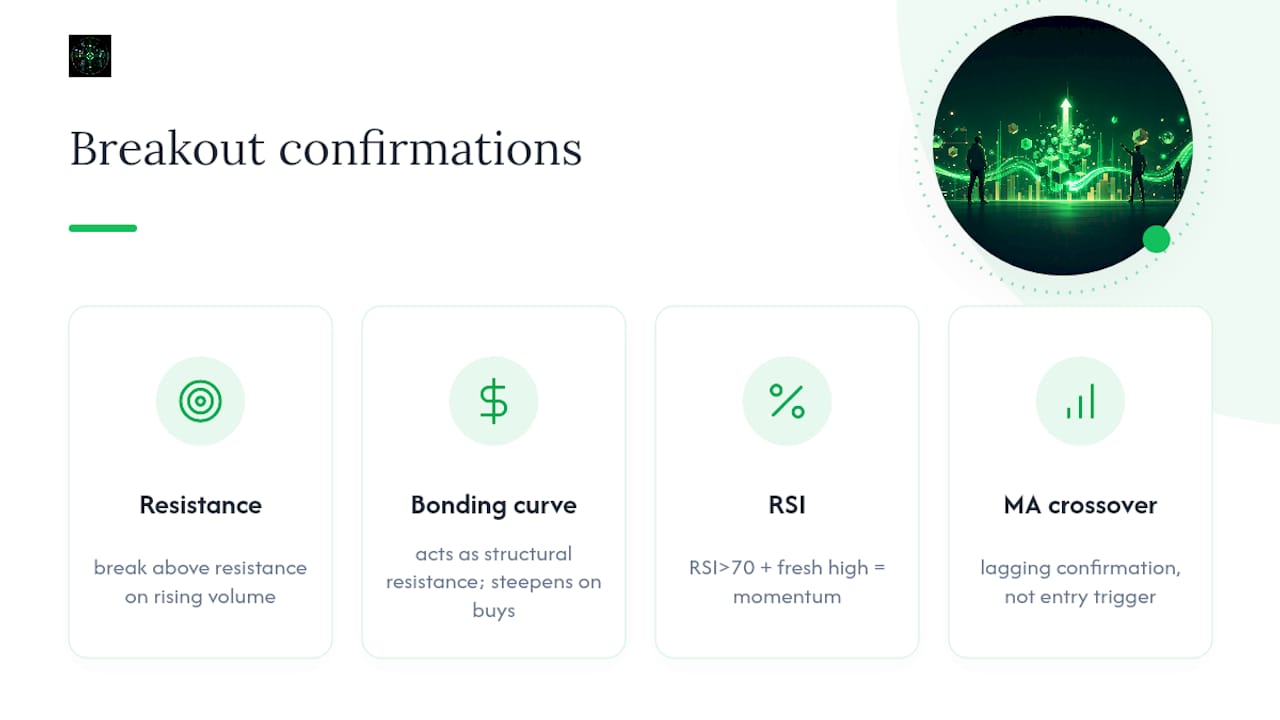
Relative Strength Index (RSI) readings above 70 combined with a fresh price high suggest strong momentum rather than an imminent reversal, in fast-moving memecoin conditions, though the same reading in a slower traditional market often flags overextension. Moving average crossovers, where a short-term average crosses above a longer one, work as a lagging confirmation rather than an entry trigger, since memecoin price action often outruns any moving average by the time it crosses.
Chart patterns translate directly: ascending triangles, where price compresses against a flat resistance line with rising lows, frequently precede breakout attempts, and a flag pattern (a short consolidation after a sharp move) often signals continuation rather than exhaustion. The catch with all of these on Pump.fun tokens is sample size. A pattern that took hours or days to form on a major asset can form in minutes on a new memecoin, which means the same technical signal carries less statistical weight and more noise.
None of these patterns matter in isolation from execution speed. A textbook breakout that you observe three seconds late has already moved past the entry price you were targeting, which is why the technical setup and the technical infrastructure behind copy access are really two halves of the same decision.
How much should you risk on a single breakout trade?
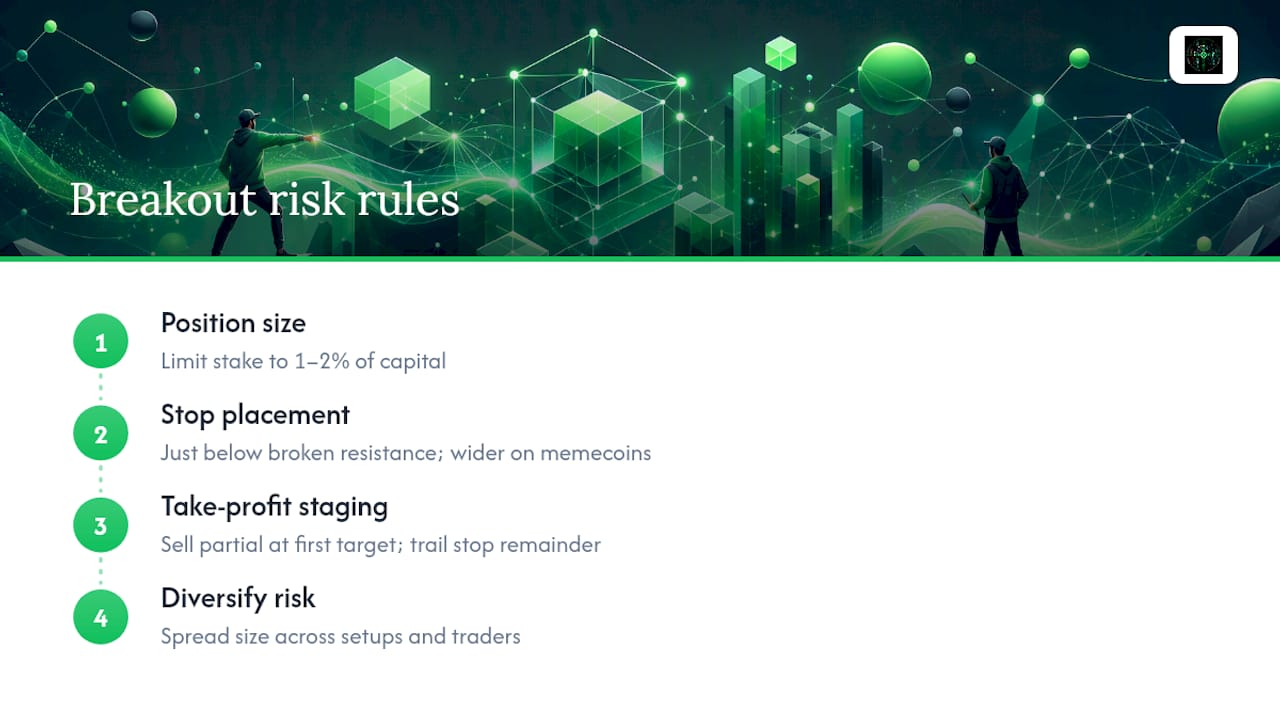
Position sizing matters more in memecoin breakout trades than in almost any other market, because losses compound fast when volatility runs 5 to 10 times higher than a typical large-cap crypto asset. A common rule among active traders is risking no more than 1 to 2% of total trading capital on a single position, sized so that a stop-loss hit doesn't meaningfully dent the account.
Stop-loss placement on a breakout trade usually sits just below the resistance level that was broken, since a genuine breakout shouldn't retrace back below that line. If price falls back through it, the breakout has likely failed rather than paused. On a memecoin, that stop needs to be wider than on a traditional asset purely because normal price swings are larger, but wider stops mean smaller position sizes to keep the dollar risk constant.
Take-profit targets work best set in stages rather than as one exit point. Selling a portion of the position at a first target, then trailing a stop on the remainder, captures the early move without giving back the entire gain if momentum fades quickly, which memecoin momentum often does within minutes. This is exactly the kind of rule to encode into a snipe bot's take-profit and lifetime-sell settings rather than trying to execute manually, since manual reaction time can't keep pace with a token that graduates and re-prices within a single trading session.
Diversifying risk across multiple breakout setups, rather than concentrating size on one token or one trader's calls, softens the impact of any single failed breakout. The same diversification logic that applies to picking multiple traders to copy applies to picking multiple breakout setups to trade.
What confirms a breakout instead of a fakeout?
Volume is the single most reliable confirmation signal available, and it matters even more in memecoin markets than in traditional ones. A price breakout on thin volume is far more likely to reverse than one accompanied by a genuine surge in buying activity, since low volume means a small number of wallets could be pushing price without real demand behind it.
On Pump.fun, a volume spike alongside rapid buyer count growth is a stronger signal than volume alone, since Pump.fun tokens make wallet-level buy activity publicly visible on-chain. Watching whether a spike comes from many distinct wallets or a handful of large ones tells you whether you're looking at organic breakout demand or a coordinated push, the same wallet-clustering pattern researchers link to sniper and bundle bot manipulation.
Market sentiment adds a secondary layer. Social mention spikes, trending-token lists, and community chatter often precede or accompany a genuine breakout, but sentiment alone is a lagging and easily gamed signal in memecoin markets specifically, since a coordinated group can manufacture apparent hype faster than it can manufacture real buy volume. Treat sentiment as a supporting signal, never the primary trigger.
The most dangerous fakeout pattern in memecoins is a sharp volume spike immediately followed by an equally sharp volume collapse within seconds, often the signature of an early sniper exiting a position right as slower buyers pile in behind them. Confirming a breakout means watching not just that volume rose, but whether it's still rising, or holding, a few seconds after the initial spike.
How does crypto breakout trading differ from stocks and forex?
Volatility is the defining difference, and it isn't a small gap. Where a breakout in a major stock might move 2 to 5% before consolidating, a Pump.fun memecoin breakout can move 50% or more in the same time frame, purely because bonding curve pricing mechanically accelerates as buy volume increases. That changes how every rule above needs to be applied.
Market hours are the second difference. Traditional breakout trading strategies build in assumptions about opening-bell volatility, midday lulls, and closing-hour volume, none of which exist in a market that trades continuously. A memecoin breakout can happen at any hour, and the liquidity available to absorb it depends entirely on how many wallets happen to be watching at that moment, not on a predictable session structure.
Liquidity depth is thinner and less uniform. A stock breakout on a major exchange usually has market makers and institutional order flow cushioning the move. A fresh Pump.fun token has whatever liquidity its bonding curve provides, and that curve's own mechanics are part of what's driving the price move, a feedback loop traditional markets simply don't have.
Regulatory oversight is the last major gap. Stock and forex breakout trading operates inside well-established market-surveillance frameworks. Memecoin markets on Solana currently operate with far less of that infrastructure, which is part of why IOSCO's guidance on copy trading leans so heavily on platform-level controls and follower education rather than assuming exchange-level surveillance will catch manipulation before it hits your position.
When does this approach actually make sense?
This style of trading fits active, high-risk traders looking for short bursts of exposure, not long-term investors building a portfolio. If you can't absorb slippage on a small account, or you're looking for passive returns, paid copy access and snipe bots aren't the right tool; the fee and slippage drag will outweigh gains before you find your footing. Start with a small position, verify your execution actually matches the leader's, then scale up only once the numbers prove out.
— dang
Get Started With Snipethem's 24-Hour Trader Access
Every control and checklist above only works if the platform underneath it executes fast and reliably.
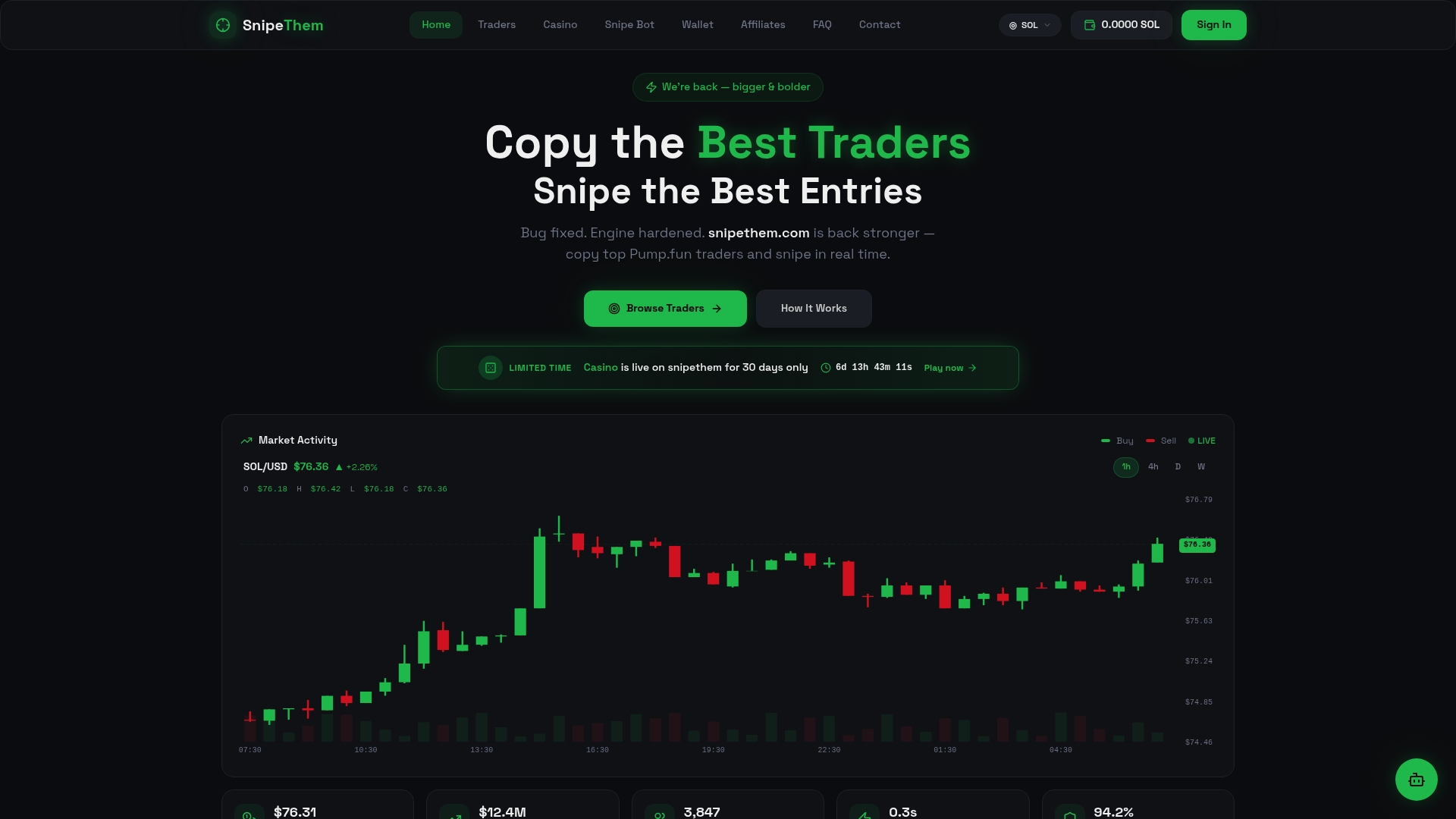
Getting started takes four steps. Visit Snipethem's trader marketplace and review live rankings and trade histories. Pick a trader whose track record passes the vetting checklist above, three-plus months of history, visible drawdowns, no suspicious win-rate spikes. Purchase 24-hour access to unlock their live feed and trade history. Then configure your replication settings, or set up the automated snipe bot with the slippage caps, stop-loss levels, and allocation limits covered earlier, starting in simulation mode before committing real capital.
Sources
- IOSCO — Online imitative trading practices: Copy trading, mirror trading, social trading (Final Report)
- Resisting Manipulative Bots in Meme Coin Copy Trading: A Multi‑Agent Approach (arXiv)
- Common mistakes to avoid in copy trading — Coin Bureau