
Price impact is the cost your trade creates by moving the market. Slippage is the cost the market creates by moving against you between quote and execution. Both appear in your final fill price, but they have different causes, different levels of predictability, and different solutions. According to Uniswap Labs, total execution cost decomposes into price impact plus realized slippage plus protocol fees.
Before placing any trade, three steps apply immediately:
- Check pool depth or order book liquidity before sizing your position.
- Set a slippage tolerance that reflects current market volatility, not the platform default.
- Split large orders into smaller tranches to reduce the per-unit price impact.
Key Takeaways
Price impact is calculable before you trade; slippage is uncertain and must be managed through execution speed, routing, and tolerance settings.
| Point | Details |
|---|---|
| Price impact is deterministic | It is calculable from trade size and pool reserves before you confirm. |
| Slippage is market-driven | It arises from volatility, latency, and MEV between quote and execution. |
| Total execution cost | Final fill cost equals price impact plus realized slippage plus protocol fees. |
| Primary mitigation for impact | Split orders, use deeper pools, and route through aggregators. |
| Primary mitigation for slippage | Use MEV protection, set conservative tolerance, and prefer limit orders. |
Table of Contents
- How slippage vs price impact actually breaks down
- What price impact is and why it grows with trade size
- What slippage is and what causes it
- Side-by-side comparison: which cost is which
- How to estimate price impact and slippage before you trade
- How to reduce price impact and slippage in practice
- How CEXs and DEXs handle price impact and slippage differently
- Common trader questions about slippage thresholds
- A trader's pragmatic note on speed versus cost
- Sources
How slippage vs price impact actually breaks down
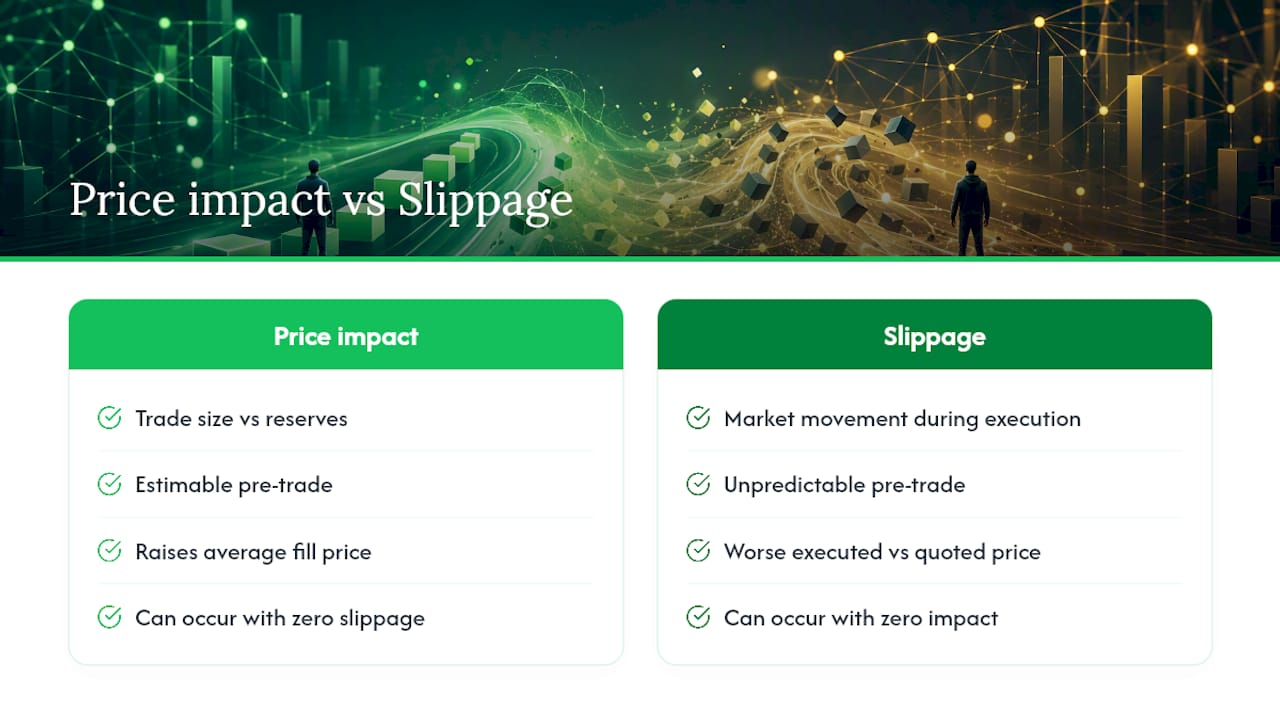
Price impact is the change in an asset's market price caused directly by your trade. It is deterministic: given the pool reserves and your trade size, the resulting price shift is calculable before you confirm. Slippage is the difference between the price quoted at the moment you initiate a trade and the price at which that trade actually executes, caused by market movement during the time between quote and confirmation.
The distinction matters because one cost is within your control and the other is not. Price impact scales with your order size relative to available liquidity. Slippage depends on network latency, market volatility, and mempool dynamics. Conflating the two leads to the wrong mitigation: raising your slippage tolerance does nothing to reduce price impact, and splitting your order does not protect you from a sudden price spike during execution.
What price impact is and why it grows with trade size
Price impact is a deterministic, calculable consequence of trading against a finite pool of liquidity. On an automated market maker (AMM) like Uniswap, the constant-product formula governs reserve ratios. When you buy token A with token B, you add B to the pool and remove A, shifting the ratio and moving the quoted price of A upward. The larger your trade relative to the pool's total reserves, the further the ratio shifts, and the worse your average fill price becomes compared to the pre-trade spot price.
On a centralized exchange (CEX) order book, the mechanism differs but the outcome is similar. A market buy order consumes the cheapest available sell orders first. Once those are filled, the next available sell orders sit at higher price levels. A large market order exhausts multiple price levels in sequence, pushing the effective average fill price above the initial best ask. As CoinMarketCap explains, more liquid pairs experience smaller price impact because there are more orders at each price level to absorb the trade.
Key factors that determine price impact magnitude:
- Pool depth or order book density: Deeper liquidity absorbs larger trades with less price movement.
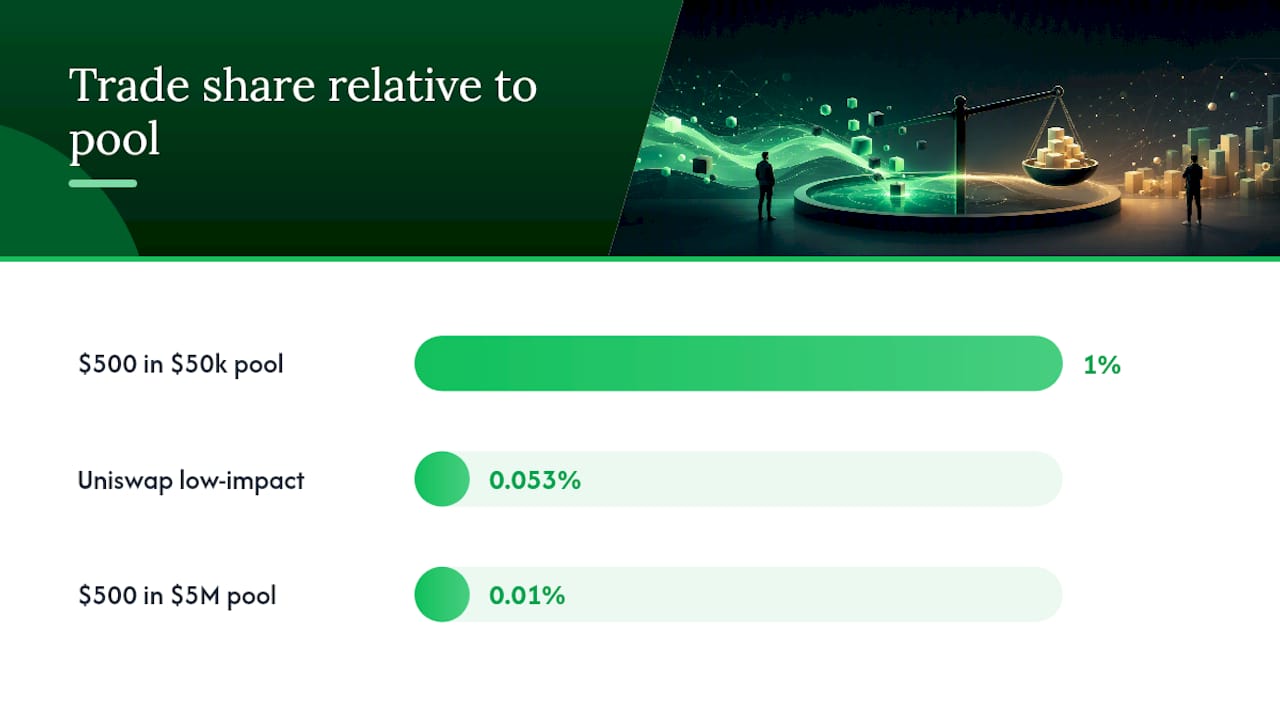
- Trade size as a percentage of total liquidity: A $500 trade in a $50,000 pool has far more impact than the same trade in a $5,000,000 pool.
- Token pair popularity: Major pairs like SOL/USDC carry far more liquidity than newly launched meme coin pairs.
Uniswap's support documentation notes that low-impact trades can cost as little as 0.053% in additional price movement, while high-impact trades trigger a visible warning in the UI. When you see that warning, the pool is telling you that your order size is large relative to available reserves.
Pro Tip: *Before committing a large trade on a DEX, check the pool's total value locked (TVL).
What slippage is and what causes it
Slippage is an execution-time phenomenon. The price shown when you initiate a trade is a snapshot of market conditions at that moment. By the time your transaction is confirmed on-chain or matched on a CEX, market conditions may have shifted. The gap between the quoted price and the executed price is slippage.
As 1inch explains, slippage can be positive or negative. Negative slippage means you received a worse price than quoted. Positive slippage means the market moved in your favor during execution, and you received a better price. Positive slippage is less common but does occur during rapid price drops when buying.
Common causes of slippage, ranked by frequency in practice:
- Market volatility: Fast-moving prices during news events or token launches mean the quote becomes stale within milliseconds.
- Network congestion and latency: On Solana or Ethereum, a transaction sitting in the mempool for even a few seconds can face a materially different price on confirmation.
- MEV and front-running: Validators or searchers can reorder transactions in a block, inserting their own trades ahead of yours to profit from the price movement your trade will create.
- Order book exhaustion on CEXs: A fast-moving market can clear price levels between your order submission and its matching.
According to Kraken's learning resources, slippage is also amplified by low liquidity and large order sizes, which is why the two costs often appear together in the same trade.
Pro Tip: To reduce slippage exposure without increasing MEV risk, prefer MEV-protected transaction routing over simply raising your slippage tolerance. A higher tolerance prevents failed transactions but gives adversarial actors more room to fill your order at a worse price.
Side-by-side comparison: which cost is which
Understanding where each cost originates determines where to focus mitigation effort. The table below maps the key comparison axes.
| Dimension | Price impact | Slippage |
|---|---|---|
| Cause | Your trade size vs. available liquidity | Market movement between quote and execution |
| Timing | Occurs during execution as reserves shift | Occurs between quote and confirmation |
| Predictability | Calculable before trade confirmation | Uncertain; depends on market conditions |
| Primary control lever | Order sizing, pool selection, routing | Slippage tolerance, execution speed, MEV protection |
| Who creates it | The trader | The market |
For small retail trades in liquid pairs, price impact is negligible and slippage dominates execution cost. For large block trades in thin pools, price impact is the primary cost driver. During highly volatile markets, such as a meme coin launch on Pump.fun. As Definitive's analysis notes, execution strategies must address the correct root cause: splitting an order reduces price impact but does not protect against a volatile market moving against you during execution.
How to estimate price impact and slippage before you trade
A practical estimate of price impact on an AMM uses the ratio of trade size to pool reserves. The constant-product formula means you will pay progressively more for each unit as reserves thin, resulting in an average fill price above the initial spot.
A simplified worked example:
Slippage estimation is less precise because it depends on conditions at execution time. A calm, liquid market may produce near-zero slippage even on a trade with measurable price impact. A volatile market can produce significant slippage on a trade with minimal price impact.
When slippage is zero despite price impact: a trade executed instantly in a perfectly stable market will have price impact but no slippage, because the quoted price and the executed price are the same.
When price impact is zero despite slippage: a small trade in a deep pool on a fast-moving market may have negligible impact but still receive a worse fill than quoted due to price movement during confirmation.
Pro Tip: Use an aggregator's quote comparison or submit a small test swap of $10–$20 before committing a large order. The test swap reveals real pool depth and current routing efficiency without meaningful capital at risk.
How to reduce price impact and slippage in practice
Managing execution costs requires addressing each cost at its source. The following steps are ordered by impact.
- Select deeper liquidity pools or pairs. For any given trade size, a pool with higher TVL produces lower price impact. On Solana, routing through major USDC or SOL pairs before reaching a thin meme coin pair often improves overall execution.
- Split large orders into smaller tranches. Executing a large trade in five smaller sequential orders reduces the per-unit price impact, because each sub-order starts from a partially recovered reserve ratio.
- Use aggregators or multi-route execution. Aggregators like those used in DeFi split trades across multiple liquidity sources simultaneously, reducing the share of any single pool that must absorb the order. 1inch's routing documentation describes how this approach reduces negative price impact.
- Prefer limit orders over market orders on CEXs. A limit order sets a maximum acceptable price, eliminating slippage risk entirely at the cost of potential non-execution if the market moves away.
- Use TWAP execution for large positions. Time-weighted average price orders spread execution across a defined window, smoothing both price impact and slippage exposure.
- Set slippage tolerance conservatively. A tolerance of 0.5%–1% is appropriate for liquid pairs. For meme coins or low-liquidity tokens, 2%–5% may be necessary to avoid repeated failed transactions.
- Avoid peak volatility windows. Executing during low-activity periods reduces the probability of adverse market movement between quote and confirmation.
Additional slippage-specific tactics:
- Use MEV-protected routing where available to prevent front-running.
- On EVM chains, increasing gas can accelerate confirmation and reduce the window during which the market can move against you.
- Watch the aggregated quote versus the single-pool quote on DEX UIs; a large spread between the two signals thin liquidity.
Pro Tip: Raising slippage tolerance to avoid failed transactions is a last resort, not a first response. A higher tolerance prevents reverts but exposes the trade to worse fills and MEV sandwich attacks. Prefer faster execution or MEV protection first, as the Uniswap blog advises.
How CEXs and DEXs handle price impact and slippage differently
The mechanics differ meaningfully between centralized and decentralized venues, and so do the practical mitigation tactics.
On a CEX order book, price impact appears as market orders consuming discrete price levels. Each filled level is slightly worse than the last. Slippage arises when the order book changes between submission and matching, which can happen in milliseconds on a fast-moving market. The spread between best bid and best ask is itself a form of execution cost that compounds with slippage.
On a DEX AMM, price impact is continuous and governed by the reserve ratio formula. There are no discrete levels; the price shifts smoothly as reserves change. Slippage arises from block confirmation time, during which other traders may have already moved the pool's reserves.
Before submitting a trade on either platform type, check the following:
- CEX: Current bid-ask spread, order book depth at your target price level, and recent trade velocity.
- DEX: Pool TVL, your trade size as a percentage of TVL, the UI's displayed price impact percentage, and whether an aggregator route is available.
Common trader questions about slippage thresholds
It prevents most failed transactions while limiting exposure to adverse fills.
This setting is occasionally used for tokens with very high buy taxes or extreme volatility, but it carries severe risk of MEV exploitation and should be avoided in almost all circumstances.
Pump.fun slippage settings often default higher than standard DEX defaults to account for thin early-stage liquidity. For Solana bot configurations, slippage settings for a Solana bot should reflect the token's liquidity profile at the time of execution, not a fixed platform default.
Red flags that should prompt you to cancel or restructure a trade:
- Quoted price impact above 5% on a standard trade size.
- Pool TVL below $50,000 for a trade above $500.
- Token contract includes a buy or sell tax above 5%.
- Aggregator and single-pool quotes differ by more than 2%.
A trader's pragmatic note on speed versus cost
The instinct to raise slippage tolerance and hit confirm is understandable, especially during a fast-moving meme coin launch. The problem is that this approach solves the wrong problem. A failed transaction is annoying.
Three practical heuristics that hold up in real trading conditions:
- If the estimated price impact exceeds 3% of your intended trade, split the order or wait for the pool to recover.
- If pool depth is unknown, execute a minimal test swap first and observe the actual fill versus the quoted price.
- If slippage tolerance must exceed 5% to avoid failed transactions, treat that as a signal about the token's liquidity risk, not just a setting to adjust.
Post-trade attribution matters as well. When reviewing a fill that came in worse than expected, separate the price impact component (calculable from the pool state at execution) from the slippage component (the residual difference). Conflating the two leads to the wrong adjustment in the next trade.
Sources
- Price Impact vs Price Slippage – Uniswap Labs
- What is price impact vs. price slippage in DeFi? | 1inch
- Price Impact vs Slippage: What's the Difference? — Definitive
- What is slippage in crypto? — Kraken Learn
- Price Impact Definition | CoinMarketCap
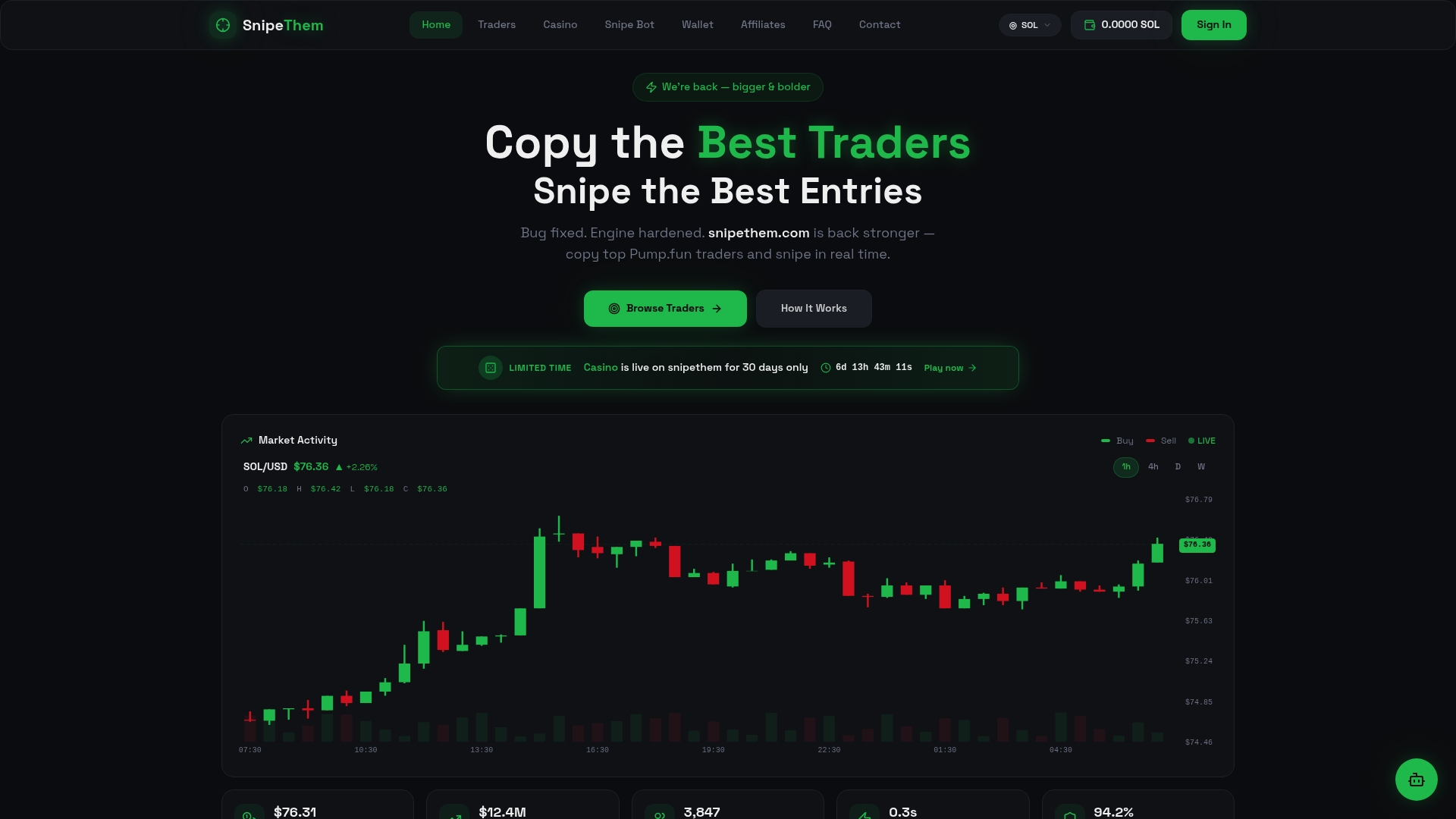
Traders who want to reduce execution costs on Pump.fun meme coins without manually calculating pool depth on every trade can use Snipethem's automated copy-trading platform. The platform's snipe bot executes trades with a 0.3-second response time, and the top trader rankings let you replicate strategies from traders with verified win rates, removing the guesswork from slippage settings on Solana.
This article is general information, not a substitute for advice from a qualified financial advisor. Consult a qualified financial professional about your own circumstances before acting on anything here.