
Position size equals your account balance times your risk percentage, divided by the distance between your entry price and your stop. Most traders risk 1% to 2% per trade, with 0.5% for conservative accounts and up to 2% reserved for setups with real conviction. A calculator needs key inputs to do this correctly, including account balance, risk percentage, entry price, stop price, and optional leverage and fee figures.
TL;DR:
- Position size should be adjusted for wider stops in low-liquidity tokens to avoid excessive risk, often reducing risk to 0.5% or less per trade.
- Leverage only impacts collateral requirements, not actual dollar risk, which is fixed at the point of entry for each trade.
- Portfolio heat from multiple open positions should stay under 6% of the account, with correlation checking to prevent large combined risk.
- Using a position calculator requires accurate entry and stop data from live trades, especially important for volatile meme coins.
- Sizing methods like volatility-adjusted and Kelly-based approaches help manage risk better than simple fixed fractions, especially across different market regimes.
Table of Contents
- Position Size Formula Explained and Quick Calculator Walkthrough
- Step-by-Step Worked Example You Can Replicate
- Fixed-Fractional, Volatility-Adjusted, and Kelly Criterion Compared
- How Leverage, Fees, and Low-Liquidity Tokens Change Sizing
- Portfolio Heat and Correlated Risk
- Common Position Sizing Mistakes and a Pre-Trade Checklist
- Using a Position-Size Calculator on Every Trade
- How Copy-Trading Signals Supply Your Sizing Inputs
- Adjusting Position Size Based on Trade Confidence
- Position Sizing in Bull, Bear, and Sideways Markets
- Sizing Altcoins Differently From Bitcoin
- Why Sizing Discipline Outlasts Any Single Trade
- Get Entry and Stop Data Straight From the Traders Making the Calls
- Sources
Position Size Formula Explained and Quick Calculator Walkthrough
The formula behind position sizing has two versions, and traders mix them up constantly. The dollar version calculates risk in cash terms: Account Risk ($) = Account Balance × Risk %. The coin-unit version converts that dollar figure into how much crypto to actually buy: Units = Account Risk ($) ÷ (Entry − Stop). Multiply units by entry price and you get position notional, the total dollar value of the trade.
Three numbers get confused constantly, and mixing them up wrecks otherwise sound risk math:
- Account risk is the maximum dollar amount you're willing to lose if the stop gets hit.
- Position notional is the total dollar value of the position, unrelated to how much of your account you actually risk.
- Margin posted is the collateral your exchange requires to open a leveraged position, which shrinks as leverage increases but never changes the dollar risk.
A working calculator asks for your account balance, risk percentage, entry price, stop price, trading fees, leverage multiplier, and whether you're running isolated or cross margin. Skip any of these and the output is a guess dressed up as a number.
Step-by-Step Worked Example You Can Replicate
Here's the math with real numbers.
- Dollar risk: $10,000 × 1% = $100.
- Stop distance: $65,000 − $63,700 = $1,300.
- Position size in coin units: $100 ÷ $1,300 = 0.0769 BTC.
- Position notional: 0.0769 × $65,000 = roughly $5,000.
Now widen the stop to $61,700, a $3,300 distance. Dollar risk stays fixed at $100, but units drop to 0.0303 BTC, less than half the original size. That's correct: a wider stop means more room for the trade to breathe, so the position has to shrink to keep the same $100 at risk.
The notional stays the same regardless of leverage. At 5×, that $5,000 position requires $1,000 margin. At 10×, it requires $500. The dollar risk never moves; only the capital tied up as collateral does.
Fixed-Fractional, Volatility-Adjusted, and Kelly Criterion Compared
Three sizing methods dominate serious crypto trading, and each solves a different problem.
Fixed-fractional sizing risks a constant 1% to 2% of the account on every trade, regardless of setup quality. Survival math explains why 1% is the common default: a string of ten straight losses at 1% risk leaves roughly 90% of the account intact, while the same streak at 5% risk cuts the account by more than half.
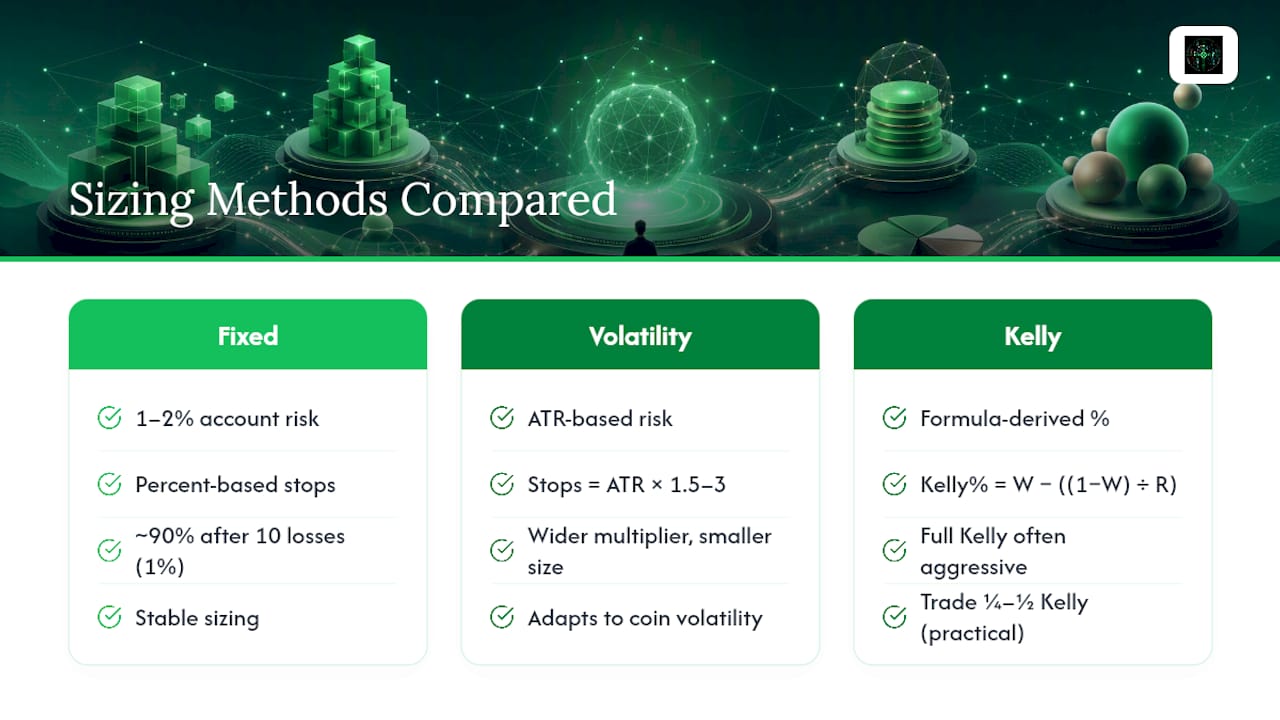
Volatility-adjusted sizing uses Average True Range to set stops that respect how much a coin actually moves, rather than an arbitrary percentage. Multipliers of 1.5× to 3× ATR are typical for crypto, since daily ranges run wider than in traditional markets. A tighter multiplier gets stopped out more often; a wider one demands smaller position sizes to hold dollar risk constant.
Kelly criterion calculates a mathematically optimal bet fraction from your win rate and win/loss ratio. The full Kelly formula is: Kelly % = Win Rate − ((1 − Win Rate) ÷ Win/Loss Ratio). In practice, full Kelly sizing is too aggressive for crypto's noisy data. Most traders treat it as a ceiling and trade at one-quarter to one-half Kelly instead.
Pro Tip: Calculate your Kelly percentage, then cut it in half before you ever size a real trade. Half-Kelly gives up little long-term growth while cutting drawdown severity dramatically.
How Leverage, Fees, and Low-Liquidity Tokens Change Sizing
Leverage changes what you post as margin, not what you actually risk in dollars. A $5,000 notional position stopped out for a $100 loss produces that same $100 loss whether you used 1× or 20× leverage. What leverage changes is how much capital sits idle as collateral, and how close your liquidation price sits to your intended stop.
Fees eat into this math more than most traders admit. A round-trip taker fee of 0.1% on each side means a $5,000 position costs roughly $10 just to enter and exit, a real drag on small accounts trading frequently.
Memecoins and other low-liquidity tokens need their own rules:
- Cut risk per trade to 0.5% to 1%, never the full 2%.
- Use wider stops of 5% to 10% since these tokens whipsaw hard.
- Avoid leverage entirely, since liquidation on a thin order book compounds losses fast.
- Keep your position size far smaller than the token's daily volume to avoid moving the price against yourself.
Portfolio Heat and Correlated Risk
Portfolio heat is the sum of dollar risk across every open position at once, and it's the control most retail traders skip. Five separate trades each risking 1% sounds conservative until you realize they add up to 5% total exposure, and if those positions move together, one bad market day can hit all five stops simultaneously.
A commonly cited heuristic caps aggregate open risk near 6% of account value. The formula is straightforward: add up the dollar risk at each position's stop, then compare that total to your cap.
- If total open risk sits under 6%, a new trade is fine at normal size.
- If it's near or over 6%, skip the trade or cut the size significantly.
- Check correlation before adding a new position; two altcoins that move together count as one large bet, not two separate small ones.
Pro Tip: Before adding a fourth open position, add up your existing stops in dollar terms first. Most traders discover they're already carrying more heat than they think.
Common Position Sizing Mistakes and a Pre-Trade Checklist
The most frequent mistake is sizing by conviction instead of math, doubling a position because a trade "feels right." A close second is moving the stop farther away after entry to avoid getting stopped out, which quietly doubles the real dollar risk.
Other repeat offenders: sizing directly in coin units without converting to dollar risk first, ignoring fees and slippage on the break-even calculation, and never checking portfolio heat before adding a new trade.
Run this checklist before every order:
- Calculate dollar risk first, using account balance times risk percentage.
- Confirm the stop is justified by chart structure, never picked to fit a desired position size.
- Check fees, spread, and available liquidity for the token.
- Add up total portfolio heat across open positions.
- Log the trade in a journal with entry, stop, size, and reasoning.
After a 5% drawdown from a recent peak, cut per-trade risk in half, from 1% down to 0.5%, until performance stabilizes.
Using a Position-Size Calculator on Every Trade
A calculator only works if you feed it complete inputs before clicking buy: account balance, risk percentage, entry price, stop price, exchange fees, and leverage if you're using it. The output you copy into your exchange order form is position size in coin units and total notional value, plus required margin if the trade is leveraged.
Before confirming the order, verify two things the calculator can't check for you. First, confirm your liquidation price on isolated margin sits well beyond your stop, so a normal wick doesn't force liquidation before your stop even triggers. Second, sanity-check that the fee and slippage estimate still makes sense for the token's actual order book depth.
For sizing tied to a trailing stop strategy, or for evaluating copy-trading signals before you size them, both deserve a closer read once the core formula is second nature.
How Copy-Trading Signals Supply Your Sizing Inputs
Those figures describe signal speed and historical accuracy, not a guarantee for any individual position.
What matters for sizing is simpler: a copied trader's entry and exit prices give you the two numbers the formula actually needs. Once Snipethem surfaces where a top trader entered and where they set their stop, you run that stop distance through your own risk percentage, not theirs. The signal supplies the inputs. The math still belongs to you.
Adjusting Position Size Based on Trade Confidence
Not every setup deserves the same risk.
The trap here is emotional confidence masquerading as analytical confidence. Feeling certain about a trade because the price already moved in your favor before entry is not the same as a setup meeting your written criteria. Traders who scale size based on gut feeling tend to size up right before losing streaks, since overconfidence peaks after a run of wins, exactly when reversion is often overdue.
A cleaner approach ties size to a scored checklist rather than a feeling: does the trade align with the higher timeframe trend, does volume confirm the move, is the stop placed at genuine structure rather than an arbitrary percentage. Three checks passed might mean full size. Two might mean half. One means skip the trade entirely.
Signal strength from a copied trader works the same way. A trader with a long, consistent track record on a specific setup type earns a larger allocation of your risk budget than one you're following on a single recent win. Treat conviction as an input to a formula, not a replacement for one.
Position Sizing in Bull, Bear, and Sideways Markets
Market regime changes what "normal" volatility looks like, and your sizing should move with it rather than staying static across every environment.
In a strong bull market, trends run longer and pullbacks tend to be shallower, which lets traders hold slightly wider stops without giving up much in stop distance efficiency. The mistake here is letting a winning streak inflate risk percentage itself rather than just the account balance it's calculated from.
Bear markets demand smaller size and tighter discipline. Volatility spikes on the way down more than it does on the way up, which means ATR-based stops widen automatically, and a fixed-fractional sizer following the formula correctly will shrink position size in response. Traders who resist that shrinkage, sizing as if conditions were still calm, take outsized losses precisely when the math is telling them to scale back.
Sideways, range-bound markets punish size in a quieter way: frequent small losses from stop-outs at range edges. Reducing trade frequency matters more than reducing size here, since the real problem isn't position size but taking too many low-quality setups in a market offering no clean trend to ride.
Sizing Altcoins Differently From Bitcoin
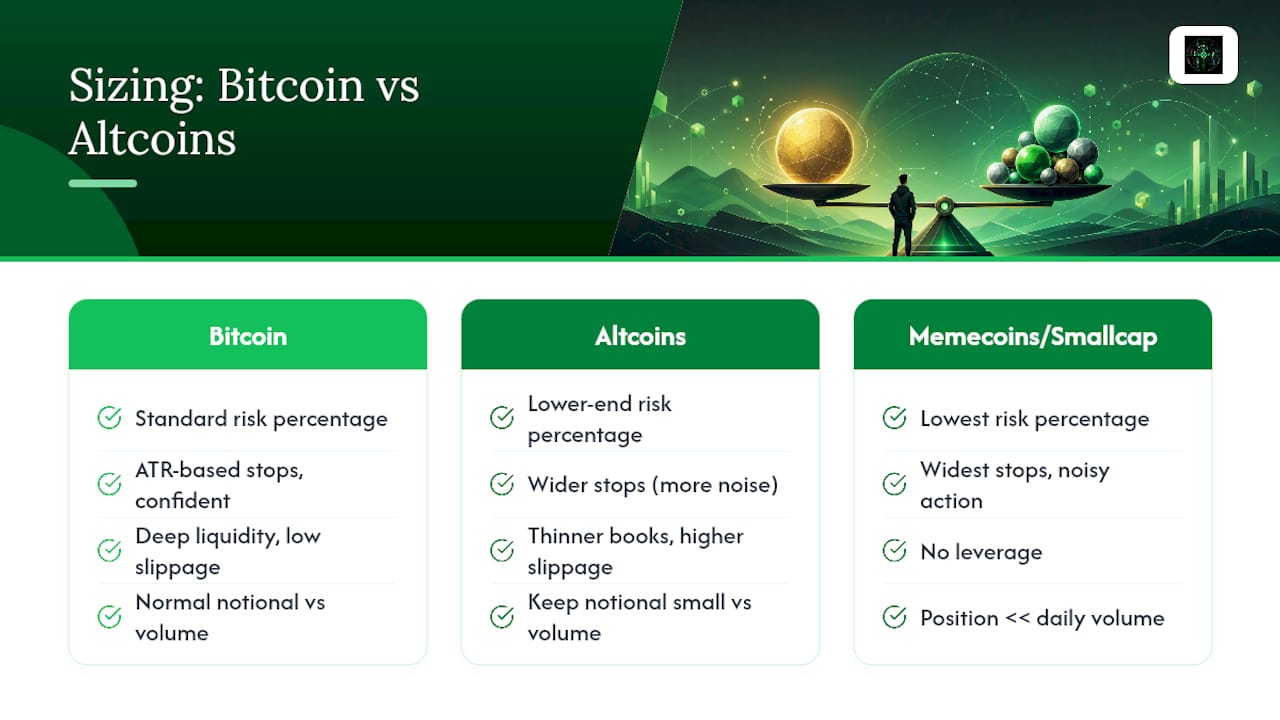
Bitcoin's volatility, while high by traditional asset standards, is tame compared to most altcoins. That gap alone justifies different risk treatment for the two.
Bitcoin trades on deep liquidity across every major exchange, which means slippage on reasonable position sizes stays minimal and ATR-based stops can be set with real confidence in execution. Altcoins, even large-cap ones, see wider bid-ask spreads and thinner order books, so the same percentage stop distance that works cleanly on Bitcoin often gets clipped by noise on an altcoin before the real move even starts.
The practical adjustment: keep Bitcoin trades at your standard risk percentage, but drop altcoin risk to the lower end of your range, and drop it further still for anything outside the top twenty by market capitalization. Position notional on an altcoin should also stay small relative to that token's daily trading volume, since a large order on a thin book moves the price against you before the fill even completes.
Memecoins and freshly launched tokens sit at the extreme end of this scale. The sizing rules from the leverage and fees section apply in full: smaller risk percentage, wider stops, no leverage, and position size kept well under daily volume.
Why Sizing Discipline Outlasts Any Single Trade
Position sizing rules feel restrictive right up until the losing streak that would have ended a differently sized account. Discipline here isn't about caution for its own sake. It's what lets a strategy with a real edge survive long enough for that edge to actually show up in the results. Run every trade through the calculator, and write it down afterward. The math only protects you if you actually use it.
— dang
Get Entry and Stop Data Straight From the Traders Making the Calls
Every formula in this guide needs two numbers you don't control: a real entry price and a real stop. Snipethem shortens that gap by surfacing live trade history from top Pump.fun traders, so you're sizing against an actual entry and exit rather than a guess pulled from a chart you glanced at for ten seconds.
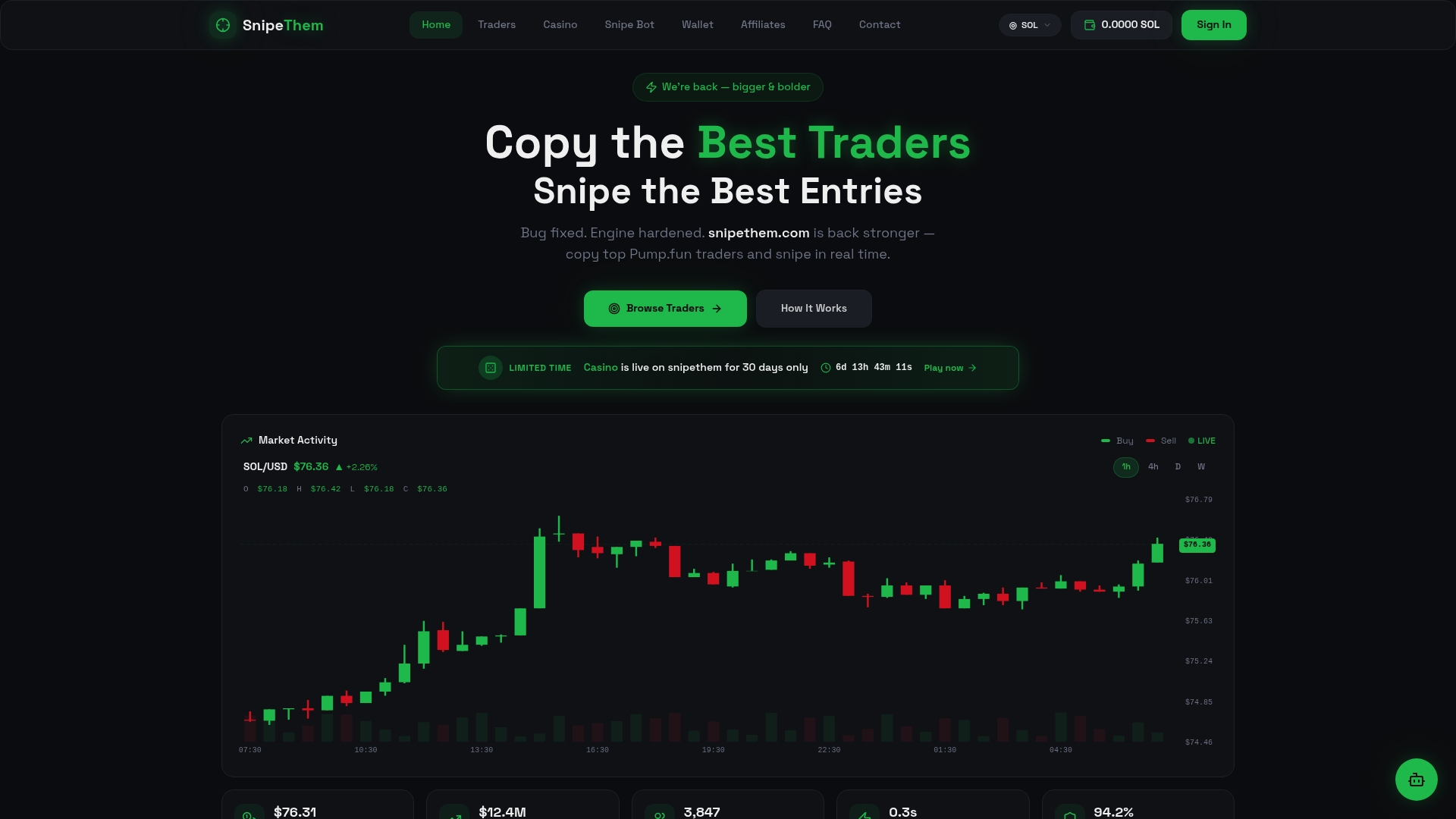
That matters most on meme coins, where prices move before most traders even finish loading the chart. Pulling entry and stop data from a trader's real, tracked history cuts down the manual guesswork that leads to mis-sized positions in the first place, and it lets you run the formula the moment a signal appears rather than after the move has already happened. Browse the ranked trader list to see win rates and trade history before you commit any capital, then size whatever you copy using the risk percentage that fits your own account, not someone else's. Start on the Snipethem platform and plug the numbers you find straight into your calculator.
Sources
- Position Sizing — The Formula That Keeps You In The Game | CryptoSignalApp
- Position sizing and risk-management overview | TradingMetrics docs
- Position Sizing for Crypto Trading: The Complete Risk Management Guide (2026) | TargetHit
- What is the Kelly bet-size criterion and how to use it in crypto trading | CoinMarketCap Academy