
The fastest way to act on whale wallet tracking is simple: pay for 24-hour copy access on a platform built for it, or build your own low-latency watcher. For most retail traders, Snipethem is the quicker route. Buy 24-hour access to a top Pump.fun trader, enable the auto-snipe bot, and let the platform's 0.3-second response time execute mirrored buys. For developers who want full control, the DIY path means running a watcher on Solana gRPC or QuickNode Metis, parsing Pump.fun buy instructions, then calling fetchSwapTransaction before signing and sending.
- Quick path: buy access, configure the bot, monitor Snipethem's dashboard.
- DIY path: subscribe to logs, filter by wallet, fetch the serialized swap, sign, submit.
Snipethem reports a 94.2% success rate on its automated copy trades, a figure worth weighing against the hours it takes to build and maintain a comparable bot yourself.
Key Takeaways
Effective whale wallet tracking on Pump.fun depends on low-latency detection, strict threshold filters, and risk controls that survive contact with manipulative bots.
| Point | Details |
|---|---|
| Speed decides outcomes | Bonding curve pricing rises with demand, so late copies pay more for fewer tokens. |
| Use the right data feed | Solana gRPC, Geyser, or QuickNode Metis deliver the low-latency detection manual polling can't match. |
| Filter before you copy | Set MIN_TX_AMOUNT, watchlist trusted wallets, and flag coordinated buy patterns before trusting a signal. |
| Cap every position | Limit snipes to a small amount and always run TEST_MODE before live funds. |
| Snipethem shortens setup | Offers 24-hour trader access and an automated snipe bot with a reported 0.3s response time, cutting the build-it-yourself timeline. |
Table of Contents
- What Is Whale Wallet Tracking on Pump.fun?
- What Do You Need Before You Start Tracking Whales?
- How Do You Build a Whale-Copying Snipe Bot?
- How Do You Spot Fake Whale Activity and Bot Manipulation?
- What Risk Controls Should Every Copy Trade Have?
- Should You Build Your Own Bot or Pay for Access?
- Get Instant Access to Top Pump.fun Traders
- Where to Learn More About Pump.fun Copy Trading
- Frequently Asked Questions
- Sources
What Is Whale Wallet Tracking on Pump.fun?
Whale wallet tracking, in this context, has nothing to do with generic large-transfer alerts. It means watching specific high-performing Pump.fun trader wallets in real time and copying their buys before the opportunity closes. Pump.fun exposes token creation events and every subsequent transaction through public program logs, which is what makes this possible at all.
The mechanism that makes speed matter is the bonding curve. Pump.fun prices each token on a curve that rises deterministically as cumulative SOL demand increases, while token issuance follows a concave schedule, meaning each additional buyer gets fewer tokens per SOL than the one before. Copy that whale's trade three seconds late and you're paying more for less. A detailed academic breakdown of this pricing mechanic also documents how the same structure gets exploited by manipulative wallets, a topic worth returning to later.
Three on-chain records matter most for detection:
- Program logs that flag new buy instructions as they hit the chain.
- Inner instructions carrying the mint, buyer address, and SOL amount.
- bondingCurve accounts tied to each mint, which reveal live pricing.
This is why serious trackers skip standard polling and use Solana gRPC / Geyser streams or QuickNode Metis' pump-fun/swap endpoint. Geyser pushes data the instant it's confirmed rather than waiting on request cycles, and Metis returns an already-serialized swap transaction, cutting out manual construction at the exact moment speed counts most.
What Do You Need Before You Start Tracking Whales?
Before you connect a bot to real funds, confirm you have the basics in place.
- A funded sniper wallet, kept separate from your main holdings.
- A low-latency RPC or Geyser endpoint (not a free, rate-limited node).
- A watchlist of specific trader wallet addresses you trust.
- A
MIN_TX_AMOUNTthreshold so noise trades don't trigger copies. TEST_MODEenabled for dry runs before any live signing.- Encrypted private key storage, never plaintext in a config file.
Factor in costs before you calculate expected returns: Pump.fun charges a 1% transaction fee on every swap, on top of standard Solana transaction fees and the priority fee you'll need to bid for fast inclusion in a block.
Pro Tip: Start with the smallest position size your platform allows and run at least a dozen simulated copies before risking real SOL. Simulation logs catch execution bugs that only show up under live network conditions.
How Do You Build a Whale-Copying Snipe Bot?
A working copy-trade bot follows one flow: monitor, detect, parse, fetch, sign, send. Here's how it breaks down in practice.
- Set up your environment and endpoints. Connect to Solana gRPC or a Geyser-enabled RPC provider, plus your chosen Pump.fun swap endpoint.
- Subscribe to the right data stream. Use
logsSubscribeor a gRPC stream filtered to Pump.fun's program ID, as outlined in Chainstack's Pump.fun bot documentation. - Parse each incoming instruction. Extract the mint address, buyer wallet, and SOL amount from inner instruction data, then check the buyer against your watchlist.
- Apply your threshold filters. Discard anything below your
MIN_TX_AMOUNTso you're not copying dust trades or bot noise. - Call the swap endpoint. QuickNode's copy-trade guide shows this step using a
fetchSwapTransactioncall that returns a ready-to-sign serialized transaction, avoiding manual transaction assembly. - Sign and submit. Bundle the transaction with an appropriate priority fee, or route it through a Jito bundle where available, then send it to the network.
- Confirm and log. Record the transaction hash, execution price, and timestamp for every copy, win or lose.
QuickNode's guide frames this around three functional pieces worth knowing by name if you're reading someone else's bot code: a handleData function that processes each incoming log, a handleWhaleBuy function that triggers once a watchlisted wallet is detected, and fetchSwapTransaction itself, which does the heavy lifting of building the swap.
Before going live, run through a short testing checklist: simulate one watchlisted wallet in TEST_MODE, confirm your parser catches every buy correctly, review the logs for missed or duplicate entries, then move to live trading with the smallest position size available.
Pro Tip: Priority fees aren't optional during high-traffic launches. A bid too low means your transaction lands after the whale's move has already repriced the curve. Jito bundles help guarantee ordering when multiple bots are racing for the same block.
How Do You Spot Fake Whale Activity and Bot Manipulation?
Not every wallet showing strong buy volume on Pump.fun is a legitimate trader worth copying. Academic research into meme coin copy-trading catalogs several coordinated manipulation patterns that show up regularly on-chain.
- Bundle bots: multiple wallets buy the same token atomically in a single block, faking organic demand.
- Gradual bundle bots: the same coordination, staggered over several blocks to look less suspicious.
- Bump bots: small, repeated buys that inflate visible activity while real exposure stays minimal.
- Comment bots: off-chain hype, fake engagement designed to pull in copiers who react to social signals rather than wallet history.
Detection comes down to pattern recognition. Watch for multiple fresh wallets buying in the same block, identical buy sizes across supposedly unrelated addresses, or a burst of comment activity that lines up suspiciously well with a buy spike.
Defenses are equally concrete: require a wallet to show a real history of overlapping profitable trades before you trust it, skip any token where the creator holds a concentrated allocation, and raise your MIN_TX_AMOUNT and timing thresholds when a launch looks coordinated rather than organic.

What Risk Controls Should Every Copy Trade Have?
Cap your exposure per snipe to a small amount depending on your bankroll, and pair every copy with an automated exit rule. Discretion is the enemy of consistency here.
- Set a fixed budget cap per sniper wallet, not just per trade.
- Limit total exposure to a small fraction of your overall portfolio.
- Cap slippage tolerance so a thin-liquidity token can't blow through your entry price.
- Configure take-profit tiers and trailing stops instead of manual selling.
- Enable copy-sell so your bot mirrors the original wallet's exit, not just its entry.
- Never skip
TEST_MODEdry runs before committing real funds.
Log every trade, win or lose, with timestamp, execution price, and the wallet you copied. Without that audit trail, you can't tell whether a strategy is actually profitable or whether one lucky week is carrying your entire track record.
Should You Build Your Own Bot or Pay for Access?
For most retail traders chasing Pump.fun whales, paying for managed copy access makes more sense than building infrastructure from scratch. The setup time alone, endpoints, parsing logic, signing flow, testing, often outweighs the cost of 24-hour trader access, and a managed system with sub-second execution closes the latency gap that decides most snipes.
DIY still has its place. If you're a developer who wants custom filters, your own manipulation-detection logic, or you're running this as a research project rather than a trading operation, building the watcher yourself gives you control no packaged tool offers.
Get Instant Access to Top Pump.fun Traders
Skip the weeks of endpoint configuration and instruction parsing. Snipethem gives you instant access to top Pump.fun traders' histories plus an automated snipe bot running at a reported 0.3-second response time, backed by simulation and test-mode logs so you can verify a strategy before committing real SOL.
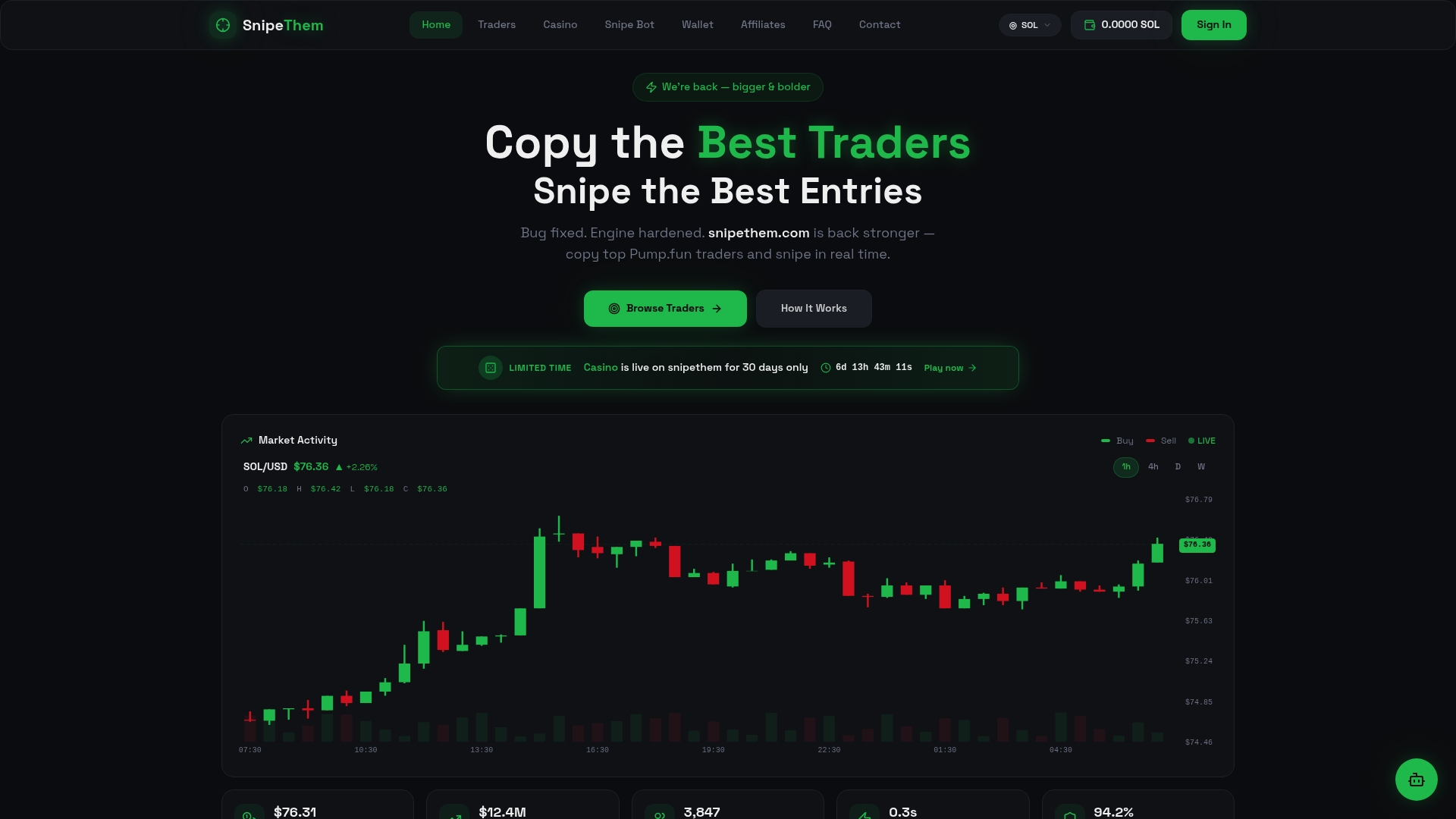
The platform includes 24-hour trader access, automated snipe bot configuration, latency-optimized execution, built-in anti-rug filters, and configurable exit rules including take-profit tiers and trailing stops. Snipethem cites a 94.2% success rate across its automated copy trades, a number worth checking against your own logged results once you start running live copies.
Browse the top Pump.fun traders available for 24-hour copy access or check the snipe bot configuration options to see how automated execution is set up before you commit funds.
Where to Learn More About Pump.fun Copy Trading
For a deeper technical dive, read Chainstack's guide to building a Pump.fun bot, which covers program log subscriptions and bondingCurve account derivation. QuickNode's copy-trade tutorial walks through the fetchSwapTransaction flow in JavaScript. For the research behind manipulation detection, see the multi-agent analysis of bundle and bump bots.
- Want to see the bot's configuration options first? Check the Snipethem bot page.
Frequently Asked Questions
Is whale wallet tracking legal on Pump.fun? Yes. Reading public on-chain data and executing your own trades based on it doesn't violate any Pump.fun terms; the entire mechanism relies on transaction data that's publicly logged on Solana.
How fast does a snipe bot need to react to copy a whale trade? Fast enough to beat the bonding curve's next price increment, typically under a second. Snipethem reports a 0.3-second response time, which is the benchmark to compare any DIY setup against.
Can I track Pump.fun whales without coding? Yes. Paid platforms like Snipethem handle the detection, parsing, and execution automatically, so you configure settings rather than write and maintain code.
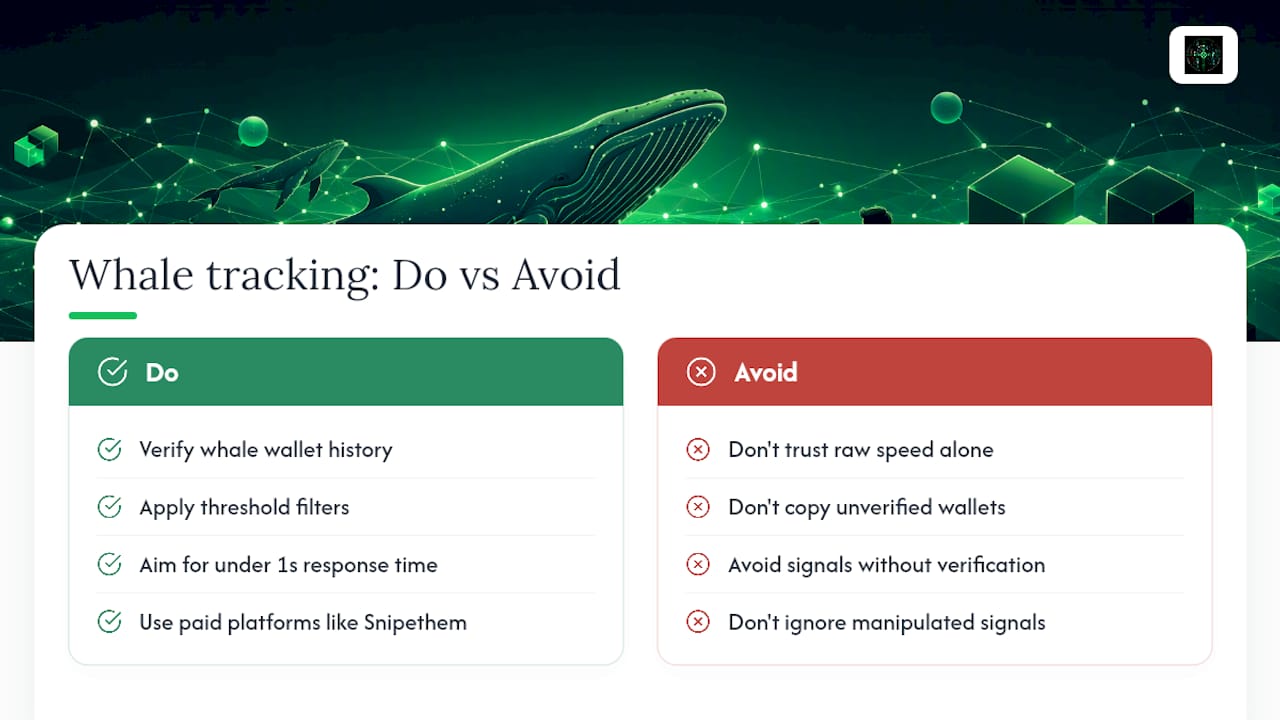
What's the biggest risk in copying whale wallets? Manipulated signals. Bundle bots and comment bots can mimic organic whale activity, so wallet history verification and threshold filters matter as much as raw speed.
This article is general information, not a substitute for advice from a qualified financial advisor. Consult a qualified financial professional about your own circumstances before acting on anything here.
Sources
- Resisting Manipulative Bots in Meme Coin Copy Trading:A Multi-Agent Approach with Chain-of-Thought Reasoning
- Pump.fun copy-trade guide (QuickNode)
- Creating a Pump.fun bot (Chainstack Docs)