
Pump.fun charges a total fee of one point two five percent on every bonding-curve trade, split as about ninety-five hundredths percent to the protocol and about thirty hundredths percent to the token creator. Once a token graduates to a PumpSwap canonical pool, that total fee scales down by market cap tier, ranging from the same fee as bonding-curve trades at the lowest tier down to the minimum fee rate at the highest. Creating a coin costs nothing if you skip the initial buy; adding a buy on creation carries a network fee of roughly 0.025 SOL. Graduation itself deducts approximately 0.015 SOL from the liquidity side. The authoritative sources for live rates are the pump.fun official fee docs, the Fee Program README on GitHub, and on-chain FeeConfig accounts.
Current headline rates (bonding curve, pre-graduation): Total fee 1.25% per trade — protocol receives ~0.95%, creator receives ~0.30%, LP receives 0%. Canonical PumpSwap pool fees range from 1.25% down to 0.30% depending on SOL-denominated market cap. Creation: free (no buy) or ~0.025 SOL (with buy). Graduation: ~0.015 SOL liquidity-side deduction.
These numbers reflect the fee structure documented in the official help center and the pump-public-docs repository as of mid-2026. Verify live values before each trade using the SDK's computeFeesBps function or a direct FeeConfig account read.
Key Takeaways
| Point | Details |
|---|---|
| Bonding-curve fee rate | 1.25% total per trade: ~0.95% protocol, ~0.30% creator, 0% LP. |
| PumpSwap canonical pool tiers | Fees scale from 1.25% down to 0.30% based on SOL-denominated market cap. |
| Creation and graduation costs | Creating with a buy costs ~0.025 SOL; graduation deducts ~0.015 SOL from liquidity. |
| Optional fees add up fast | Priority fees (0.003–0.01 SOL) and MEV protection (0.01–0.03 SOL) stack on top of platform fees. |
| Verify before every trade | Use computeFeesBps in the SDK or read the FeeConfig account on-chain; cross-check pump.fun docs. |
| Snipethem for fee-aware copying | Snipethem's copy-trading bot factors pump.fun fee tiers into execution and profit estimates automatically. |
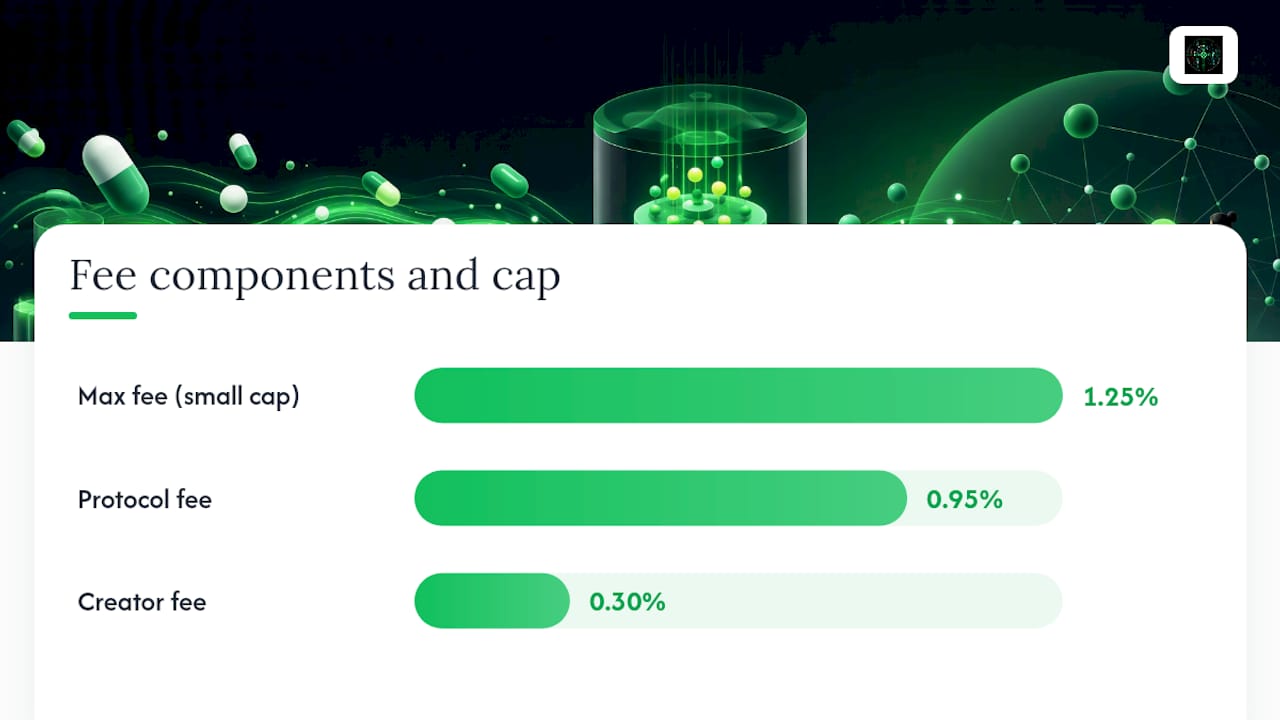
Table of Contents
- What are the pump.fun fees and how are they split?
- How do dynamic fee tiers work and how are fees calculated?
- What other fees and edge cases affect the total cost?
- What do pump.fun's fees look like at protocol scale?
- How do you verify live pump.fun fees before a trade?
- How do pump.fun fees affect trader returns and copy-trading profitability?
- Why the fee model matters more than most traders realize
- Snipethem accounts for pump.fun fees in every copied trade
- Sources
What are the pump.fun fees and how are they split?
Pump.fun uses three fee types: a protocol fee, a creator fee, and an LP fee. Each applies at a different point in the trade flow, and which ones are active depends entirely on where the token sits in its lifecycle.
The protocol fee goes to pump.fun itself. On a bonding-curve trade, it takes roughly ninety-five hundredths percent of the trade value. The creator fee, about thirty hundredths percent, routes to the token creator's vault via the collectCreatorFee instruction, which was added in a mainnet upgrade introducing the Global::creator_fee_basis_points field. Before that upgrade, creators received no direct fee slice.
Pump.fun intentionally avoids a conventional maker/taker fee grid. Fees are state-driven, not volume-driven: the trade state (bonding curve vs. canonical pool) determines the schedule, not the user's trading history or volume tier.
The canonical pool tiers are selected by the on-chain FeeConfig account for that mint. For any given trade, the total fee is the sum of all three components at the applicable tier.
How do dynamic fee tiers work and how are fees calculated?
The shift from a single flat fee to market-cap-based tiers is the most significant structural change in pump.fun's fee model, rolled out as part of Project Ascend and formalized in the Fee Program README. The design intent is straightforward: align creator earnings with token success rather than charging the same percentage regardless of whether a token has $10,000 or $10 million in market cap.
The SDK's computeFeesBps and calculateFeeTier functions handle the logic. At a high level, the sequence is:
- Check whether a FeeConfig account exists for the mint or pool.
- If it does, compute the token's current SOL-denominated market cap.
- Match that market cap against the
feeTiersarray in FeeConfig to select the applicable tier. - Return the basis-point split for protocol, creator, and LP at that tier.
- If no FeeConfig account is present, fall back to the global flat fee values.
The exact lamport thresholds for each tier boundary are readable from the on-chain FeeConfig account.
Pro Tip: Always call computeFeesBps with the current market cap at trade time, not at the time you analyzed the token. Build the SDK call into your pre-trade logic, not just your research phase.
What other fees and edge cases affect the total cost?
Beyond the percentage-based trading fees, several one-off and optional charges can materially change what a trade actually costs.
Creation costs are the simplest: creating a coin with no initial buy is free. Adding a buy at creation triggers a network fee of approximately 0.025 SOL. This is not a platform fee in the traditional sense; it covers the on-chain account initialization and the buy transaction itself.

Graduation deducts approximately 0.015 SOL from the liquidity side when a token migrates from the bonding curve to a PumpSwap canonical pool. Creators and traders watching a token approach graduation should factor this into their expectations for the opening pool liquidity.
Mayhem mode is a special trading state that pump.fun has offered during high-activity periods. When active, it can carry modified fee parameters. Check the official docs for any active Mayhem-mode fee schedule before trading during promotional events.
Priority and MEV protection fees are optional but practically necessary on Solana during congestion. Priority fees typically run 0.003–0.01 SOL per transaction; MEV (front-running) protection fees add roughly 0.01–0.03 SOL. These are set by the user, not the protocol, but they stack on top of the percentage-based platform fee and can dominate the cost of a small trade.
Referral and mobile overlays can alter the net fee on specific transactions. Some third-party interfaces and mobile apps apply their own markup or offer cashback arrangements. If you are trading through an aggregator or a copy-trading bot rather than the native pump.fun interface, confirm whether that layer adds its own fee on top of the protocol's.
Pro Tip: To estimate the true all-in cost of a trade, add the percentage fee (in SOL equivalent at current price) to your expected priority fee and any MEV protection you plan to use. Size accordingly.
What do pump.fun's fees look like at protocol scale?
The aggregate numbers put the fee model in context. DeFiLlama's protocol metrics show pump.fun generating approximately $29.31 million in fees over a trailing 30-day period, roughly $1.23 million in a single 24-hour window, and cumulative fees exceeding $1.166 billion since launch. The Defiant's reporting corroborates the scale of these figures, noting that a substantial portion of user-paid fees converts directly into protocol revenue.
| Metric | Value (trailing period) |
|---|---|
| Fees, 30-day | roughly tens of millions of dollars |
| Fees, 24-hour | slightly over one million dollars |
| Cumulative fees | ~$1.166 billion |
Scale note: At $29.31 million in 30-day fees with the creator slice at roughly 24% of total fees (0.30 out of 1.25 percentage points), creator vaults collectively receive on the order of $7 million per month across all active tokens. Individual creator earnings depend entirely on trading volume for that specific token.
Token Terminal's pump.fun fee explorer provides an independent cross-check on these trailing figures. One important caveat: dashboards that display "annualized" fee figures extrapolate from a short trailing window, which can overstate or understate actual annual run-rate depending on market conditions. Use the 7-day and 30-day trailing figures as the more reliable reference.
How do you verify live pump.fun fees before a trade?
Fee tiers can change with protocol upgrades, so checking live values before a significant trade is worth the two minutes it takes.
- Step 1: Confirm the token's trade state. Is it still on the bonding curve, or has it graduated to a canonical PumpSwap pool? The pump.fun UI shows this, and the on-chain program state is readable via any Solana explorer.
- Step 2: For a graduated token, query the FeeConfig account associated with that mint or pool. The FeeConfig account stores the
feeTiersarray and the current global fallback values. Solana explorers like Solscan or SolanaFM can display this account's data directly. - Step 3: Call
computeFeesBpsorgetFeesfrom the pump.fun TypeScript SDK, passing the current market cap. The return value gives you the exact basis-point split at the current tier. - Step 4: Cross-check the official fee docs for any announced changes to global fallback values or new fee schedules.
- Step 5: Confirm against DeFiLlama or Token Terminal that protocol revenue patterns are consistent with the fee schedule you expect. A sudden drop in protocol revenue relative to volume can signal a fee-schedule change.
Pro Tip: The fastest on-chain verification sequence is: (1) fetch the FeeConfig account for the pool using getProgramAccounts filtered by the FeeProgram ID, (2) deserialize the feeTiers field, and (3) run calculateFeeTier locally with the current market cap. This takes under a second with a standard RPC call and gives you the exact bps before you sign the transaction.
How do pump.fun fees affect trader returns and copy-trading profitability?
Fees compound quickly for active traders. A bonding-curve token at the platform's fee rate means a round trip (buy plus sell) costs double that fee percent of position value before any price movement.
Example calculation for a copy-trader:
- Copy-trader allocates 1 SOL to replicate a buy on a bonding-curve token.
- Platform fee on entry: 1.25% = 0.0125 SOL.
- Token price increases 8% before the copied trader exits.
- Position value at exit: approximately 1.08 SOL.
- Platform fee on exit: 1.25% of 1.08 SOL = 0.0135 SOL.
- Total fees paid: ~0.026 SOL.
- Net gain: ~0.054 SOL (roughly 5.4% return on the original 1 SOL, not 8%).
The fee tier difference alone accounts for nearly 2 percentage points of return per trade.
Creator fees affect copy-traders indirectly: a higher creator fee percentage means more of each trade's value leaves the pool, which can widen effective spreads on low-liquidity tokens. Referral discounts, where available, reduce the protocol slice and improve net returns for high-frequency traders.
Pro Tip: When sizing a copy-trade position, calculate the expected fee drag across the full round trip at the applicable tier before committing. Applying this filter to the top Pump.fun traders you follow will cut the number of marginal trades that look profitable on paper but break even or lose after fees.
Why the fee model matters more than most traders realize
The move to market-cap-based fee tiers is a more consequential design choice than it appears at first glance. Flat fees are predictable but indiscriminate: they charge the same percentage on a $500 token and a $5 million token, which means creators of successful tokens were effectively penalized with the same economics as creators of tokens that never gained traction. The tiered model changes that incentive structure.
What this means practically is that creators now have a financial reason to build tokens that actually grow. A token that reaches a high market-cap tier generates lower fees per trade, which encourages trading volume, which in turn generates more absolute creator revenue even at a lower percentage. The math favors quality over quantity in a way the old flat model did not.
For copy-traders, the implication is equally direct. Copying trades on fresh bonding-curve tokens is the highest-fee environment on the platform. Traders who consistently operate in that space need a much higher win rate to stay profitable than traders who focus on graduated tokens in higher market-cap tiers. Verifying the fee tier before replicating a trade is not optional risk management; it is basic position sizing.
Snipethem accounts for pump.fun fees in every copied trade
Knowing the fee structure is one thing. Having a platform that factors those fees into execution and profit estimates before you commit is another. Snipethem builds pump.fun's fee tiers directly into its bot execution logic, so the profit signals you see on the top traders leaderboard already reflect the applicable fee drag, not just gross price movement.
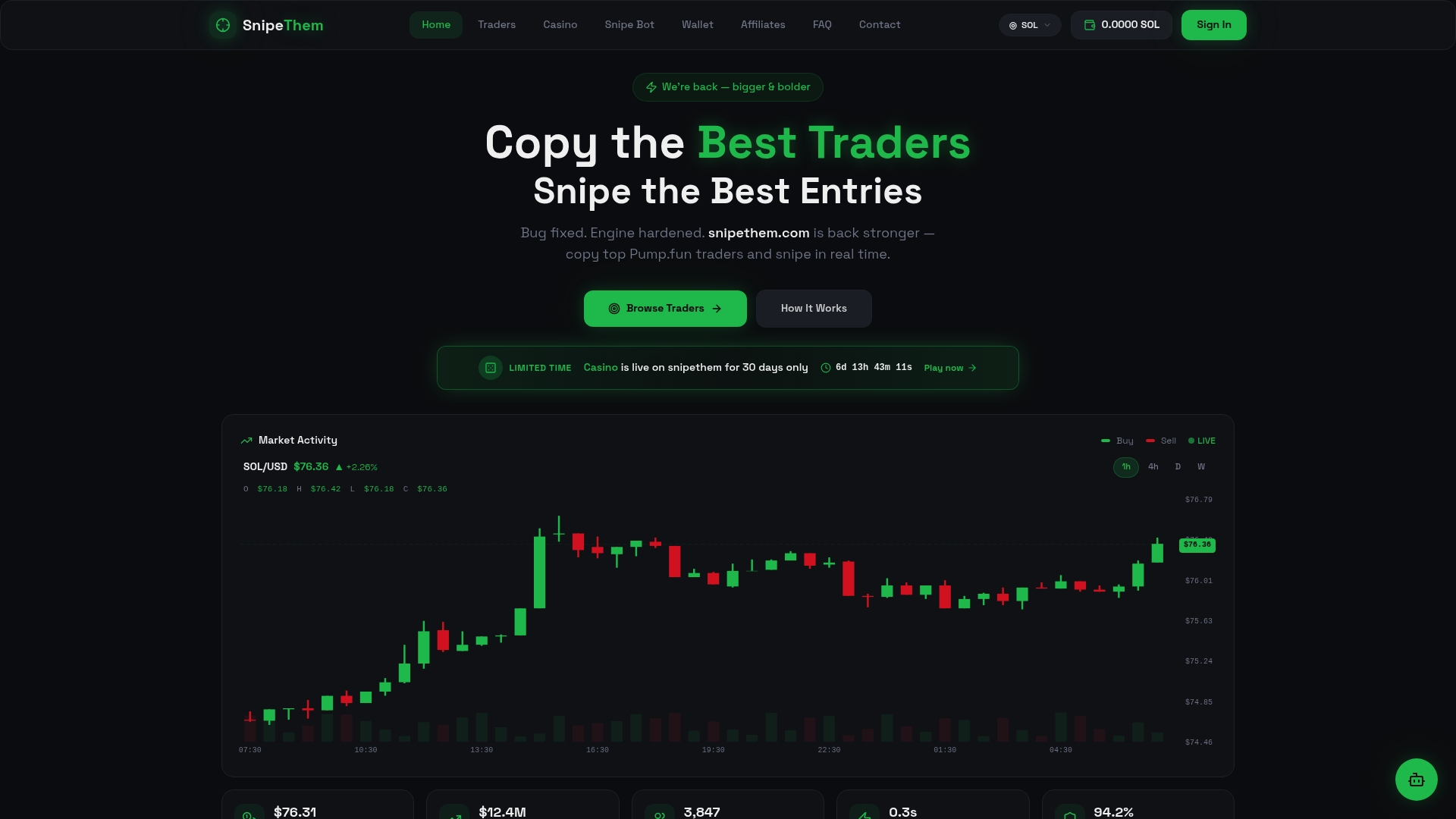
The platform's 0.3-second response time means your copy-trade executes at the same fee tier the original trader faced, not a tier that shifted while a slower system was processing. You can browse live trader rankings, filter by win rate and volume, and configure your snipe bot to replicate strategies with fee-adjusted position sizing built in. Visit Snipethem to review the bot's fee-accounting configuration. Always verify current live fees via the official pump.fun docs before enabling automated replication, as protocol upgrades can change tier thresholds without advance notice.
Sources
The headline numbers in this article were pulled from the following authoritative references:
- Transaction Fees on Pump.fun | Pump.Fun Web Help Center
- pump.fun Fees, Revenue & Volume
- Pump.fun launchpad fee share story — The Defiant
This article is general information, not a substitute for advice from a qualified financial advisor. Consult a qualified financial professional about your own circumstances before acting on anything here.