
Meme coin copy trading works — but only when three conditions are met: you follow wallets with verified, multi-week track records; you execute on Solana, where block times are very fast and fees are very low per transaction; and you apply strict position sizing from day one.
Key Takeaways
Meme coin copy trading on Solana is viable when execution speed, wallet vetting, and conservative position sizing are applied together from the first session.
| Point | Details |
|---|---|
| Start with a burner wallet | Fund a fresh Solana wallet with 0.1–0.5 SOL and run demo mode before any live capital is deployed. |
| Vet wallets rigorously | Follow 3–5 wallets with 50+ trades, 55%+ win rate, and positive realized PnL over at least two weeks. |
| Use conservative parameters | Set COPY_PERCENT to a conservative level and SLIPPAGE_BPS to a moderate range for the first two weeks of live trading. |
| Track metrics weekly | Monitor win rate, fill slippage, realized PnL per wallet, and max drawdown before scaling. |
| Snipethem for faster onboarding | Snipethem provides vetted Pump.fun trader access and built-in execution for traders who want a ready-to-run path. |
Table of Contents
- How does meme coin copy trading actually work on Solana?
- How to set up your first copy trading session step by step
- Which configuration parameters matter most for execution quality?
- What risks and red flags should you check before copying a trade?
- How should you test and scale your copy trading strategy safely?
- What U.S. tax and legal obligations apply to copy trading memecoins?
- Which implementation path fits your situation: DIY bot or Snipethem?
- Snipethem gives you vetted trader access and fast execution from day one
- What most copy traders get wrong about following wallets
- Sources
How does meme coin copy trading actually work on Solana?
Copy trading memecoins follows a straightforward on-chain workflow: a bot or platform monitors a target wallet's public address, detects an outgoing swap on a Solana DEX such as Raydium or Jupiter, and mirrors that trade in your wallet within milliseconds using pre-configured size and filter rules. The entire sequence is public and permissionless, with no API keys from the target wallet needed, only its address.
Speed and fees determine whether a copied trade is profitable or a losing echo of someone else's entry. Solana's low fees and sub-second block times make it the practical default for high-frequency memecoin copying, where a 1–3 second execution delay can convert a wallet's theoretical 5x gain into a 2–3x for the copier, depending on available liquidity. Priority RPCs and Jito bundles help close that gap, but they do not eliminate it entirely.
The five components of any functioning copy setup are:
- Discovery: Identifying and vetting target wallets by win rate, realized PnL, trade count, and average hold time.
- Monitoring: Subscribing to real-time on-chain events via WebSocket or gRPC streams on the target wallet's address.
- Execution: Submitting a mirrored swap transaction with configured size, slippage tolerance, and priority fee.
- Risk rules: Applying per-trade filters — minimum liquidity, token age, holder concentration — before the order fires.
- Reporting: Logging fill price, slippage vs. target wallet entry, realized PnL, and fees per trade for ongoing calibration.
How to set up your first copy trading session step by step
Start with a burner wallet and demo mode. Deploying real capital before validating your configuration against live market conditions is the single most common and costly mistake in copy trading memecoins.
Step 1: Create a burner Solana wallet. Generate a fresh wallet in Phantom or Solflare that has no connection to your main holdings. Fund it with a small amount of SOL strictly for testing. Never paste a mainnet private key into any bot config or shared environment file.
Step 2: Choose your RPC and WebSocket endpoints. Free public RPC nodes introduce latency that makes competitive memecoin execution nearly impossible. Use a private RPC provider or, better, integrate Jito bundles and gRPC streams for the lowest achievable latency. Set both RPC_HTTP and WS_URL in your configuration to the same private node.
Step 3: Select 3–5 target wallets. Pull candidates from a smart-money dashboard or the Snipethem trader marketplace, filtering for wallets with a substantial number of completed trades, a win rate above average, and positive realized PnL over a period of at least two weeks. Avoid wallets with fewer than 20 trades regardless of their win rate — small samples are dominated by luck.
Step 4: Configure your bot or platform. Whether you use an open-source bot or a managed platform, the core variables are the same: COPY_PERCENT, SLIPPAGE_BPS, minimum trade size, and gas/priority tip. See the parameters section below for safe starting values.
Step 5: Run in demo or simulation mode first. Most credible platforms and open-source repos support a paper-trading or dry-run mode. Observe fill prices against the target wallet's entry prices for at least 48 hours before switching to live execution.
Monitor every trade for the first 24 hours.
Pro Tip: During your first 24-hour live session, check fill slippage on every executed trade. Tighten SLIPPAGE_BPS and upgrade your RPC before scaling.
Which configuration parameters matter most for execution quality?
The parameters below directly determine whether a copied trade is profitable or a fee-eroded approximation of the original. Open-source bot repos document these as standard environment variables across both TypeScript and Rust implementations.
| Parameter | Purpose | Conservative value | When to change |
|---|---|---|---|
COPY_PERCENT | Sets trade size as a percentage of the target wallet's position size | 10% | Increase after 2+ weeks of positive realized PnL |
SLIPPAGE_BPS | Maximum acceptable slippage in basis points (150 bps = 1.5%) | 150–200 bps | Widen only for low-liquidity tokens; tighten if fills are consistently better than expected |
MIN_TRADE_SIZE | Filters out micro-trades below a threshold (in SOL) | 0.1 SOL | Lower only if target wallet consistently trades small sizes |
MAX_POSITION | Hard cap on total exposure per token | 0.5 SOL | Raise only after validating strategy over multiple weeks |
GAS_MULTIPLIER / priority tip | Controls transaction priority on the network | priority fee | Raise during high-congestion periods to avoid failed transactions |
Three execution profiles to consider:
- Conservative (recommended for new users):
COPY_PERCENT= 10%,SLIPPAGE_BPS= 150,MAX_POSITION= 0.3 SOL. Prioritizes capital preservation over upside capture. - Moderate:
COPY_PERCENT= 25%,SLIPPAGE_BPS= 200,MAX_POSITION= 1 SOL. Suitable after two weeks of validated positive PnL. - Aggressive:
COPY_PERCENT= 50%+,SLIPPAGE_BPS= 300+. Carries substantially higher drawdown risk and is appropriate only for experienced operators with well-tested wallet selections.
One practical illustration of the latency-slippage relationship: a target wallet buys a token at $0.0010.
What risks and red flags should you check before copying a trade?
Treat every memecoin trade as high risk and complete the following checklist before your bot goes live on any new token or wallet.
Token-level checks:
- Run a honeypot test using a tool such as Rugcheck or Token Sniffer before the bot is authorized to trade a new token.
- Verify liquidity depth: pools with less than $50,000 in liquidity are vulnerable to price manipulation and will produce severe slippage on exit.
- Check token age: tokens under 24 hours old carry substantially higher rug risk.
- Review holder concentration: if the top 10 wallets hold more than 30% of supply, a coordinated dump is a realistic scenario.
- Confirm mint and freeze authority have been revoked on the token contract.
Wallet-level checks:
- Review the target wallet's sell history. A wallet that consistently sells within minutes of buying is likely front-running or participating in coordinated pumps — not a strategy that copies cleanly.
- Cross-reference the wallet's recent trades against known rug-pull token lists.
- Check for sudden changes in trade frequency or position size, which can signal a compromised or sold wallet.
Operational security:
- Never store private keys in plaintext config files or public repositories.
- Use a dedicated burner wallet for each copy session — never your primary holdings wallet.
- Be aware of MEV and front-running risk: on Solana, gRPC and high-speed data streams reduce but do not eliminate the window in which your transaction can be sandwiched.
Pro Tip: Configure an automated pre-trade filter that blocks any token failing two or more of the above checks. A single failed filter should be enough to skip the trade entirely — the opportunity cost of missing one trade is far lower than the cost of a rug.
Warning: If a wallet you are copying shows a sudden, large sell of a position it has held for less than 10 minutes, pause copying from that wallet immediately and review its full recent transaction history before resuming. Sudden exits often precede coordinated dumps that will leave slower copiers holding worthless tokens.
How should you test and scale your copy trading strategy safely?
The safe onboarding plan is: demo mode first, then a burner wallet with 0.1–0.5 SOL, then two weeks of live tracking before any increase in sizing. A practical Solana copy trading guide recommends validating wallets over weeks rather than days and applying slippage and liquidity filters from the first session.
Testing checklist before going live:
- Run the bot in demo/sandbox mode for a minimum of 48 hours and log every simulated fill.
- Compare simulated fill prices against the target wallet's actual on-chain entry prices using a block explorer.
- Confirm that open-source test transactions show your bot is correctly identifying and mirroring the target wallet's swaps.
- Verify that all risk filters (honeypot, liquidity, holder concentration) are firing correctly on known bad tokens.
- Check that your RPC node is delivering events within 500 milliseconds of on-chain confirmation.
Sample starter strategy with concrete numbers:
- Per-trade copy size: 0.1 SOL maximum
- Maximum open positions simultaneously: 3
- Daily loss limit: 0.3 SOL (stop all copying for the day if hit)
- Time-based exit: automatically close any position held longer than 4 hours with no exit signal from the target wallet
- Maximum wallets followed simultaneously: 5
Metrics to track weekly:
- Win rate per wallet (target: above 50% over at least 20 trades)
- Average fill slippage vs. target wallet entry
- Realized PnL per wallet after fees
- Fees paid per trade as a percentage of trade size
- Maximum drawdown in a single session
Never increase sizing after a losing week, regardless of how confident you feel about the next trade.
What U.S. tax and legal obligations apply to copy trading memecoins?
Every swap executed by a copy trading bot is a taxable event under current IRS guidance. Each buy and each sell of a memecoin constitutes a reportable transaction, and realized gains or losses must be calculated using cost basis at the time of each fill. The fact that a trade was automated does not change its tax treatment.
Practical U.S. tax points to understand:
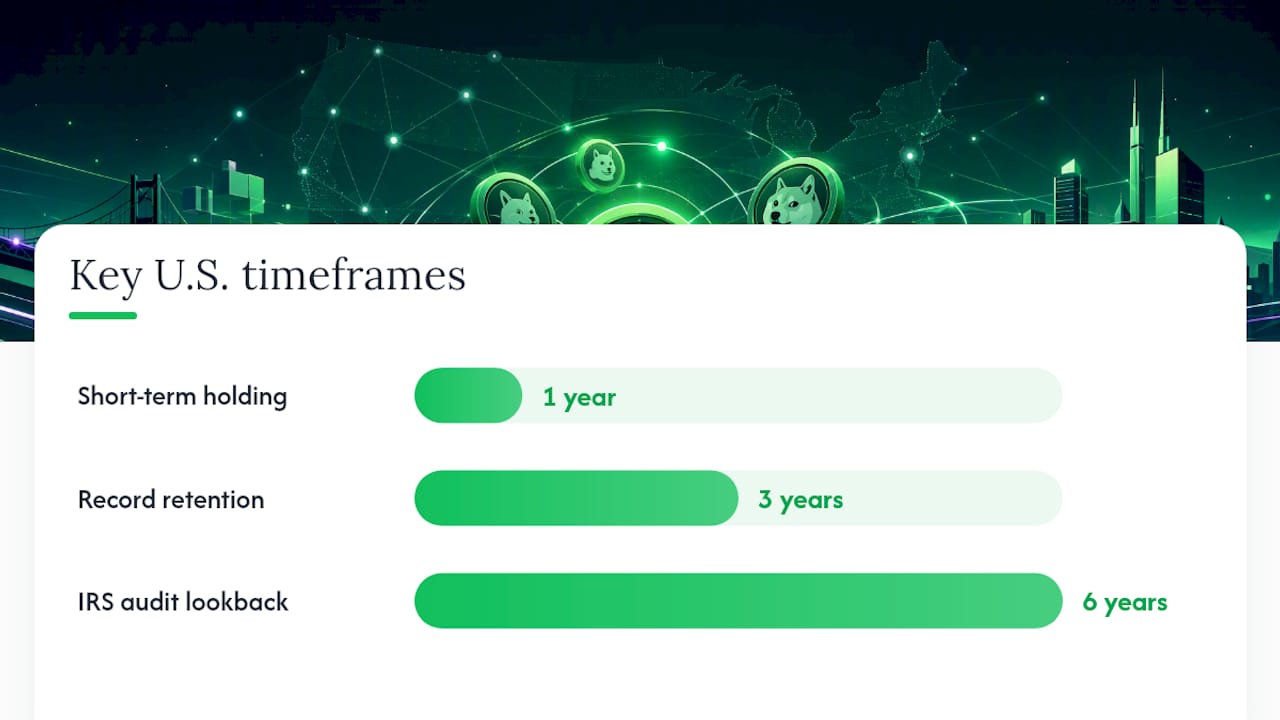
- Short-term capital gains (assets held under one year) are taxed at ordinary income rates, which can reach 37% for high earners.
- Cost-basis tracking is complicated when a bot copies partial position sizes at different fill prices across multiple sessions — each lot must be tracked separately.
- Transaction fees paid in SOL are deductible as part of the cost basis or as a trading expense, depending on how your CPA structures the filing.
- The IRS treats crypto-to-crypto swaps as taxable disposals, meaning swapping SOL for a memecoin and then swapping that memecoin for another token each generate a separate taxable event.
Recordkeeping checklist:
- Export a complete CSV of all bot-executed transactions from your platform or wallet after every session.
- Record fill price, fee paid, timestamp, and token pair for every trade.
- Use a crypto tax tool such as Koinly, CoinTracker, or TaxBit to reconcile on-chain transaction histories with cost-basis calculations.
- Retain records for a minimum of three years; the IRS can audit crypto transactions up to six years back in cases of substantial underreporting.
Tax and legal note: The information above is general background, not tax or legal advice. U.S. tax treatment of cryptocurrency transactions is an evolving area. Consult a CPA with demonstrated crypto experience before filing, and verify current IRS guidance directly at Irs.
Which implementation path fits your situation: DIY bot or Snipethem?
Both paths work. The right choice depends on whether you have the technical infrastructure and time to maintain a self-hosted solution, or whether you prefer a ready-to-run platform with vetted trader access and built-in execution tooling.
DIY open-source bot path:
- Full control over every configuration parameter, execution logic, and data source.
- Open-source examples such as the Four.meme copy trading bot for BNB Chain/PancakeSwap demonstrate real-time wallet mirroring with configurable
COPY_PERCENT,SLIPPAGE_BPS, and gas optimization. - Requires you to provision and maintain private RPC nodes, manage WebSocket subscriptions, handle key security, and update the bot as DEX contracts change.
- No ongoing platform fee, but infrastructure costs (private RPC, server hosting) add up, and any downtime is your responsibility to diagnose and fix.
- Best suited to traders who can run private RPCs, write or modify TypeScript/Rust code, and dedicate time to ongoing maintenance.
Snipethem platform path:
- Vetted Pump.fun trader access via a curated trader marketplace, with rankings, win rates, and realized PnL visible before you commit capital.
- Sniper bot integration handles low-latency execution, removing the need to configure private RPC infrastructure independently.
- 24-hour access sessions purchased with a one-time SOL fee — no long-term subscription lock-in.
- Built-in analytics and risk filter tooling reduce the configuration overhead that trips up most first-time copy traders.
- Demo and trial options allow validation before live capital is deployed.
- Best suited to retail traders who want faster time-to-first-trade and prefer not to manage bot infrastructure.
Decision checklist:
- Choose DIY if: you can provision and maintain private RPCs, you are comfortable with TypeScript or Rust, and you want full control over execution logic.
- Choose Snipethem if: you want vetted trader access, faster onboarding, built-in execution quality, and lower setup overhead.
Snipethem gives you vetted trader access and fast execution from day one
Snipethem addresses the two hardest parts of copy trading memecoins for retail traders: finding wallets worth copying and executing trades fast enough to capture meaningful upside. The platform's trader marketplace lists top Pump.fun traders with verified win rates, realized PnL, and trade histories — so the wallet-vetting work described earlier in this guide is already done before you purchase access.
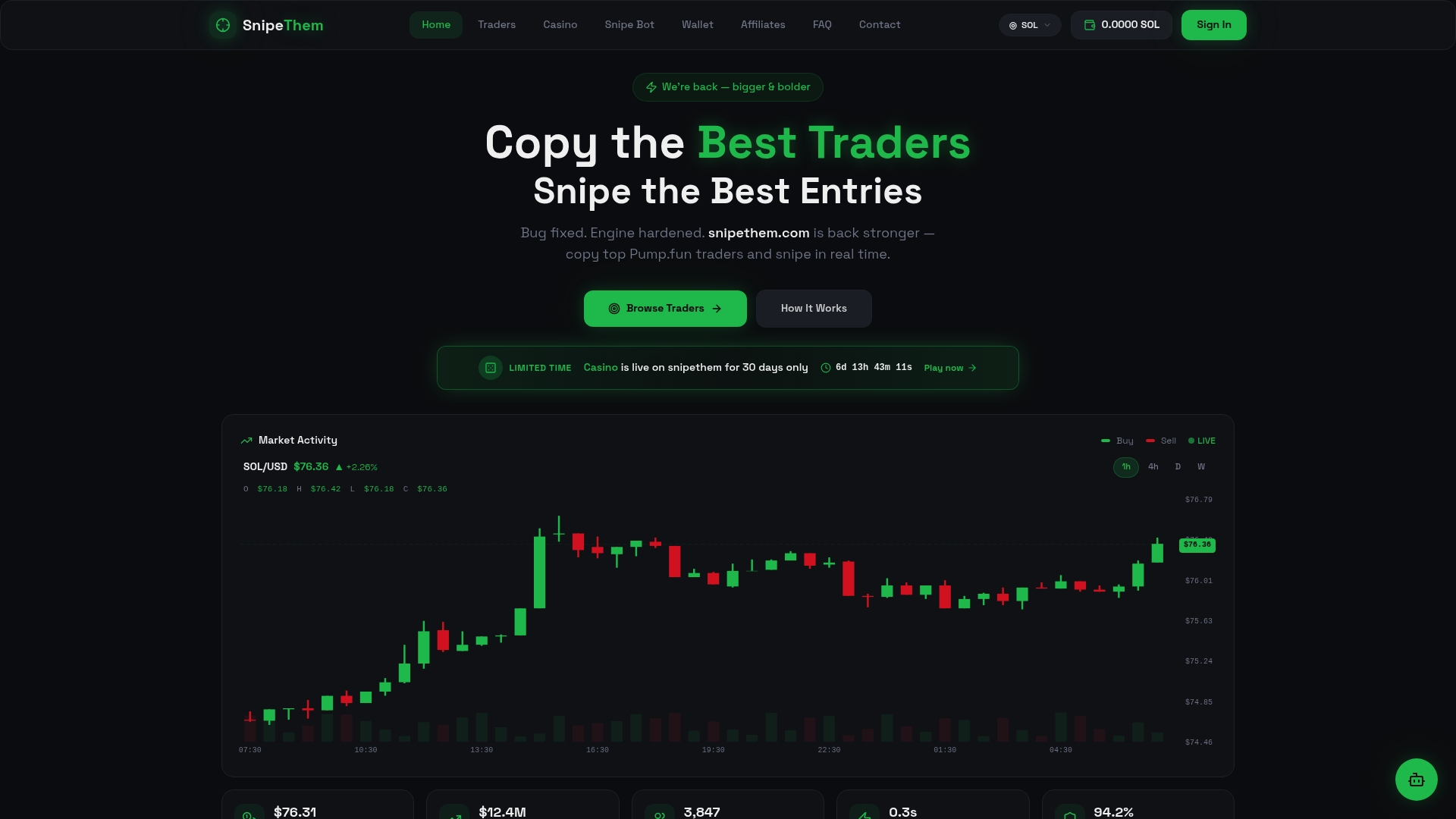
The sniper bot integration handles low-latency execution on Solana, removing the need to configure private RPC nodes or manage WebSocket subscriptions independently. Access is purchased as a one-time SOL fee for a 24-hour copy session, which means no recurring subscription and no long-term commitment. Demo and trial options are available for traders who want to validate fill quality before deploying real capital.
For traders ready to move from setup to live copying, the practical next step is to browse the Snipethem trader marketplace, review the available trader stats, and purchase a 24-hour access session on a wallet that meets the vetting criteria covered in this guide.
What most copy traders get wrong about following wallets
The conventional wisdom in copy trading memecoins is to find the wallet with the highest win rate and follow it. That framing misses the more important variable: sample size. Wallet vetting should prioritize trade count and realized PnL over short-term win rate from a small sample — a principle that most guides mention briefly but few traders actually apply when selecting wallets.
There is a second, less-discussed problem: wallet crowding. When a profitable wallet becomes widely known on a smart-money dashboard, dozens or hundreds of bots begin copying it simultaneously. The target wallet's trades start moving the market before most copiers can fill, which compresses the available upside and widens effective slippage for every follower. The practical response is to rotate wallet selections regularly and avoid any wallet that appears on public leaderboards with more than a few weeks of visibility.
The third misunderstanding is about what copy trading actually guarantees. It does not replicate the target wallet's PnL — it replicates the target wallet's trade signals, subject to your own execution latency, slippage, and fee structure. That gap is not a platform failure; it is the structural reality of on-chain copy execution. Sizing conservatively from the start, as this guide recommends, is the only reliable way to stay in the game long enough to find the wallet selections and configurations that work for your specific setup.
This article is general information, not a substitute for advice from a qualified financial advisor. Consult a qualified financial professional about your own circumstances before acting on anything here.
Sources
The following references were used to build this guide and are worth reviewing directly for technical depth and implementation detail.
- Copy Trading Bot — Automated Wallet Tracking for Solana & EVM | OpenLiquid
- How to Copy Trade on Solana: Complete Guide (2026)
- YALDAKHOSHPEY/solana-copy-trading-bot