
The most reliable way to find meme coins early is to monitor on-chain launch venues directly, especially bonding-curve platforms and their migration events, rather than waiting for a token to trend on social media. Watch for a bonding-curve completion (around a $69,000 market cap on Pump.fun) and the migration transaction that follows, then run fast safety checks before sizing a position.
Act on these signals the moment they appear:
- A migration or new-pair alert firing in real time, not a delayed feed.
- Liquidity amount and whether it's locked (roughly $12,000 gets seeded at migration).
- Holder distribution that isn't dominated by one or two wallets.
Pro Tip: In the first 30 seconds, check only liquidity size and holder count. Skip the chart and skip the Telegram chatter entirely; both waste time you don't have.
Key Takeaways
Finding meme coins early requires monitoring on-chain migration events directly, verifying safety signals within minutes, and executing with pre-set size and slippage rules rather than improvising under pressure.
| Point | Details |
|---|---|
| Watch migration events first | A Pump.fun bonding-curve completion (≈$69k market cap) followed by a migration transaction is the strongest early signal available. |
| Verify before you buy | Check liquidity lock, holder concentration, and contract verification within the first two minutes after an alert fires. |
| Size positions defensively | Cap individual Phase 1 snipes at a small fraction of portfolio value and treat total memecoin exposure as fully at risk. |
| Combine on-chain and social signals | Social virality confirms a trend but lags on-chain data; treat it as secondary confirmation, not a discovery tool. |
| Use copy-trading to close the speed gap | Snipethem gives 24-hour access to proven Pump.fun traders with a 0.3-second response time for faster execution than manual monitoring. |
Table of Contents
- Where Meme Coins Tend to Launch First
- How Do You Verify a Token Is Actually Early?
- What Tools Give You the Fastest, Most Reliable Signals?
- The Step-by-Step Workflow: Monitor, Verify, Act
- How Do You Detect Pump.fun Migrations in Real Time?
- Risk Controls That Actually Prevent Rug-Pull Losses
- Sniping Bots vs. Copy-Trading vs. Manual Buys
- What Legal and Regulatory Rules Apply to Early Meme Coin Trading?
- How Do You Read Community Sentiment Without Getting Fooled?
- How Should You Size Ultra-Early Positions in a Portfolio?
- What I've Learned Chasing Early Entries Long Enough to See the Pattern
- Get From Signal to Execution Without Building a Listener Yourself
- Frequently Asked Questions
- Sources
Where Meme Coins Tend to Launch First
Almost every meme coin that later shows up on a trending list started somewhere quieter. Pump.fun's bonding-curve model is the dominant entry point on Solana: tokens launch with no upfront liquidity pool, trade directly against the curve, and only become tradable on an automated market maker once the curve completes. That completion event, at roughly a $69,000 market cap, triggers a migration that seeds about $12,000 in liquidity into a new pool.
Since March 2025, the overwhelming majority of these graduations route to PumpSwap rather than Raydium, though Raydium's own migration documentation still matters for legacy pools and understanding pool-type behavior.
"Early" has a specific on-chain shape:
- Token age under six hours, often just minutes old.
- Liquidity in the low single-digit thousands of dollars.
- A holder count still in the double digits, not hundreds.
An ideal early snapshot looks like this: a token minted eight minutes ago, $4,200 in liquidity, and 23 holders, none holding more than 6% of supply. That's the window most traders never see because they're watching Twitter instead of the chain.
How Do You Verify a Token Is Actually Early?
Speed without verification is how traders lose money fast in this market. Run through a short checklist before committing capital, and rank each signal by how much it should influence your decision under time pressure.
- Token age: Under six hours strongly favors Phase 1 entry; anything older has likely already been discovered.
- Liquidity in USD: Aim for a minimum threshold of roughly $5,000 to $10,000 to avoid pools too thin to exit.
- Liquidity lock status: Unlocked liquidity means the deployer can pull funds instantly.
- Top-holder concentration: A handful of wallets holding a majority of supply signals coordinated dumping risk.
- Contract verification: Unverified or unusual mint/freeze authorities are a hard stop.
- Bonding-curve completion or migration event: This is the strongest, hardest-to-fake signal available.
Under time pressure, trust signals in this order: migration event first, liquidity lock second, holder spread third, social buzz last. Social virality tends to arrive after the on-chain evidence, not before it, according to Coingecko's research on how traders find new tokens.
Pro Tip: Wash volume and single-wallet liquidity are the two traps that catch experienced traders off guard. If one wallet supplied all the liquidity and also accounts for most of the buy volume, that's not organic demand. It's a setup.
What Tools Give You the Fastest, Most Reliable Signals?
No single feed covers everything, so most serious traders run three types of monitoring at once.
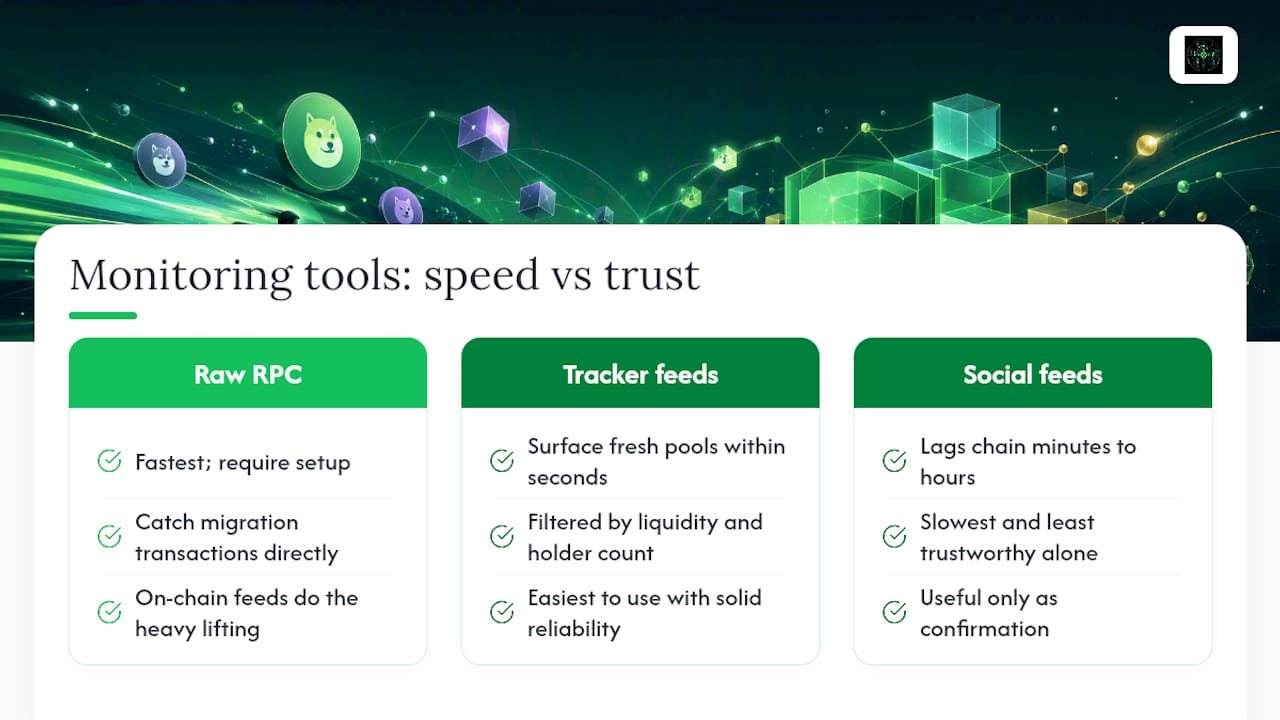
On-chain feeds do the heavy lifting. New-pair trackers similar to what DEXTools documents surface fresh pools within seconds, filtered by liquidity and holder count. For deeper inspection, RPC-based logsSubscribe or programSubscribe connections catch migration transactions directly, and Solscan lets you inspect any transaction or wallet history manually when you need to confirm what an alert claims happened.
Launchpad-specific monitors matter more than generic ones. A Pump.fun or PumpSwap migration listener tells you a token just graduated, which is a fundamentally different (and more valuable) signal than a generic new-pair alert that fires on every deployment, most of which never gain traction.
Social feeds fill the gaps on-chain data can't. Curated X accounts, on-chain analysts, and specific Discord or Telegram channels surface narrative momentum, but they lag the chain by minutes to hours.
Rank these roughly by speed and trust: raw RPC subscriptions are fastest but require setup; GeckoTerminal and similar trackers are easiest to use with solid reliability; social feeds are slowest and least trustworthy alone, useful only as confirmation.
The Step-by-Step Workflow: Monitor, Verify, Act
Every early entry follows the same rhythm, whether you're doing it manually or through automation. The difference between a good trade and a bad one usually comes down to whether you respected the time budget for each step.
- Alert fires (0 to 30 seconds). A migration listener or new-pair feed flags a token. Glance at market cap, liquidity, and age immediately, and discard anything outside your thresholds.
- Verification (30 to 120 seconds). Confirm the contract is verified, liquidity is locked, and no single wallet controls an outsized share of supply. This is where most bad trades get filtered out.
- Execution decision (0 to 10 seconds for sniping tools). If the token passes verification, decide order type. Sniper bots and copy-trading tools operate in this window; manual limit orders are usually too slow here.
- Exit planning (set before you buy, not after). Define your targets and abort signals ahead of time so you're not making decisions in real time under adrenaline.
Concrete parameters that keep this disciplined: risk only a small fraction of your portfolio per Phase 1 snipe, and expect slippage tolerance in a moderate range immediately after migration, since early pools are thin and price moves fast. If liquidity gets pulled or holder concentration spikes after you buy, that's your abort signal, not a "wait and see" moment.
How Do You Detect Pump.fun Migrations in Real Time?
Building or vetting a migration listener comes down to two complementary detection patterns, and running both in parallel matters more than picking a favorite.
logsSubscribe watches for program logs matching known Pump.fun or PumpSwap program activity and fires almost instantly, but it can miss events when logs get truncated. programSubscribe watches account state changes directly, catching what logs miss, at the cost of slightly more noise to filter.
The trigger you're watching for is the bonding-curve completion event, roughly a $69,000 market cap threshold, followed by a migration transaction that seeds approximately $12,000 into a new AMM pool. From that transaction, extract the token mint, pool address, LP mint, blockTime, and transaction signature. Practical detection code parses instructions, matches the programId against known Pump.fun or Raydium program identifiers, then returns structured migration data for downstream logic.
Since PumpSwap's launch, more than 95% of Pump.fun graduations route there instead of Raydium, per GetBlock's migration guide. A listener tuned only for Raydium in 2026 will miss the vast majority of graduations.
Implementation concerns worth planning for upfront:
- RPC provider reliability, since a single dropped connection means missed migrations.
- Versioned transaction handling, since Solana's transaction format has evolved.
- Reconnection and backfill logic for when a WebSocket connection drops mid-session.
- False-positive filtering, since not every program log matches an actual completed migration.
Pro Tip: Run two RPC providers in parallel and treat any discrepancy between them as a signal to double-check with a direct getTransaction call. Relying on one provider is the single most common reason traders miss a migration entirely.
Risk Controls That Actually Prevent Rug-Pull Losses
Ultra-early tokens carry ultra-early risk, and the checklist that filters out most rug pulls takes under two minutes to run.
- Contract verification, with unusual mint or freeze authorities treated as an automatic fail.
- Liquidity-lock status, confirmed rather than assumed.
- Top-holder concentration below a threshold you set in advance, not decided in the moment.
- Renounced ownership, or a clear understanding of who still controls the contract if it isn't.
- Known honeypot indicators, such as a token that allows buys but blocks sells.
Position sizing matters as much as the checklist itself.
Pro Tip: Front-running and MEV bots target the same migration windows you're trying to catch. Setting a tighter slippage bound than you think you need, and letting a failed transaction simply fail rather than resubmitting blindly, avoids getting sandwiched by faster bots.
Sniping Bots vs. Copy-Trading vs. Manual Buys
Execution speed decides outcomes in this window, and each method trades speed against setup complexity differently.
- Sniping bots: Fastest execution, but require wallet custody setup, priority-fee configuration, and carry the highest setup risk if misconfigured.
- Copy-trading: Mirrors a proven trader's entries automatically, needs far less manual skill, and runs at a speed close to sniping bots without the configuration overhead. For more details on how copy-trading and signal-following mechanics work, see How it works · SafeFly.
- Manual buys: Slowest option by far, with the most friction, but gives full control over every parameter for traders who want it.
For a trader who wants execution speed without building infrastructure from scratch, copy-trading through a platform like Snipethem maps directly onto this workflow: replicate a trader who already verifies migrations and safety signals, instead of doing it manually every time.
Pro Tip: Always have a fallback. If an automated snipe fails to fill, don't chase it with a worse-priced manual buy. Walk away and wait for the next signal.
What Legal and Regulatory Rules Apply to Early Meme Coin Trading?
Meme coin regulation varies sharply by country, and no single legal framework governs Solana-based tokens globally. In the United States, the SEC has pursued cases against token issuers it considers unregistered securities offerings, though meme coins with no stated utility or profit-sharing promise occupy a gray area regulators haven't fully settled. The European Union's MiCA framework imposes disclosure requirements on crypto-asset issuers, but enforcement against anonymous, ultra-early launches remains limited in practice.
Tax treatment is where most traders get caught off guard. Nearly every jurisdiction treats a token sale as a taxable event, meaning even a quick flip on a migration snipe generates a reportable gain or loss. Record-keeping matters here: transaction signatures and timestamps from your own wallet activity serve as your audit trail if a tax authority asks.
Anonymity cuts both ways. Anonymous developer teams are common in the bonding-curve launch model, and while that's not illegal on its own, it removes any legal recourse if a project turns out to be fraudulent. Check whether your jurisdiction restricts trading tokens from unregistered or unlicensed platforms, since some countries have moved to limit retail access to decentralized exchanges entirely.
None of this is legal advice specific to your situation. Rules shift quickly, and what's permitted in one country can carry real penalties in another, so verify your local requirements before trading rather than assuming a global standard applies.
How Do You Read Community Sentiment Without Getting Fooled?
Social sentiment is a lagging confirmation signal, not a leading one, and traders who treat it as the primary discovery tool consistently arrive after the best entries are gone. Real engagement looks different from manufactured hype once you know what to check.
Genuine communities show organic conversation patterns: comments referencing the token's actual mechanics, questions about liquidity or holder distribution, and engagement that grows gradually rather than spiking instantly from zero. Manufactured hype tends to show the opposite: a wave of near-identical replies within minutes of launch, accounts with no posting history suddenly active, and enthusiasm with no specific detail behind it.

On-chain data can validate or contradict social buzz quickly. If a token has thousands of social mentions but only 30 holders and $3,000 in liquidity, the mentions are almost certainly bot-driven or purchased engagement rather than real interest. According to Coingecko's research, traders who combine meme virality with on-chain listing location and token activity data make more accurate earliness judgments than those relying on either signal alone.
Practical technique: cross-reference the wallet addresses posting the loudest praise against the token's holder list. If the accounts hyping a token don't actually hold meaningful positions, that's a strong signal the enthusiasm is manufactured rather than organic community formation.
How Should You Size Ultra-Early Positions in a Portfolio?
Ultra-early meme coin exposure behaves nothing like a normal portfolio allocation, and treating it that way is how traders blow up accounts. Most of these tokens lose the majority of their value within days, so position sizing has to assume failure as the default outcome, not the exception.
A workable framework: treat your total memecoin allocation as a small, clearly bounded slice of overall capital, one you're genuinely prepared to lose entirely. This isn't about missing upside. It's about surviving the losing trades long enough to be present for the rare winner that returns multiples.
Diversification within the memecoin sleeve matters too. Spreading capital across several early entries rather than concentrating in one "high conviction" pick reduces the odds that a single rug pull wipes out the entire allocation. Correlation is another overlooked factor: several tokens launched in the same narrative wave (a shared theme, a shared community, a shared influencer push) tend to rise and fall together, so treating them as diversified when they're not is a common mistake.
Finally, separate your memecoin capital from funds earmarked for anything time-sensitive. The volatility here is not a bug. It's the entire mechanism by which early entries generate outsized returns, and it cuts both directions without warning.
What I've Learned Chasing Early Entries Long Enough to See the Pattern
The gap between traders who consistently catch early entries and those who consistently get caught holding a bag isn't intelligence or access to better tools. It's discipline under pressure. Every rule in this piece is easy to state and genuinely hard to follow when a chart is moving and a signal just fired.
FOMO is the single biggest destroyer of otherwise sound setups. The fix is mechanical, not emotional: pre-defined exits and pre-defined size limits, set before you're staring at a live chart.
A few behavioral rules worth internalizing:
- Never override a pre-set exit target because "it feels like it's going higher."
- Treat social virality as confirmation, never as the reason to enter.
- Check whether the same smart-money wallets show up across multiple early winners before trusting a single alert blindly.
Pro Tip: Keep a running log of every migration snipe you take, win or lose. Patterns in your own mistakes surface faster than patterns in the market ever will.
Get From Signal to Execution Without Building a Listener Yourself
Everything in this guide, monitoring migrations, verifying safety signals, sizing positions correctly, still leaves one problem: acting on it fast enough to matter. Snipethem closes that gap by giving you 24-hour copy access to Pump.fun traders who already run this verification process, backed by a 0.3-second response time and an automated snipe bot that executes the moment a signal you've licensed fires.
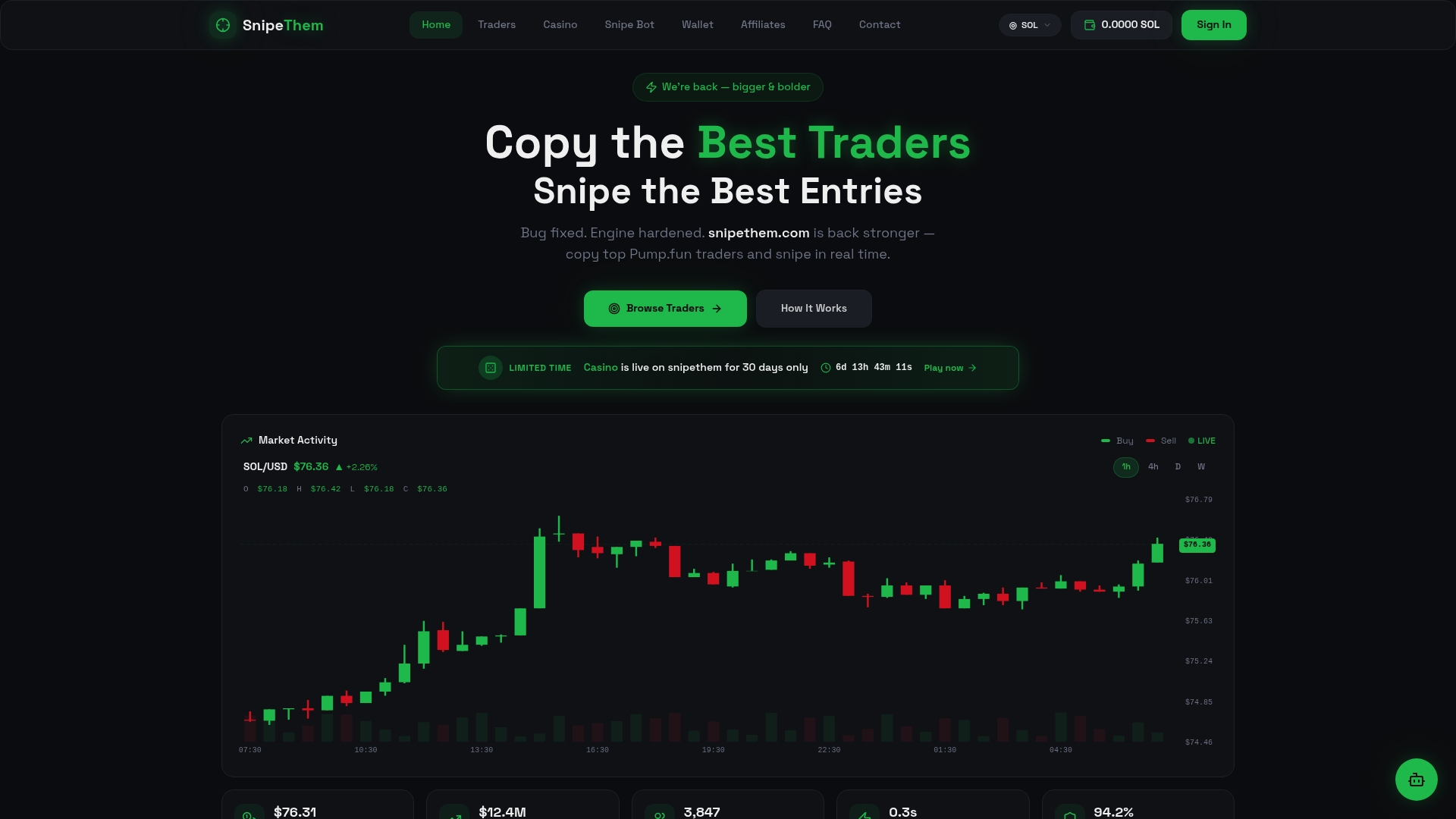
Consider two ways traders use this in practice. First, a trader spots a migration alert manually, then checks Snipethem's top trader rankings to see if a high-win-rate trader already entered that same token, treating the overlap as an extra confirmation layer. Second, a trader with limited time simply buys 24-hour access to a proven trader's history and lets the platform's copy-trading replicate entries in real time, skipping the manual monitoring workflow entirely.
Snipethem doesn't remove risk from ultra-early meme coin trading, no product can. What it removes is the execution lag between spotting an opportunity and acting on it. If the workflow in this guide sounds right but building your own migration listener doesn't, start with Snipethem's trader marketplace and see which trader's history matches the risk profile you're comfortable with.
Frequently Asked Questions
What's the fastest way to find meme coins early? Monitor bonding-curve migration events directly through RPC subscriptions or a dedicated listener, then verify liquidity and holder distribution before acting. Social feeds confirm trends late; on-chain migration data catches them first.
How do you know if you're actually early on a meme coin? Check token age (under six hours), liquidity size (low thousands of dollars), and holder count (double digits). If a token already has hundreds of holders and heavy social buzz, you're likely late.
Is Raydium migration timing still relevant if most tokens move to PumpSwap? Yes, though you should prioritize PumpSwap program activity in your monitoring since it's now the dominant migration destination. Legacy Raydium pools still exist and some tokens still migrate there directly.
What's the safest way to invest in meme coins at the earliest stage? Run a safety checklist (contract verification, liquidity lock, holder concentration) before every trade, and cap position size to a fraction of your total portfolio, since most ultra-early tokens lose most of their value.
Can copy-trading replace manual meme coin research? It reduces the manual workload significantly by letting you replicate a trader who already runs verification steps, but it doesn't eliminate risk entirely. Platforms like Snipethem still require you to choose which trader's strategy fits your risk tolerance.
Sources
- how-to-build-pump.fun-to-pumpswap-and-raydium-migrations-listener-with-getblock.md
- solana-listening-to-pumpfun-migrations-to-raydium
- How Traders Find New Memecoins
- protocol-overview/versions-and-migration