
Degen trading is short-horizon, high-risk crypto speculation on assets like memecoins and new token listings, pursued for outsized returns rather than steady growth. The realistic outcome for most trades is a loss, so treat every position as money you have already decided to lose. The one rule that matters before anything else: fund a burner wallet with an amount you can afford to lose entirely, and set your exit points before you ever click buy.
Key Takeaways
Surviving degen trading depends on capping losses per trade, using burner wallets, and verifying contract safety before every entry.
| Point | Details |
|---|---|
| Define your risk upfront | Treat degen trading as high-risk speculation and only fund it with money you can lose completely. |
| Use burner wallets | Keep degen funds separate from your main holdings to isolate risk from a single bad trade or approval. |
| Cap position and total exposure | Limit single trades to 1% to 3% of your bankroll and total open exposure to 10% to 20%. |
| Check contracts before buying | Verify liquidity locks, mint functions, and holder concentration to avoid rug pulls and honeypots. |
| Use Snipethem for faster execution | Snipethem's copy-trading and sniper bot tools cut execution lag but don't remove the underlying trade risk. |
Table of Contents
- What Is Degen Trading and How Does It Differ From Investing?
- What Mindset and Risk Rules Keep You From Blowing Up Your Bankroll?
- What Are the Core Degen Trading Strategies?
- What Tools Do You Need for Degen Trading?
- How Do You Start Degen Trading Safely?
- What Red Flags Signal a Rug Pull or Honeypot?
- What Are the Regulatory and Tax Rules for Degen Trading?
- What Are the Psychological Risks of Degen Trading?
- How Snipethem Fits Into a Degen Trader's Toolkit
- Get Faster Execution With Snipethem
- Sources
What Is Degen Trading and How Does It Differ From Investing?
"Degen" comes from "degenerate," a term gambling culture reclaimed and crypto traders adopted as a badge of honor rather than an insult, according to Coingecko's glossary. It describes trading that chases social momentum over fundamentals like fully diluted valuation or total value locked. The venues are decentralized exchanges, brand-new token launches, memecoins, and newer Layer 2 or Layer 3 chains where liquidity moves fast and listings can 10x in hours.
Traditional crypto investing looks at adoption curves, tokenomics, and multi-year horizons. Degen trading operates in minutes or days, and the "analysis" is often a wallet tracker, a trending chart, or a Telegram channel lighting up with buzz.
What Mindset and Risk Rules Keep You From Blowing Up Your Bankroll?
Survivability in degen trading comes down to a handful of enforceable rules, not willpower. Volatility and total-loss risk are baked into this style of trading, so the rules exist to contain damage when a trade goes wrong, not if.
- Cap any single trade at 1% to 3% of your total degen bankroll, never your life savings.
- Set a hard ceiling on total exposure across open positions to a limited portion of that bankroll at once.
- Decide your exit price and your stop loss before entry, and write it down.
- Never chase a token after missing the entry; there is always another listing.
- Use a dedicated burner wallet funded only with what you can lose, never your main holdings.
Pro Tip: Move your "degen budget" into a separate wallet monthly, like an allowance. When it's gone, you stop until the next cycle. This removes the temptation to top up mid loss streak.
What Are the Core Degen Trading Strategies?
Most degen plays fall into a few repeatable patterns, and degens generally chase new tokens, memecoin momentum, and listing jumps instead of fundamentals.
- Sniping new listings: buying within seconds of a token's liquidity pool going live, betting on the first wave of buyers pushing price up before anyone can react.
- Narrative-driven memecoin plays: riding a trending theme, an animal coin, a meme tied to news, or a celebrity mention, where price moves on attention rather than utility.
- Liquidity hunts: watching where large wallets ("whales") move funds and following capital into freshly deployed pools.
- Speculative liquidity provision: depositing into new pools for high yield, accepting impermanent loss and rug risk in exchange for early rewards.
- Pre-listing and momentum trades: accumulating before a known exchange listing or unlock event, then selling into the volume spike.
Every one of these compresses the holding period to hours or less, and traders pursuing 100x or larger returns accept that most attempts end at zero.
What Tools Do You Need for Degen Trading?
Speed decides outcomes in this style of trading more than research depth does, and scanners, social signals, and bots form the backbone of how modern degens operate.
- Token discovery screens and on-chain scanners surface new pairs, volume spikes, and wallet activity in real time.
- Sniper and limit-order bots execute entries in fractions of a second, since manual clicking is too slow once a pool is public.
- Block explorers and contract-safety checkers flag suspicious functions, ownership renouncement status, and liquidity lock details before you buy.
- A properly funded wallet with gas buffer matters as much as the trade itself; failed transactions from underpriced gas can cost you the entry window entirely.
Slippage tolerance settings also belong here. Too tight and your trade fails during volatility; too loose and a thin-liquidity token can drain value on the swap itself.
How Do You Start Degen Trading Safely?
A first trade should follow a fixed sequence, not a gut feeling. This checklist mirrors what experienced degens use to avoid the most common execution mistakes.
- Create a burner wallet separate from any wallet holding real savings, and fund it only with your predetermined loss limit.
- Scan for opportunities using a token screener or trending feed, and shortlist anything with rising volume or narrative buzz.
- Run safety checks before entry: confirm liquidity is locked, check for mint or blacklist functions in the contract, and review holder distribution for one wallet controlling an outsized share.
- Set your slippage conservatively, usually 5% to 15% depending on the token's liquidity depth.
- Enter with a small position, then immediately set a partial take-profit order and a mental (or automated) emergency exit price.
- Log the trade: entry price, size, reasoning, and outcome, win or lose.
A few habits make this repeatable:
- Never skip the contract check, even when a call comes from a trusted channel.
- Take partial profits on the way up instead of waiting for a peak you can't predict.
- Review your trade log weekly to spot which setups actually work for you.
What Red Flags Signal a Rug Pull or Honeypot?
Most catastrophic degen losses trace back to a handful of repeatable warning signs, not bad luck. High volatility and total-loss risk are structural features of this market, not edge cases.
- Owner concentration: if one wallet holds more than 20% to 30% of supply, that wallet can dump on you at any time.
- Active mint functions: a contract that can create new tokens at will can dilute your holding to nothing.
- Unlocked or short-locked liquidity: if the developer can pull liquidity, the token can go to zero in one transaction.
- Honeypot mechanics: some contracts let you buy but block or heavily tax sales, trapping your funds.
- Thin liquidity: a small pool means even a modest sell order crashes the price through slippage alone.
Survivorship bias compounds all of this. Publicized 100x wins represent a sliver of total attempts, and the losses rarely get screenshotted. FOMO fills that gap, pushing traders into positions with no exit plan simply because a chart is green.
What Are the Regulatory and Tax Rules for Degen Trading?
Tax treatment of degen trading follows the same principle as any other crypto activity in most jurisdictions: every swap, sale, or token exchange is typically a taxable event, not just cashing out to fiat currency. Selling a memecoin for a stablecoin, swapping one token for another, or moving into a different chain's native asset can each trigger a capital gain or loss calculation depending on your country's rules.
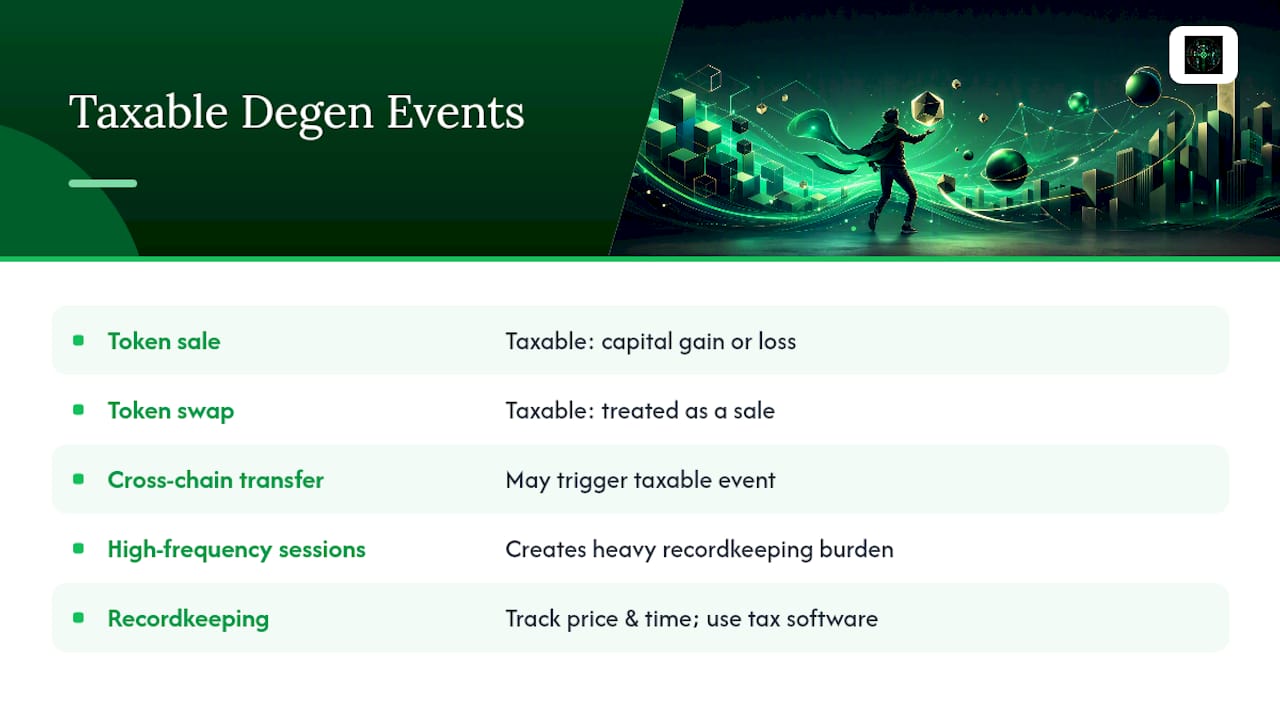
Given the pace of degen trading, this creates a real recordkeeping problem. A single sniping session can generate dozens of taxable transactions in an hour, and reconstructing cost basis months later from a blockchain explorer is painful. Track every entry price, exit price, and timestamp as you go, ideally through wallet-connected tax software rather than a spreadsheet you fill in later.
Regulatory oversight of decentralized exchanges and new token launches also varies enormously by country, and many jurisdictions are still writing the rules for this specific activity. Some regulators treat certain tokens as unregistered securities depending on how they were marketed and distributed, which can affect platform access or reporting obligations. None of this is legal advice, and the right approach depends on your residency and local law, so a tax professional familiar with crypto is worth the cost once your trade volume grows past a handful of transactions a year. What holds everywhere: keep records as you trade, not after, and never assume a decentralized exchange means the activity is invisible to tax authorities.
What Are the Psychological Risks of Degen Trading?
Losses in degen trading don't feel like ordinary investment losses. They happen fast, often within minutes of entry, and the speed makes the emotional hit sharper than a slow-moving stock decline. That immediacy is part of what makes this style of trading psychologically sticky. A win pays out in real time, on-chain, visible in your wallet balance, and that instant feedback loop shares more in common with gambling mechanics than with long-term investing.

Recognize the addiction pattern early: chasing a loss with a bigger position to "win it back," trading when tired or emotional, or checking charts compulsively between trades are all warning signs, not personality quirks. Framing this activity as high-risk speculation rather than skill-based investing helps set realistic expectations before losses start affecting decisions outside the trade itself.
Build in structural breaks. A fixed daily or weekly loss limit that forces you to stop, regardless of how confident the next setup looks, protects you from tilt better than any amount of discipline in the moment. If degen trading starts affecting sleep, relationships, or spending outside your designated bankroll, that's a signal to step back entirely, not adjust your strategy. Treat losing streaks as data to review in your trade log, not personal failures to fix by doubling down.
How Snipethem Fits Into a Degen Trader's Toolkit
Execution speed separates profitable snipes from missed entries, and manual clicking increasingly loses to automated bots on fast-moving chains. Snipethem lets traders copy top Pump.fun traders in real time, citing a 0.3 second response time and a 94.2% success rate on tracked strategies. Faster execution and copied strategies improve your odds of entering well, but they do not remove the underlying risk. Every rule in this guide, from bankroll caps to contract checks, still applies.
— dang
Get Faster Execution With Snipethem
If you've read this far and you're already comfortable with degen risk, the next constraint is speed, not knowledge. Snipethem gives you 24-hour copy access to top-performing Pump.fun traders, so instead of manually scanning charts and racing bots to a new listing, you replicate a track record in real time.
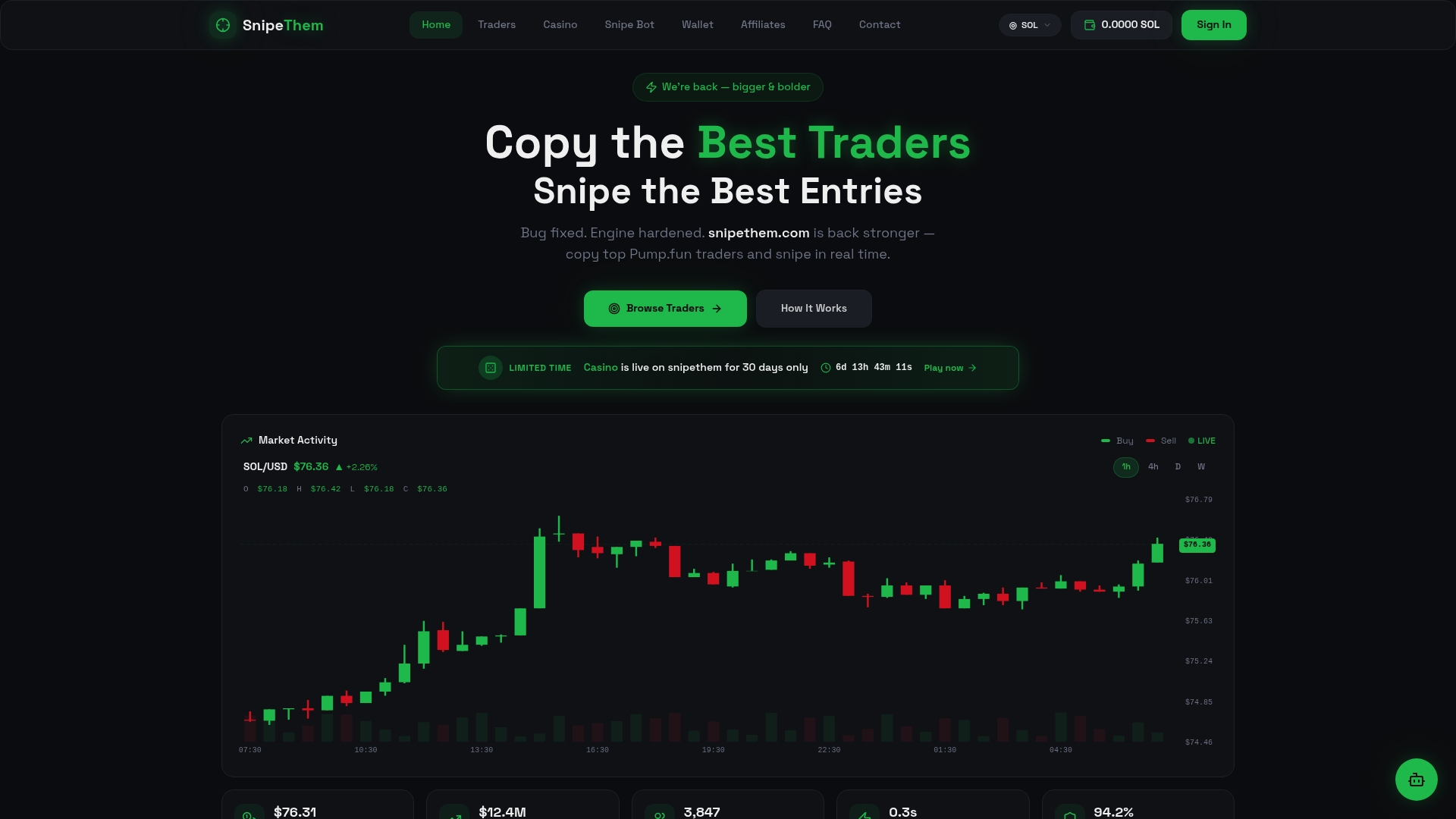
For traders who want to run their own entries instead of copying, the Solana sniper bot handles execution speed on new pairs directly. Either route still requires the same bankroll discipline covered above: fund only what you can afford to lose, and read Snipethem's platform terms before connecting a wallet. Start by browsing current top traders and their tracked win rates to see if copy access fits how you already trade.
Sources
For deeper background on terminology and risk, see Equals Money's glossary entry, KuCoin's explainer on degen culture and tools, and Bitcoin Foundation's analysis of the 1000x chase. To act on copy-trading data directly, visit Snipethem.
- What Is Degen Trading? | Financial Glossary
- What is Degen in Crypto | KuCoin
- Degen Crypto Explained: Why High-Risk Traders Are Chasing 1000x Gains Again - Bitcoin Foundation
- Degen (Coingecko glossary)