
The fastest way into copy trading no code requires is a hosted Auto Copy service, and for meme coins specifically, that means Snipethem. If you want fully custom rules instead of a preset strategy, a visual no-code builder gives you that flexibility without touching a programming language. Both routes let you replicate another trader's activity automatically, with no scripts, no bots you have to build yourself, and no technical background required.
Here's the shortlist, sorted by what each option actually solves:
- Snipethem — recommended for meme-coin snipe copying on Solana; buy 24-hour access to a top Pump.fun trader's history and let the platform mirror their moves in near real time.
- Hosted Auto Copy marketplaces — best for prediction markets and DEX-style copying where you want filters and sizing logic between the signal and your wallet, not a blind mirror.
- Visual no-code builders — best for traders who want to design their own rule sets across multiple assets without writing code.
Pro Tip: Match the platform to the timeframe you're actually trading. Meme coins move in minutes, not days, so a hosted, low-latency option matters more than a builder with a steep learning curve.
Key Takeaways
No-code copy trading works best when you match the platform category to your market and timeframe, and verify performance and fees before allocating capital.
| Point | Details |
|---|---|
| Match category to goal | Choose hosted Auto Copy for guardrails, builders for custom rules, Snipethem for meme-coin speed. |
| Test before funding | Use demo or paper trading wherever it's offered before committing real capital. |
| Verify performance claims | Prefer platform-tracked trader statistics over self-reported returns in marketing copy. |
| Cap allocation per trader | Keep any single copied trader or strategy under a small share of total risk capital. |
| Snipethem for meme coins | Buy 24-hour access to a Pump.fun trader's history for fast, no-code snipe-bot replication. |
Table of Contents
- What Is Copy Trading No Code and How Does It Compare?
- What Should You Know Before Picking a No-Code Copy Platform?
- How Do You Choose the Right No-Code Copy Trading Platform?
- How Does No-Code Copy Trading Actually Work?
- What Do Regulators and Researchers Say About Copy Trading Risk?
- Our Take on Getting Started Fast
- Ready to Start Copy Trading Without Writing a Line of Code?
- Frequently Asked Questions
- Sources
What Is Copy Trading No Code and How Does It Compare?
No-code copy trading platforms let a trader replicate someone else's positions or run automated rule sets without writing a single line of code. Instead of building a bot from scratch, you configure settings through a dashboard: how much capital to allocate, which trader or strategy to follow, and what guardrails should stop a trade before it executes. Copy trading itself works by mirroring another trader's positions in real time, and the "no-code" layer is what makes that mirroring configurable by anyone, not just developers.
The category splits into four practical buckets, and each one solves a slightly different problem.
| Category | Best For | No-Code Features | Markets Supported | Pricing Shape | Performance Transparency | Risk Controls | Demo/Paper Testing |
|---|---|---|---|---|---|---|---|
| Hosted Auto Copy marketplace | Prediction markets and DEX-style copying with guardrails | Filter and sizing logic set via dashboard toggles | Crypto, prediction markets | Subscription or per-copy fee | Varies by provider; some publish win rates | Sizing filters, allocation limits | Often available |
| Exchange-native copy trading | Traders already inside a major exchange ecosystem | Built-in copy toggle, minimal configuration | Crypto, sometimes forex | Often free with spread markup | Trader leaderboards, follower counts | Basic stop-loss, allocation cap | Sometimes, exchange-dependent |
| Visual no-code builder | Custom rule-based automation across assets | Drag-and-drop logic, webhook triggers | Crypto, forex, stocks | Subscription tiers | Backtested results, not always live-audited | Fully customizable by the user | Usually included |
| Snipethem (meme-coin snipe copy) | Fast entry into Pump.fun trader replication | 24-hour access purchase, automatic snipe bot configuration | Solana meme coins | One-time SOL payment per 24-hour access | Live trader rankings and win-rate stats | Bot-level allocation settings | Not the primary use case; access is time-boxed |
"No-code features" in this table means anything you configure through menus, sliders, or toggles rather than through a scripting environment. A "filter" is a rule that blocks a copied trade from executing unless it meets a condition you set, like a maximum position size or a minimum trader confidence score.
Editorial guides comparing copy trading platforms consistently flag four criteria that matter most to users: verified performance, fee transparency, demo testing, and regulatory standing. Those four should anchor your own evaluation, no matter which category you're leaning toward.
Statistic Callout: ESMA's supervisory briefing on copy trading specifically calls out weak transparency and inconsistent suitability checks as recurring problems across copy trading platforms, which is exactly why fee disclosure and verified track records deserve more scrutiny than marketing copy.
Pro Tip: If a platform doesn't disclose exactly how fees are charged, whether that's a flat subscription, a per-copy fee, or a spread markup, treat that opacity as a warning sign rather than an oversight.
Integrations vary widely too. Some tools connect through TradingView webhooks and MT4/MT5 execution for cloud-based, no-VPS automation. Others, like Snipethem, are purpose-built around a single blockchain ecosystem, which trades broad market coverage for speed and specialization.
What Should You Know Before Picking a No-Code Copy Platform?
Every category above earns its place for a different kind of trader. Here's what actually matters once you get past the marketing page.
Hosted Auto Copy marketplaces work well when you want structure between the signal and your money. Products in this space typically apply filters, sizing logic, and paper-trading modes so a copied trade isn't just a blind mirror of whatever the source trader does. Setup usually takes under 15 minutes: connect a wallet or account, pick a trader or strategy feed, set your allocation cap, and turn it on.
- Ease of use: high, once you understand the filter settings.
- Speed to live: fast, typically same-day.
- Customizability: moderate. You're working within the provider's rule framework, not building your own from scratch.
- Beginner suitability: strong, especially with paper trading available.
The common pitfall here is treating the filters as a formality instead of the safety layer they're meant to be. A sizing filter set too loose defeats the purpose of having one at all.
Pro Tip: Start every hosted Auto Copy setup with the tightest allocation cap the platform allows, then loosen it only after a week of live monitoring.
Exchange-native copy features appeal to traders who already hold funds on a major exchange and don't want to move capital elsewhere. The tradeoff is flexibility: you get whatever copy settings the exchange decided to build, and customization tends to be minimal. Fee structures are often folded into the spread rather than charged as a visible line item, which makes cost comparison harder than it should be.
- Ease of use: very high, since it's built into an interface you already know.
- Speed to live: immediate, no new account required.
- Customizability: low.
- Beginner suitability: good for a first try, weaker for anyone wanting granular control.
The pitfall with exchange-native tools is assuming leaderboard rank equals reliability. A trader can rank highly on short-term returns while carrying risk exposure that a longer track record would expose.
Visual no-code builders are the right call when you have a specific strategy idea and want to test it before risking capital. These builders let you express conditional logic, entry and exit rules, and multi-asset triggers through a drag-and-drop interface rather than code, which makes your logic reproducible instead of something you remember doing manually last Tuesday.
- Ease of use: moderate; there's a learning curve for the logic-building interface itself.
- Speed to live: slower, often a few days to properly test and refine.
- Customizability: highest of any category here.
- Beginner suitability: decent for patient learners, frustrating for anyone wanting instant results.
The pitfall is over-engineering a strategy with so many conditions that it rarely triggers, or backtesting on a narrow window that doesn't reflect real market conditions.
Snipethem occupies a distinct niche: fast, no-code access to real trader histories on Pump.fun, built specifically for Solana meme-coin activity. Instead of a subscription, you pay a one-time fee in SOL to unlock 24 hours of copy access to a specific trader's history, then configure a snipe bot to replicate their trades automatically. You can also browse trader rankings and statistics before committing to a purchase, which gives you a performance snapshot most exchange-native tools don't surface as clearly.
- Ease of use: high. The purchase-and-configure flow is designed for speed.
- Speed to live: immediate once access is purchased.
- Customizability: focused rather than broad. You're configuring bot parameters around a specific trader, not building open-ended logic.
- Beginner suitability: strong for anyone specifically targeting meme-coin momentum, less useful if your interest is forex or equities.
Snipethem fits best when speed matters more than breadth, and when you're comfortable with the short-term, high-volatility nature of meme-coin trading. If your goal is diversified exposure across forex and stocks, a visual builder or a broader marketplace suits you better.
Pro Tip: Treat any 24-hour access window as a single, self-contained experiment. Track the outcome before buying access to a second trader, rather than stacking multiple unproven copies at once.
How Do You Choose the Right No-Code Copy Trading Platform?
Run through this checklist before you fund any account, no matter which category you're leaning toward:
- Check for demo or paper trading. Platforms that offer paper testing let you validate a strategy or trader's behavior without risking capital first.
- Verify performance claims. Look for trader statistics that are platform-tracked or independently auditable, not just self-reported numbers in a promotional graphic.
- Read the fee structure line by line. Distinguish between subscription costs, per-copy fees, and spread markups, since these compound differently over time.
- Confirm deposit and withdrawal mechanics. Know the minimum deposit, any withdrawal delay, and whether funds are held on the platform or in a wallet you control.
- Match supported markets to your goals. A platform built for forex copying won't serve you well if your actual interest is Solana meme coins, and vice versa.
- Check integrations if you plan to scale up. MT4/MT5 compatibility or webhook support matters if you eventually want to layer in your own signals.
- Look for regulatory or membership status. A platform's standing with a body like the NFA signals a baseline level of compliance oversight, though not every crypto-native platform will carry this kind of registration.
Ask these questions directly, and be suspicious of vague answers:
- Does the platform disclose slippage or execution latency, or just headline returns?
- Is the trader's track record verified by the platform itself, or purely self-reported?
- What happens to your allocation if the source trader stops trading mid-session?
- Are there caps on how much of your capital can be allocated to a single trader or strategy?
Watch for these red flags, which show up more often than they should:
- Performance figures with no timeframe or sample size attached.
- No paper trading or demo mode offered at all.
- Fee disclosure buried in fine print instead of stated upfront.
- Withdrawal processes that require support tickets rather than self-service.
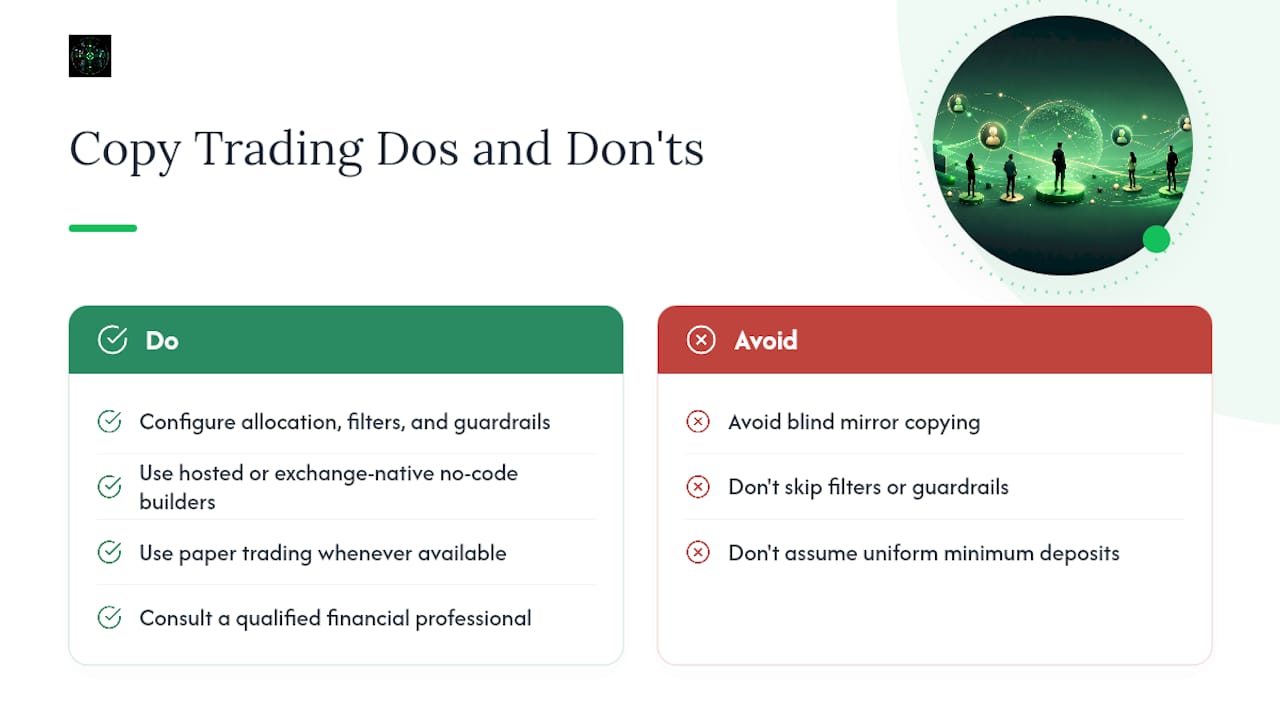
For risk management defaults, cap any single copied trader or strategy at a small percentage of your total risk capital, diversify across at least two or three sources rather than one, and set a stop-loss guardrail wherever the platform allows it. Testing with the smallest allocation the platform permits, or using paper trading first, costs you nothing but time.
Pro Tip: Write your allocation rules down before you fund the account. Deciding "no more than 5% per trader" in a calm moment beats deciding it mid-trade when a position is already moving against you.
How Does No-Code Copy Trading Actually Work?
The mechanics are simpler than the terminology suggests. Here's the flow from signup to your first live copy:
- Choose a provider or marketplace. Decide whether you want a hosted Auto Copy service, an exchange-native tool, a visual builder, or a focused platform like Snipethem for meme coins.
- Pick a trader or strategy. Review available performance data, rankings, or backtested results before committing.
- Allocate funds. Decide how much capital goes toward this specific copy, keeping it a small fraction of your total trading capital.
- Configure guardrails. Set filters, sizing limits, or stop-loss rules depending on what the platform allows.
- Enable Auto Copy. Turn the automation on and let the platform begin mirroring trades according to your settings.
- Monitor and adjust. Check execution quality, review performance regularly, and adjust allocation or guardrails as needed.
Execution models differ in how much control sits between the source trader and your account. Blind mirror copying replicates every trade exactly as the source trader makes it, with no filtering. Filtered Auto Copy applies rules, like minimum trade size or maximum exposure, before a copied trade executes. Rule-based automation built in a visual no-code builder gives you the most control: you define the conditions from scratch rather than inheriting someone else's trade-by-trade behavior. Trade sizing in each case usually scales proportionally to your allocated capital relative to the source trader's account size, though the exact scaling logic varies by platform.
Pro Tip: Always start with paper trading or the smallest real allocation the platform allows, and watch execution latency and slippage closely for the first several trades before scaling up.
What Do Regulators and Researchers Say About Copy Trading Risk?
Regulatory scrutiny of copy trading isn't hypothetical. ESMA's supervisory briefing specifically flags transparency gaps and inconsistent suitability checks as recurring issues across copy trading platforms, and recommends stronger oversight from the platforms themselves. That's a direct signal to check a platform's disclosure practices before assuming automated mirroring means automated safety.
Academic research adds a structural layer to this concern. A study on algorithmic and platform-mediated trading shows that platform design choices can shape how information spreads and how markets respond, which means the platform itself is never a neutral pipe between trader and follower.
Past performance from a copied trader says nothing certain about future results. Platform features, filters, and disclosure practices shape outcomes just as much as the trader's own skill does.
Before funding any account, verify the trader's track record is platform-tracked rather than self-reported, confirm demo testing is available, and read the fee disclosure in full. Those three checks catch most of the problems regulators are actually worried about.
Our Take on Getting Started Fast
Start small: use demo or paper trading first, then allocate under 5% of your risk capital to any single copied trader or strategy. Spread that risk across a few traders instead of one, since diversification does more for a beginner's survival than picking the "best" single trader ever will.
For meme-coin snipe-copy specifically, Snipethem fits the job better than a general-purpose builder, because speed and short-term focus matter more here than broad customization. If your interest is forex or equities instead, a visual builder or exchange-native tool will serve you better.

Pro Tip: Set an exit rule before you enter, not after. Fast-moving tokens punish traders who wait to decide what "too late" looks like.
Ready to Start Copy Trading Without Writing a Line of Code?
Snipethem gets you into meme-coin copy trading faster than any general-purpose builder can, because there's no strategy to design and no bot to configure from scratch. You browse top Pump.fun traders by rank and win rate, pay a one-time fee in SOL for 24-hour access to a trader's history, and let the platform's automatic snipe bot replicate their moves in real time.
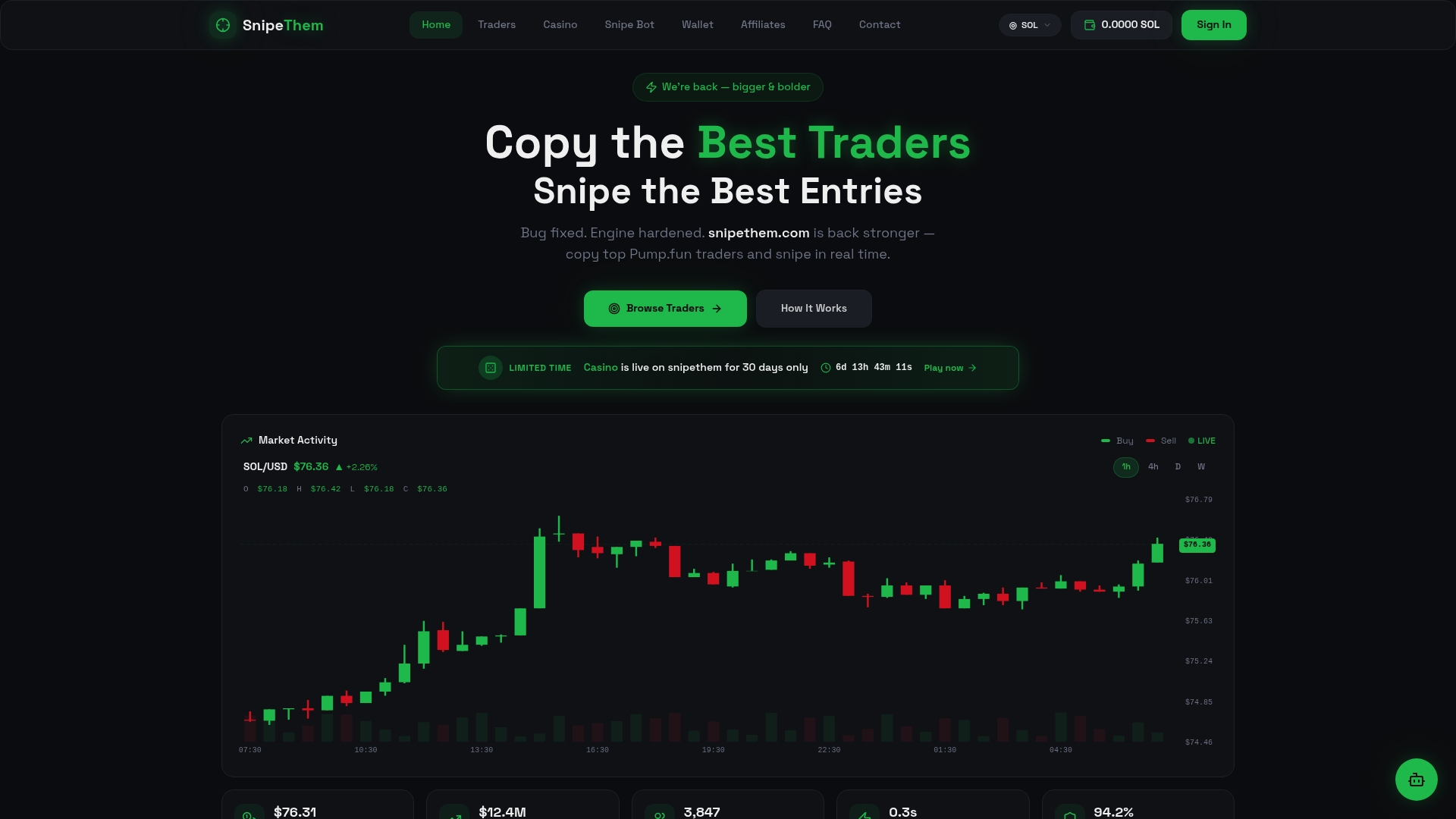
This model fits best if you want fast entry into a specific meme-coin opportunity rather than broad, multi-asset automation. It costs nothing beyond the access fee itself; there's no subscription lock-in. If you'd rather test the platform's core mechanics before purchasing trader access, start with the main platform overview to see how the bot configuration and analytics dashboard work. When you're ready to copy an actual trader, head to the trader rankings page and purchase your first 24-hour access window.
Frequently Asked Questions
Is copy trading no code actually beginner-friendly?
Yes, that's the entire point of the no-code layer. You configure allocation, filters, and guardrails through a dashboard instead of writing scripts, which removes the technical barrier that used to limit automated trading to developers.
Do I need coding skills for automated copy trading?
No. Hosted Auto Copy marketplaces, exchange-native copy features, and visual no-code builders are all designed around menus, toggles, and drag-and-drop logic rather than programming languages.
What's the difference between blind mirror copying and filtered Auto Copy?
Blind mirror copying replicates every trade a source trader makes with no conditions attached. Filtered Auto Copy applies rules, like maximum position size or minimum confidence thresholds, before a copied trade executes, which gives you more control over risk.
How much money do I need to start no-code copy trading?
Minimum deposits vary widely by platform and category. Exchange-native tools often have low or no minimums, while Snipethem's model charges a one-time SOL fee per 24-hour access window rather than a traditional deposit.
Is Snipethem good for beginners specifically interested in meme coins?
Yes, for that specific use case. Snipethem is built around fast, no-code access to Pump.fun trader histories and automatic snipe bot configuration, which suits traders focused on short-term Solana meme-coin momentum rather than diversified, long-horizon portfolios.
Should I use demo or paper trading before copying a real trader?
Whenever it's available, yes. Paper trading lets you observe execution behavior, latency, and how a strategy performs in current market conditions without risking real capital first.
This article is general information, not a substitute for advice from a qualified financial advisor. Consult a qualified financial professional about your own circumstances before acting on anything here.
Sources
For readers who want to dig deeper before committing capital:
- ESMA — Supervisory Briefing on Copy Trading
- What Is Copy Trading – A Beginner’s Guide — TradingView News
- INFORMS — Academic paper on algorithmic trading/platform effects
- NFA basic profile