
Per-trade percentage commissions and profit sharing are the two costs that will most shrink your copy trading returns, and which one hurts more depends entirely on how often you trade. High-frequency copiers lose more to small percentage fees compounding over dozens of trades; low-frequency copiers with occasional big wins often come out ahead paying a profit share instead. Before funding any account, pull up the platform's fee schedule and run your typical monthly trade count against both models.
TL;DR:
- Low-frequency traders benefit more from profit-sharing models, while high-volume traders usually save money with low-percentage per-trade fees due to compounding effects.
- Fee stacking varies by platform type, with custodial exchanges often charging spreads, financing, and withdrawal fees, while on-chain platforms incur blockchain transaction costs.
- On Solana, network fees are minimal and rarely impact overall costs, but small trades require careful consideration of slippage and priority fee overpaying.
- Running personalized calculations based on your typical trade count and profit rate is essential to determine the most cost-effective fee structure for your trading style.
- Snipethem’s flat fee for 24-hour trader access offers predictable costs ideal for short-term, high-velocity meme coin copying, avoiding profit-sharing uncertainties.
Table of Contents
- What Fees Actually Show Up in Copy Trading
- How Fee Models Differ by Platform Type
- What Fees Actually Cost You in Dollar Terms
- How to Cut Your Copy Trading Costs
- Where Snipethem Fits Into the Fee Equation
- Is the Conventional Advice on Copy Trading Fees Wrong?
- Get Fee-Predictable Access to Top Solana Traders
- Sources
What Fees Actually Show Up in Copy Trading
Copy trading fees rarely arrive as one line item. They stack, and each layer behaves differently depending on how a platform is built.
Most platforms apply a high-water mark, meaning you only pay once your account exceeds its previous peak value, so a losing month doesn't trigger a fee on a later recovery to breakeven. Some platforms cap performance fees at 30% and pair them with separate management charges of up to 10% annually, a structure documented in cTrader's copy trading fee guide.
Per-trade commissions charge a percentage on every open and close, meaning a full round trip effectively pays the fee twice. This is where frequency does the most damage, since the math compounds with each trade regardless of whether that trade was profitable.
Management and subscription fees accrue daily or annually just for keeping strategy access active, independent of performance.
Volume and per-million fees scale with position size rather than trade count, common on institutional-style platforms.
Platform-level costs round out the picture:
- Spreads on entry and exit prices
- Overnight or CFD financing charges on leveraged positions
- Withdrawal and currency conversion fees
- Network fees, which on Solana mean a base charge of 5,000 lamports per signature plus an optional priority fee that pushes a transaction ahead in the queue
Platform help pages, like eToro's CopyTrader disclosure, often clarify that copying itself carries no extra charge, but standard trading fees, spreads, and financing costs still apply underneath.
How Fee Models Differ by Platform Type
The platform architecture you choose determines which fees you'll actually pay, and custody is the dividing line.
Comparisons of custodial exchange models against on-chain alternatives show this stacking can meaningfully shrink headline returns, as detailed in Stratium's analysis of Solana copy trading versus centralized exchanges. The trade-off is convenience and, in many jurisdictions, regulatory oversight, against giving up custody of your assets.
Non-custodial, on-chain platforms on Solana generally charge low per-trade percentages, sometimes a flat access fee instead of profit sharing, with network costs added at the blockchain level. Because every transaction is recorded on-chain, profit and loss figures are independently verifiable rather than self-reported.

Bot and marketplace tools sit in between, charging per-trade commissions that vary widely, from roughly 0.1% to 1%, according to Stratium's bot fee comparison. Execution speed matters here: a slower bot can cost you more in slippage than a slightly higher stated fee would.
Where to check the real numbers:
- The platform's dedicated fees or help page (search "fees" or "commission" specifically)
- Your transaction history, where executed price versus quoted price reveals slippage
- Wallet activity for on-chain platforms, which shows the exact lamport cost per signature
What Fees Actually Cost You in Dollar Terms
Numbers make this concrete. Consider three copying styles.
- Low-frequency copier, 8 trades a month, $500 per trade, 1% per-trade commission. Monthly fee cost: $40. Annualized: $480, a manageable drag on a modest account.
- Active copier, 150 round-trip trades a month, $200 per trade. At 0.1% per trade, monthly cost runs about $30. At 1% per trade, the same activity costs roughly $300, a tenfold difference driven entirely by the fee rate, echoing the compounding effect described in Stratium's fee comparison.
- Profit-share model, a $1,000 trade nets $200 profit. At a 20% profit share, you pay $40 and keep $160. At 30%, you pay $60 and keep $140. No fee applies if the trade loses money.
Pro Tip: Run your own numbers before committing capital. Multiply your typical trade count by each platform's stated fee rate, then compare the profit share model against the same trades assuming a realistic win rate. The winner usually surprises people who assumed profit sharing was always cheaper.
Network fees barely register against these figures. Every Solana transaction pays a base fee of 5,000 lamports per signature, about $0.001 at typical SOL prices, and priority fees usually stay under $0.01 even during network congestion. For a $200 trade, that's a rounding error. For a $5 trade, that same fixed network cost becomes a meaningfully larger percentage, which is why tiny position sizes deserve extra scrutiny.
How to Cut Your Copy Trading Costs
Start with your own trading pattern, not the platform's marketing.
- If you trade frequently, prioritize the lowest per-trade percentage you can find. Fee frequency compounds fast, and a 0.1% platform can save you hundreds of dollars a month over a 1% one at high volume.
- If you trade rarely and rely on occasional large wins, a profit-share structure can work in your favor since you never pay on a losing month.
- Cap allocation size per trade and stagger entries rather than committing your full balance to one copy, which limits slippage-driven cost on volatile meme coins.
- On Solana, stick to normal priority fees unless a trade is genuinely time-sensitive; overpaying for priority on routine trades adds up for no real benefit.
- Close unused token accounts periodically to reclaim the rent deposit tied up in them.
- Test any new platform with a small amount of capital first, then check the actual transaction log, not just the advertised fee, to confirm what was charged.
Pro Tip: Screenshot your first few executed trades and the fees applied. Platforms occasionally list one rate on their fees page and apply a different one at execution, and you want a record if you ever need to dispute a charge.
Where Snipethem Fits Into the Fee Equation
Snipethem's model sidesteps the profit-share debate entirely: users pay a one-time fee in SOL for 24-hour access to a specific trader's history rather than surrendering a percentage of every winning trade. For short-lived, high-velocity meme-coin copying, that flat structure means your cost is fixed regardless of how many trades you replicate during that window.

Execution speed also factors into effective cost. Faster replication of a trader's entry means less gap between the price they got and the price you get. Combined with live market analytics and trader ranking data, the platform gives copiers a way to evaluate a trader's track record before spending on access.
Is the Conventional Advice on Copy Trading Fees Wrong?
Most fee guides treat percentage commissions and profit sharing as interchangeable evils to minimize at all costs. That framing misses the actual decision variable: your trade frequency, not the fee type itself, determines which model costs you less. A trader making 8 moves a month can absorb a profit share far more comfortably than someone running 150 trades, where even a fraction of a percentage point compounds into real money.
The bigger blind spot is how little attention Solana network fees deserve relative to how much anxiety they generate. At a fraction of a cent per transaction, they're almost never the reason a copy trading account underperforms. Slippage and platform commission percentage do that work. If you're evaluating a platform and it spends more time explaining gas costs than its actual commission structure, that's worth noticing.
What should come first: pull the exact fee schedule, run it against your realistic monthly trade count using the scenario math above, and only then compare execution speed and trader win rates. Fee structure sets your ceiling; execution quality determines how close you get to it.
— dang
Get Fee-Predictable Access to Top Solana Traders
Flat, one-time SOL payments instead of a recurring cut of your winnings: that's the practical difference between Snipethem and profit-share copy trading models. You know your cost before you commit, whether you're copying one trader for a single volatile session or several traders across a week of meme-coin activity.
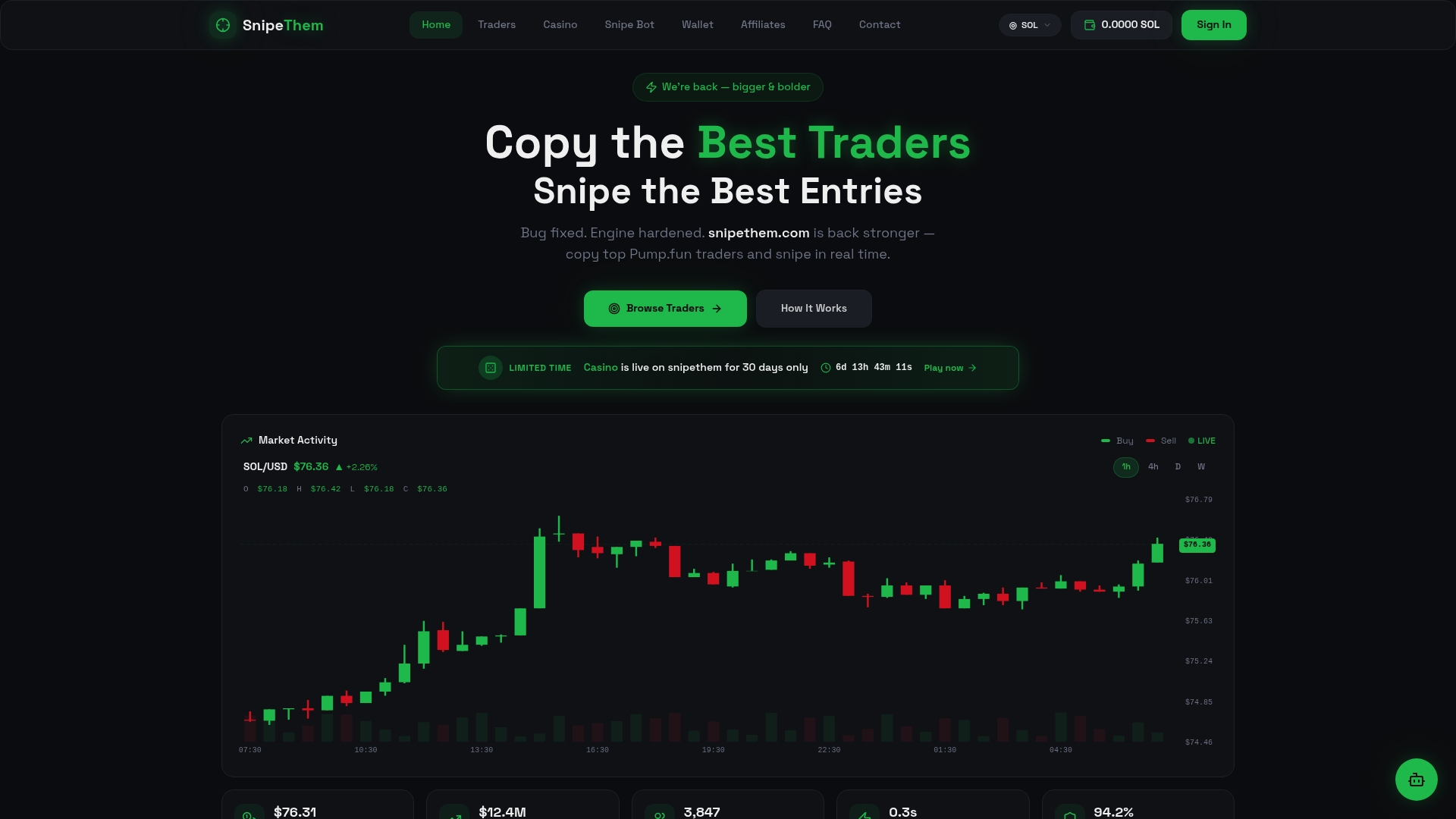
That predictability matters most for the active, short-window trading style Solana meme coins reward. Instead of watching a percentage disappear from every winning trade, you pay once for 24-hour access and keep what you make. Browse the current lineup of top Pump.fun traders ranked by recent performance, check their trade history before you buy access, and decide for yourself whether the math favors a flat fee over a profit share given how often you plan to trade this week.